
Natural remedies for hair & nails
Direct answer
For hair loss the best-supported option in our data is rosemary oil, rated Limited (2) for male pattern hair loss: in one 6-month trial in 100 men it raised hair count about as much as minoxidil 2%, with no placebo group and no repeat trial. If you are losing hair, the NHS says to see a GP to find the cause before paying for a hair clinic or supplement.
For dandruff two oils are also Limited (2) on one trial each: a 5% tea tree oil shampoo (126 people, 41% improvement in severity against 11% with placebo shampoo) and a 10% lemongrass oil hair tonic (30 volunteers, two weeks, scores down 81% by day 14). Neither has been confirmed by a second trial.
Coconut oil (less protein loss in one industry-authored study) and oral vitamin E tocotrienols are Limited (2) too. Everything else is weaker. Carrot seed oil, lemon oil, hydrolysed wheat protein, silk amino acids, strawberry extract and glycerin are conditioning or cosmetic ingredients with no human hair trial (Traditional, 1).
Argan, avocado, olive, sunflower, rosehip, grapeseed, sweet almond, apricot kernel, shea, cocoa butter, beeswax, castor, jojoba, horsetail, bentonite clay, baking soda, sea salt, oral collagen and oral vitamin B5 are Traditional (1) for hair or nails, with no human trial showing they grow hair or cut breakage.
Compare the options
Of the 31 remedies for hair & nails we have rated, none has better than Limited evidence. See our evidence report.
Click a column heading to sort.
| Rated for | Typical form & use | Main caution | |||
|---|---|---|---|---|---|
| Coconut oil Cocos nucifera (fruit oil) | Limited | Hair protein loss and breakage | Oil before or after washing | Raises LDL cholesterol; can clog pores on the face | 2 weeks |
| Lemongrass Cymbopogon citratus (leaf and oil) | Limited | Dandruff (hair tonic with lemongrass oil) | 10% oil in hair tonic, twice daily | Common skin sensitiser; dilute and patch-test | About a week |
| Rosemary oil Salvia rosmarinus (leaf essential oil) | Limited | Male pattern hair loss (androgenetic alopecia) | Diluted oil, 2 mL to scalp twice daily | Dilute first; never swallow the essential oil | 4+ weeks |
| Saw palmetto Serenoa repens (fruit) | Limited | Male pattern hair loss (androgenetic alopecia) | Capsule or scalp lotion | Warfarin: a few cases of raised INR reported | 4+ weeks |
| Tea tree oil Melaleuca alternifolia (leaf oil) | Limited | Dandruff | 5% shampoo, daily for 4 weeks | Poisonous if swallowed; can cause contact allergy | 4+ weeks |
| Vitamin E Tocopherols (fat-soluble vitamin) | Limited | Hair loss, oral tocotrienols | Mixed tocotrienols, 100 mg daily | High doses raise bleeding and prostate cancer risk | 4+ weeks |
| Apricot kernel (and apricot kernel oil) Prunus armeniaca (kernel, kernel oil) | Traditional | Hair | Oil on hair; not established | Don't swallow it; raw kernels release cyanide | 4+ weeks |
| Argan oil Argania spinosa (kernel oil) | Traditional | Hair frizz, shine and breakage | Oil on hair; no studied dose | Rare contact allergy; anaphylaxis reported | 4+ weeks |
| Avocado oil Persea americana (fruit oil) | Traditional | Hair | Oil on hair; no studied dose | Latex allergy: avocado often cross-reacts | 4+ weeks |
| Baking soda (sodium bicarbonate) Sodium bicarbonate (mineral salt) | Traditional | Hair (baking soda shampoo) | Hair wash; not established | Alkaline pH may damage the hair cuticle | Same night |
| Beeswax Cera alba / cera flava (bee wax) | Traditional | Hair styling and conditioning | Wax in pomades and hair balms | Beeswax or propolis allergy | 2–3 days |
| Bentonite clay Montmorillonite-rich volcanic clay | Traditional | Hair and scalp (clay wash or mask) | Clay wash or mask; not established | Keep out of eyes; don't breathe in the dry powder | 4+ weeks |
| Carrot seed oil Daucus carota (seed essential oil) | Traditional | Hair and scalp | Essential oil, diluted; no studied dose | Avoid in pregnancy; dilute and patch-test first | 4+ weeks |
| Castor oil Ricinus communis (seed oil) | Traditional | Hair growth and thinning | Oil on scalp; no studied dose | Keep out of eyes; patch test first | Same night |
| Cocoa butter Theobroma cacao (seed fat) | Traditional | Hair conditioning | Butter as hair mask or sealant | Stop if skin reddens, itches or breaks out | 2 weeks |
| Collagen Hydrolysed collagen (cattle, fish) | Traditional | Hair and nails, oral | Oral hydrolysed peptides (dose varies) | Fish or bovine allergy: check the source | 4+ weeks |
| Glycerin (glycerol) Glycerol (E 422), a polyol humectant | Traditional | Hair conditioning, in products | Hair and skin care product ingredient | Cosmetic use judged safe; slush drinks harm under-7s | About a week |
| Grapeseed oil Vitis vinifera (seed oil) | Traditional | Hair damage and hair loss | Oil on hair; no studied dose | Little human evidence; not the same as the extract | 2 weeks |
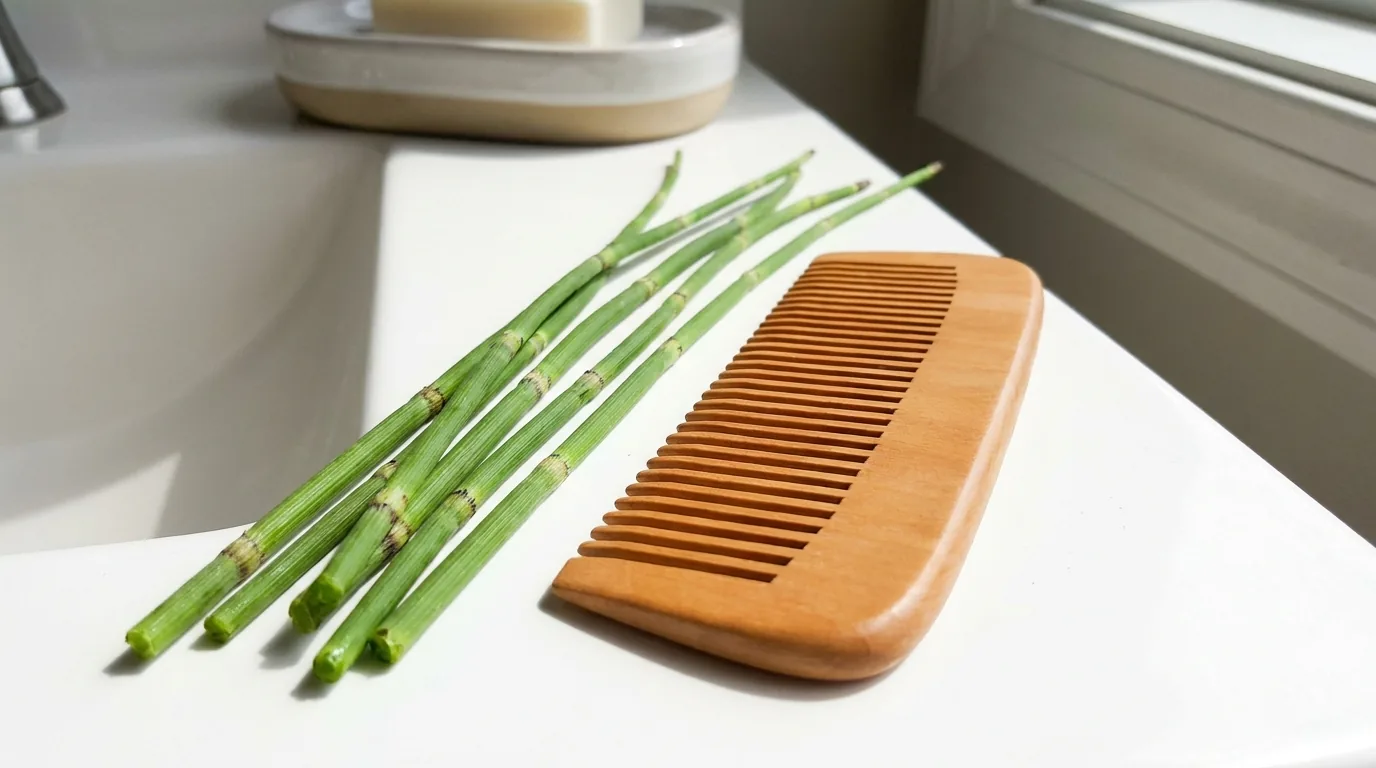
| Horsetail Equisetum arvense (aerial parts) | Traditional | Hair and nail strength | Dry aqueous extract, about 900 mg/day | Not with fluid restriction (heart or kidney disease) | 2–3 days |
| Hydrolysed wheat protein Triticum aestivum (gluten, hydrolysed) | Traditional | Hair conditioning and repair of damaged hair | Conditioning agent in hair products | Skin exposure has caused wheat allergy and anaphylaxis | Same night |
| Jojoba oil Simmondsia chinensis (seed wax ester) | Traditional | Hair growth and hair loss | Oil on scalp; no studied dose | Patch test first; allergy is rare | 4+ weeks |
| Lemon essential oil Citrus limon (peel essential oil) | Traditional | Hair and scalp | Diluted on skin, 2% maximum (industry) | Cold-pressed oil on skin burns in sunlight | 2–3 days |
| Olive oil Olea europaea (fruit oil) | Traditional | Hair care and hair growth | Hair oil or mask; not established | Skip on eczema-prone skin or a baby’s scalp | 4+ weeks |
| Rosehip oil Rosa canina and relatives (seed oil) | Traditional | Hair | Oil on hair; traditional use only | Allergic contact dermatitis has been reported | 4+ weeks |
| Sea salt Sodium chloride from evaporated seawater | Traditional | Sea salt for hair (texturising spray, scalp scrubs) | Sea salt spray; not established | Skip on broken or irritated skin | About a week |
| Shea butter Vitellaria paradoxa (nut fat) | Traditional | Hair conditioning and scalp moisturising | Thin layer on hair ends | Tree nut allergy: low risk, ask your allergist first | 2 weeks |
| Silk amino acids (silk protein) Silkworm (Bombyx mori) silk protein | Traditional | Hair and skin conditioning in cosmetic products | Hydrolysed silk in shampoo, conditioner | Avoid if you react to silk or have silk-triggered asthma | 2 weeks |
| Strawberry (fruit and extract) Fragaria x ananassa (fruit) | Traditional | Skin and hair products (extract) | Extract in skin or hair products | Strawberry allergy or oral allergy syndrome | 4+ weeks |
| Sunflower oil Helianthus annuus (seed oil) | Traditional | Hair care and hair growth | Oil on hair; no studied dose | Did not reduce hair protein loss in one lab test | 4+ weeks |
| Sweet almond oil Prunus dulcis (seed oil) | Traditional | Hair and scalp | Oil on hair; no studied dose | Avoid with tree-nut allergy, especially on eczema | 2 weeks |
| Vitamin B5 (pantothenic acid) Pantothenic acid; dexpanthenol (topical) | Traditional | Hair loss, oral or injected | Oral or injected; dose not established | Diarrhoea at 10–20 g a day; no upper limit set | About a week |
- Rated for
- Hair protein loss and breakage
- Form
- Oil before or after washing
- Onset
- 2 weeks
- Rated for
- Dandruff (hair tonic with lemongrass oil)
- Form
- 10% oil in hair tonic, twice daily
- Onset
- About a week
- Rated for
- Male pattern hair loss (androgenetic alopecia)
- Form
- Diluted oil, 2 mL to scalp twice daily
- Onset
- 4+ weeks
- Rated for
- Male pattern hair loss (androgenetic alopecia)
- Form
- Capsule or scalp lotion
- Onset
- 4+ weeks
- Rated for
- Dandruff
- Form
- 5% shampoo, daily for 4 weeks
- Onset
- 4+ weeks
- Rated for
- Hair loss, oral tocotrienols
- Form
- Mixed tocotrienols, 100 mg daily
- Onset
- 4+ weeks
- Rated for
- Hair
- Form
- Oil on hair; not established
- Onset
- 4+ weeks
- Rated for
- Hair frizz, shine and breakage
- Form
- Oil on hair; no studied dose
- Onset
- 4+ weeks
- Rated for
- Hair
- Form
- Oil on hair; no studied dose
- Onset
- 4+ weeks
- Rated for
- Hair (baking soda shampoo)
- Form
- Hair wash; not established
- Onset
- Same night
- Rated for
- Hair styling and conditioning
- Form
- Wax in pomades and hair balms
- Onset
- 2–3 days
- Rated for
- Hair and scalp (clay wash or mask)
- Form
- Clay wash or mask; not established
- Onset
- 4+ weeks
- Rated for
- Hair and scalp
- Form
- Essential oil, diluted; no studied dose
- Onset
- 4+ weeks
- Rated for
- Hair growth and thinning
- Form
- Oil on scalp; no studied dose
- Onset
- Same night
- Rated for
- Hair conditioning
- Form
- Butter as hair mask or sealant
- Onset
- 2 weeks
- Rated for
- Hair and nails, oral
- Form
- Oral hydrolysed peptides (dose varies)
- Onset
- 4+ weeks
- Rated for
- Hair conditioning, in products
- Form
- Hair and skin care product ingredient
- Onset
- About a week
- Rated for
- Hair damage and hair loss
- Form
- Oil on hair; no studied dose
- Onset
- 2 weeks
- Rated for
- Hair and nail strength
- Form
- Dry aqueous extract, about 900 mg/day
- Onset
- 2–3 days
- Rated for
- Hair conditioning and repair of damaged hair
- Form
- Conditioning agent in hair products
- Onset
- Same night
- Rated for
- Hair growth and hair loss
- Form
- Oil on scalp; no studied dose
- Onset
- 4+ weeks
- Rated for
- Hair and scalp
- Form
- Diluted on skin, 2% maximum (industry)
- Onset
- 2–3 days
- Rated for
- Hair care and hair growth
- Form
- Hair oil or mask; not established
- Onset
- 4+ weeks
- Rated for
- Hair
- Form
- Oil on hair; traditional use only
- Onset
- 4+ weeks
- Rated for
- Sea salt for hair (texturising spray, scalp scrubs)
- Form
- Sea salt spray; not established
- Onset
- About a week
- Rated for
- Hair conditioning and scalp moisturising
- Form
- Thin layer on hair ends
- Onset
- 2 weeks
- Rated for
- Hair and skin conditioning in cosmetic products
- Form
- Hydrolysed silk in shampoo, conditioner
- Onset
- 2 weeks
- Rated for
- Skin and hair products (extract)
- Form
- Extract in skin or hair products
- Onset
- 4+ weeks
- Rated for
- Hair care and hair growth
- Form
- Oil on hair; no studied dose
- Onset
- 4+ weeks
- Rated for
- Hair and scalp
- Form
- Oil on hair; no studied dose
- Onset
- 2 weeks
- Rated for
- Hair loss, oral or injected
- Form
- Oral or injected; dose not established
- Onset
- About a week
Quick picks
Rated Limited (2) for male pattern hair loss: 100 men used rosemary oil or minoxidil 2% twice daily for 6 months, and hair count rose significantly in both groups by 6 months with no significant difference between them. With no placebo group, no repeat trial and no study in women, it is the best-supported option here but not a proven one. Dilute it, keep it away from your eyes and never swallow it.
Traditional favouriteCastor oilThe most widely used oil for hair, rated Traditional (1): a 2022 systematic review of 22 articles found no strong evidence that castor oil improves hair growth, and only weaker evidence that it adds shine, and found no significant evidence for argan oil either. Expect smoother-feeling hair, not regrowth.
Key facts about hair & nails
- Hereditary pattern hair loss affects an estimated 50 million men and 30 million women in the US, and more than half of men over 50 have some degree of hair loss.9
- In a UK study of 377 women seen at a dermatology clinic for other reasons, 6% of those under 50 had female pattern hair loss, rising to 38% of those aged 70 and over.10
- Losing 50 to 100 hairs a day is normal. Temporary hair loss can follow an illness, stress, cancer treatment, weight loss or iron deficiency.1
- Childbirth, major surgery, a high fever or severe infection, stress or even flu can bring on hair loss, and if you need treatment for regrowth, the earlier you start, the more likely it is to work.11
- Alopecia areata, in which the immune system attacks hair follicles, usually starts in the teens, twenties or thirties; some people have a single episode and others have bouts throughout their lives.12
- Fungal infection causes about half of all nail disease and affects an estimated 5.5% of people worldwide; diabetes, HIV, a weakened immune system, obesity, smoking and older age raise the risk.13
- Fungal nail infections usually affect toenails and are slow to treat: pharmacy nail paints are used for 6 to 12 months. See a GP if you have diabetes or the infection spreads to other nails.14
Talk to a doctor first if…
Who should avoid
- Tea tree oil: it is poisonous if swallowed (children have become confused, unsteady or unconscious), so keep it out of children's reach. It can cause contact allergy, so use only a diluted product such as a 5% shampoo.
- Apricot kernels: never swallow apricot kernel oil or eat raw kernels; they release cyanide.
- Wheat allergy: avoid hydrolysed wheat protein, since skin exposure to it has caused wheat allergy and anaphylaxis. Stop if a product with it causes hives or swelling.
- Rosemary oil: advised against in pregnancy, breastfeeding and under-18s, and to be avoided in epilepsy (the oil contains camphor) and on broken or irritated skin. Keep it out of the eyes and never swallow it.
- Horsetail: not for use where fluid intake has to be limited, such as severe heart or kidney disease, in pregnancy or breastfeeding, by children under 12, or with thiamine (vitamin B1) deficiency or heavy alcohol use.
- Vitamin E supplements: ask a doctor first if you use blood thinners or aspirin, are due for surgery, or are a man with or at risk of prostate cancer.
- Lemongrass oil: a known skin sensitiser (2.6% of dermatitis patients tested positive), so dilute it, patch test it and avoid it on a broken or inflamed scalp.
- Lemongrass oil in pregnancy, breastfeeding or children: we found no safety data.
- Pregnancy: avoid carrot seed oil.
- Cold-pressed lemon oil: keep it off the scalp before sun; it is phototoxic.
- Any oil or butter: patch test it first.
- Tree-nut allergy: avoid sweet almond oil, and ask an allergist before using shea butter.
- Latex allergy: avoid avocado oil.
- Beeswax or propolis allergy: avoid beeswax.
- Fish or bovine allergy: avoid oral collagen.
- Silk allergy or silk-triggered asthma: avoid silk amino acids. Protein hydrolysates in hair products caused hives in some people with atopic dermatitis.
- Strawberry allergy: avoid strawberry extract.
- Castor oil and clay washes: keep them out of the eyes.
- Broken skin: skip sea salt sprays.
- Baking soda: a shampoo review argues alkaline products such as baking soda may damage the cuticle.
- Oral vitamin B5: causes diarrhoea at 10 to 20 g a day.
Known interactions
- High-dose vitamin E (300 mg a day or more): may alter the effect of warfarin and aspirin, so ask a doctor first if you take blood thinners or antiplatelet drugs.
- Horsetail and HIV antiretrovirals: two case reports describe viral rebound in people taking a horsetail supplement alongside long-standing antiretroviral treatment. The authors advise avoiding the combination, although a link is unproven.
- Rosemary, castor, coconut, jojoba, tea tree and lemongrass oils: their entries list no interactions.
- Carrot seed, lemon, hydrolysed wheat protein, silk amino acids, strawberry extract and glycerin: their entries list no interactions either.
- Collagen, vitamin B5, clay, baking soda, sea salt, apricot kernel, argan, avocado, olive, rosehip, grapeseed, sweet almond, shea, cocoa butter and beeswax: their entries list none either.
Before you reach for an ingredient
Before buying anything for hair loss, find out why it is happening: many causes are temporary.
- The NHS says losing 50 to 100 hairs a day is normal, and that temporary hair loss can follow illness, stress, cancer treatment, weight loss or iron deficiency. Hair loss caused by a medical condition usually stops or grows back once you have recovered.1
- See a GP if you are worried about hair loss, and before going to a commercial hair clinic. Pattern baldness is often inherited and permanent; the NHS names finasteride and minoxidil as the main treatments, which do not work for everyone and work only while used.1
Questions people ask
What actually helps with hair loss?
The NHS names finasteride and minoxidil as the main treatments for male pattern baldness, and minoxidil for female pattern baldness (women should not use finasteride). It says no treatment is 100% effective.
Of the natural options here, only rosemary oil has been compared with minoxidil, in one 6-month trial in 100 men with no placebo group and no study in women. Dilute the oil, patch-test first and keep it away from your eyes. See a GP first, because many causes of hair loss are temporary.
Do collagen, vitamin B5 or baking soda help hair and nails?
We found no good evidence that they do. A 2026 review of oral collagen found only four hair studies and two nail studies, small, short and often multi-ingredient or industry-funded, with modest nail improvements.
Vitamin B5 (pantothenic acid) has no controlled trial for hair loss, and we found no human study of baking soda, bentonite clay or sea salt on hair. A shampoo review argues alkaline products may damage the cuticle, so baking soda is best left out of your hair routine.
Do argan, castor, coconut or other oils help hair grow?
We found no human trial showing that any oil grows hair. A 2022 systematic review found no strong evidence for castor oil and no significant evidence for argan oil, and coconut oil reduced protein loss from hair in one industry-authored study, but no trial shows less breakage or growth.
Avocado, olive, rosehip, sweet almond, apricot kernel, shea, cocoa butter, beeswax and horsetail have no hair trial at all. Jojoba and grapeseed appear only in the carrier-oil mix that served as the control in one alopecia trial.
Carrot seed oil, lemon oil, hydrolysed wheat protein, silk amino acids, strawberry extract and glycerin are used in hair products as conditioners with no human trial of growth, dryness or frizz, so at best expect smoother-feeling hair.
Does tea tree oil or lemongrass oil help dandruff?
Possibly, each on one trial. In 126 people with mild to moderate dandruff, a 5% tea tree oil shampoo used daily for 4 weeks improved the severity score by 41% against 11% for placebo shampoo, though the scaliness rating did not improve significantly.
In 30 volunteers a twice-daily 10% lemongrass oil tonic cut dandruff scores by 81% in two weeks in a split-head, placebo-controlled trial, but that tested a formulated tonic, not the plain oil. Use diluted products rather than neat oil, and never swallow either.
Sources (14)
- Clinical guidance NHS. Hair loss. nhs.uk (last reviewed 24 January 2024).
- Regulator monograph European Medicines Agency HMPC. European Union herbal monograph on Equisetum arvense L., herba (EMA/HMPC/278091/2015). 2016.
- Randomised trial Panahi Y, Taghizadeh M, Marzony ET, Sahebkar A. Rosemary oil vs minoxidil 2% for the treatment of androgenetic alopecia: a randomized comparative trial. Skinmed. 2015.
- Systematic review Phong C, Lee V, Yale K, Sung C, Mesinkovska N. Coconut, Castor, and Argan Oil for Hair in Skin of Color Patients: A Systematic Review. J Drugs Dermatol. 2022.
- Randomised trial (split-head) Chaisripipat W, Lourith N, Kanlayavattanakul M. Anti-dandruff Hair Tonic Containing Lemongrass (Cymbopogon flexuosus) Oil. Forsch Komplementmed. 2015.
- Review Biełach-Bazyluk A, et al. Dietary Collagen Supplementation as a Strategy for Skin Health: A Narrative Review of Clinical Effects on Skin, Hair, Nails, and Wound Healing. Nutrients. 2026.
- Regulator assessment report European Medicines Agency HMPC. Assessment report on Rosmarinus officinalis L., aetheroleum and Rosmarinus officinalis L., folium (EMA/HMPC/681037/2021). 2024.
- Randomised trial Satchell AC, Saurajen A, Bell C, Barnetson RS. Treatment of dandruff with 5% tea tree oil shampoo. J Am Acad Dermatol. 2002.
- Regulator/health agency MedlinePlus Genetics. Androgenetic alopecia. US National Library of Medicine (last updated 27 July 2023).
- Cross-sectional study Birch MP, Messenger JF, Messenger AG. Hair density, hair diameter and the prevalence of female pattern hair loss. Br J Dermatol. 2001.
- Professional body American Academy of Dermatology Association. Skin conditions by the numbers. AAD (accessed October 2026).
- Regulator/health agency NIAMS. Alopecia Areata. National Institute of Arthritis and Musculoskeletal and Skin Diseases (reviewed August 2024).
- Review Gupta AK, Versteeg SG, Shear NH. Onychomycosis in the 21st Century: An Update on Diagnosis, Epidemiology, and Treatment. J Cutan Med Surg. 2017.
- Clinical guidance NHS. Fungal nail infection. nhs.uk (last reviewed 27 March 2024).
Reviewed by Healthy and Herbal editors · 10 October 2026 · Next review April 2027
Reader notes
Experiences and questions from readers, read by an editor before they appear. They are personal accounts, not evidence, and are not medical advice.