
Cocoa butter
Cocoa butter is a rich, greasy fat that softens dry skin like other emollients, but there is no trial showing it does so better than a plain moisturiser. Its most famous use, preventing stretch marks in pregnancy, has been tested in two placebo-controlled trials that enrolled 510 women in total, and it did not work. On the face it can clog pores. We found no evidence for hair.
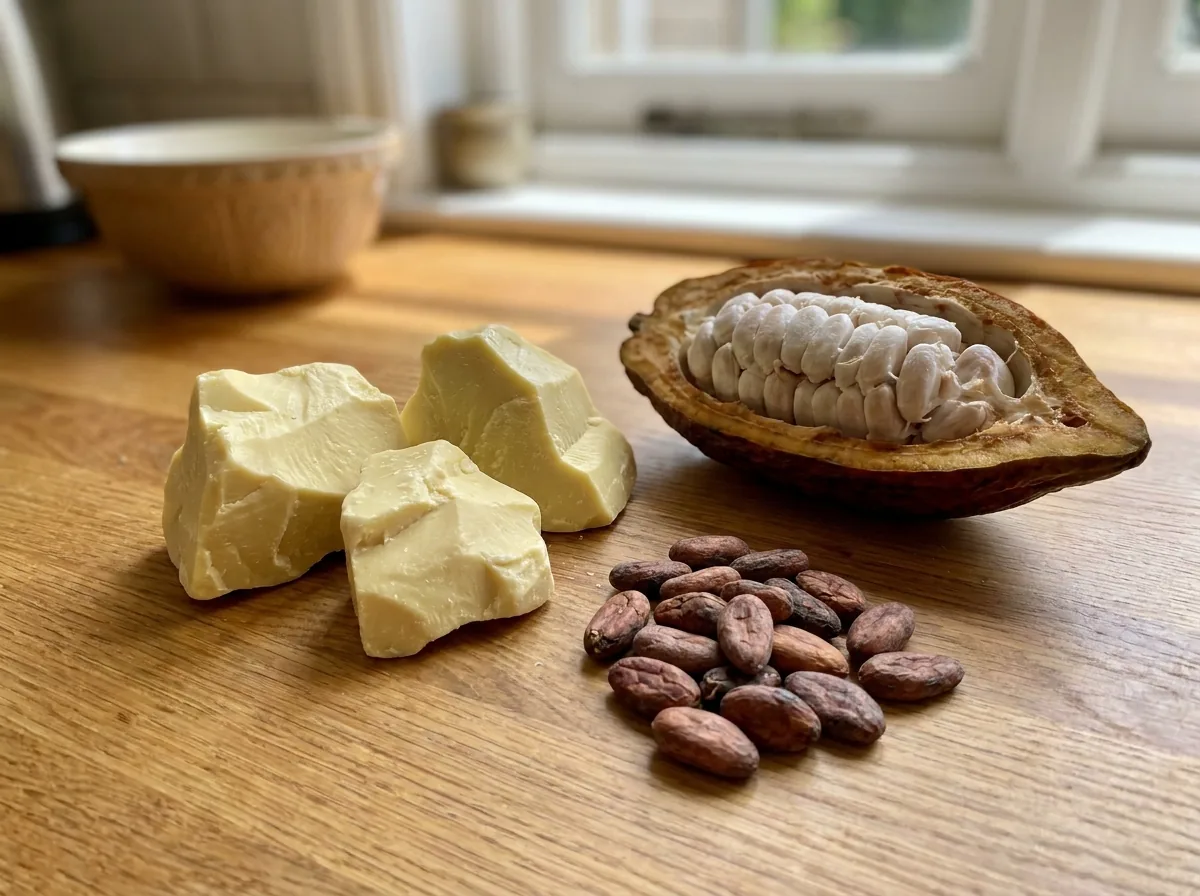
At a glance
Last reviewed 10 October 2026What it's used for
Evidence is rated per use. The same ingredient can be strong for one thing and traditional for another.
| Use | Evidence | What the research shows |
|---|---|---|
| Dry skin (as an emollient)Compare remedies for skin → | Traditional | The Cosmetic Ingredient Review panel describes plant fatty oils as used for their skin conditioning, occlusive, emollient and moisturising properties, and cocoa butter is among those it judged safe as used. We found no trial of cocoa butter alone on dry skin. The one human test we found put it into a baby cream with beeswax, urea and glycerol, which improved hydration in 8 volunteers, so the effect cannot be credited to cocoa butter.6,7 |
| Preventing stretch marks in pregnancy | Traditional | Two placebo-controlled trials found no significant benefit. In 175 Lebanese women who finished the trial, stretch marks developed in 45.1% using cocoa butter lotion and 48.8% using placebo. In 300 women, 44% using cocoa butter cream and 55% using placebo developed them, a difference that was not significant. A Cochrane review found no high-quality evidence for any topical preparation. The scale has no grade for 'does not work', so this sits at 1, with the trials pointing the wrong way.1,2,3,4 |
| Hair conditioningCompare remedies for hair & nails → | Traditional | Cocoa butter is used as a hair mask or sealant, but we found no trial or laboratory study of it on hair. Any benefit is a guess from it being a greasy fat that coats the surface. |
How much
Ranges below are what studies used and what supplements commonly contain. They are not a recommendation for you. Start at the low end.
How people take it
Safety
Who should avoid
- Acne-prone or oily facial skin — it caused microcomedones in a small human study
- Relying on it to prevent stretch marks — two placebo-controlled trials found no significant benefit
- Skin that reddens, itches or breaks out after use — stop and see a pharmacist or doctor
Known interactions
Questions people ask
Does cocoa butter prevent stretch marks?
No. Two placebo-controlled trials found no significant difference: 45.1% versus 48.8% developed stretch marks in one, and 44% versus 55% in the other (p = 0.09). A Cochrane review found no high-quality evidence for any topical preparation. Rubbing a cream on can still feel pleasant, but it is not a proven preventive.
Is cocoa butter good for your skin?
It is a rich emollient that softens and seals dry skin, and safety reviews consider cocoa butter safe as used in cosmetics. We found no trial showing it works better than a plain moisturiser. It is heavy, and on the face it can block pores.
Does cocoa butter clog pores?
It can. In a small study of 6 people, patches of cocoa butter on the upper back produced more microcomedones (early blocked pores) than untreated skin over 2 to 4 weeks. It is a small study, so it shows a plausible risk rather than how common it is. If you are prone to spots, keep it off your face.
Is cocoa butter good for hair?
There is no evidence either way. We found no trial or laboratory study of cocoa butter on hair. It is a greasy fat, so it may coat and soften hair, but that is a guess, and heavy fats can be hard to wash out.
What are the uses of cocoa butter?
It is used as a body moisturiser, an ingredient in lip balms and body butters, and a base in cosmetics. Its use as a stretch-mark preventive is not supported by trials. As a moisturiser it is a plausible emollient with little direct testing.
Make it yourself
DIY guides that use cocoa butter, with quantities, safety notes and an honest word on what they do.
Sources (7)
- Randomised trial Osman H, Usta IM, Rubeiz N, et al. Cocoa butter lotion for prevention of striae gravidarum: a double-blind, randomised and placebo-controlled trial. BJOG. 2008.
- Randomised trial Buchanan K, Fletcher HM, Reid M. Prevention of striae gravidarum with cocoa butter cream. Int J Gynaecol Obstet. 2010.
- Systematic review Brennan M, Young G, Devane D. Topical preparations for preventing stretch marks in pregnancy. Cochrane Database Syst Rev. 2012.
- Review Korgavkar K, Wang F. Stretch marks during pregnancy: a review of topical prevention. Br J Dermatol. 2015.
- Human study Baek JH, Ahn HJ, Koh JS, Kwon H, Shin MK. Early detection of microcomedones induced by cocoa butter using reflectance confocal microscopy. J Cosmet Dermatol. 2022.
- Safety review Burnett CL, Fiume MM, Bergfeld WF, et al. Safety Assessment of Plant-Derived Fatty Acid Oils. Int J Toxicol. 2017.
- Formulation study Kovács A, Péter-Héderi D, Perei K, et al. Effects of Formulation Excipients on Skin Barrier Function in Creams Used in Pediatric Care. Pharmaceutics. 2020.
Last reviewed 10 October 2026 · Next review April 2027 · How we rate evidence
Reader notes
Experiences and questions from readers, read by an editor before they appear. They are personal accounts, not evidence, and are not medical advice.