
Castor oil
Castor oil works as a strong stimulant laxative for occasional constipation, typically within 6 to 12 hours, and is a recognised US over-the-counter drug for that. For hair growth, eyelashes and skin there are no good human trials, so those uses rate 1 or 2 at best.
The main caution is that it is a harsh laxative that should not be used for more than a week, and pregnant women should ask a health professional first, even though it is a common folk method for starting labour.
At a glance
Last reviewed 10 October 2026What it's used for
Evidence is rated per use. The same ingredient can be strong for one thing and traditional for another.
| Use | Evidence | What the research shows |
|---|---|---|
| Occasional constipationCompare remedies for digestion → | Limited | US over-the-counter labels list castor oil as a stimulant laxative for occasional constipation, generally producing a bowel movement in 6 to 12 hours. We did not find a placebo-controlled trial in constipation itself. The best modern data are from bowel preparation: in a retrospective study of 1,251 inpatients, 2 L of polyethylene glycol plus castor oil gave adequate cleansing in 83.2% versus 77.4% with the standard 4 L (P = .011).1,9 |
| Starting labour (term pregnancy) | Limited | Two 2022 meta-analyses of mostly small trials found more women went into labour after oral castor oil (relative risk 3.27 across 12 studies and 1,653 women in one; odds ratio 11.67 in the other). The Cochrane review, limited to 3 trials and 233 women of poor methodological quality, could not confirm this, found no clear difference in caesarean rates (relative risk 2.04, 95% CI 0.92 to 4.55), and reported that all women given castor oil felt nauseous. Harms to mother and baby have not been measured well enough.6,7,8 |
| Dry skin and general moisturisingCompare remedies for skin → | Traditional | Castor oil is a long-established skin-conditioning ingredient, and the Cosmetic Ingredient Review panel judged it safe in cosmetics as currently used. That is a safety finding, not proof of benefit: we found no controlled trial showing it improves dry skin, acne, scars or wrinkles on the face or body. It is a thick oil that stays on the surface.2,3 |
| Hair growth and thinningCompare remedies for hair & nails → | Traditional | A 2022 systematic review of 22 articles found no strong evidence that castor oil improves hair growth, and only weaker evidence that it adds shine. A 2023 dermatology review of hair oils for pattern hair loss noted that most work on hair oils has been in mice. Oiling may make hair feel smoother, but there is no human evidence that it grows or thickens hair.4,5 |
| Eyelashes and eyebrows | Traditional | We found no clinical trial of castor oil for lash or brow growth, so this rests on popular use alone. A 2026 analysis of 79 lash-growth serums found about 30% contained unregulated prostaglandin drugs, and castor oil appeared in those that did not, so improvements from a product are not proof that castor oil caused them. Near the eye, one study reported corneal cell damage with instilled castor oil.10,2 |
How much
Ranges below are what studies used and what supplements commonly contain. They are not a recommendation for you. Start at the low end.
How people take it
Safety
Who should avoid
- Pregnancy — ask a health professional first; nausea universal, harms not well studied
- Breastfeeding — the label says to ask a health professional first
- Children under 2 — do not use; ages 2 to 11 need lower doses
- Abdominal pain, nausea, vomiting or sudden bowel change — see a doctor before use
- Rectal bleeding or no bowel movement after a dose — seek medical advice
- Use for more than 1 week as a laxative — not advised on the label
- Near or in the eye — reported corneal damage when instilled
- Known skin reaction to castor oil or ricinoleic acid — sensitisation is reported, infrequently
Known interactions
Questions people ask
Does castor oil work for hair growth?
There is no good human evidence that it does. A 2022 systematic review of 22 articles found no strong support for hair growth, only weaker evidence that it improves shine. It is unlikely to be harmful on the scalp, but expect smoother-feeling hair, not regrowth.
How do I use castor oil for hair, skin or lashes, and how much?
No trial has tested an amount, so we cannot give an evidence-based dose. Because it is very thick, people usually use a few drops, sometimes mixed with a lighter oil. Patch-test on the inner forearm first, keep it out of your eyes, and stop if you get redness, itching or a stinging eye.
What are the side effects of castor oil?
Taken by mouth it is a strong laxative that causes cramping, diarrhoea and nausea, and the label limits use to one week. On the skin, reactions are seen infrequently, mostly in people with existing skin conditions. The Cosmetic Ingredient Review panel judged it safe in cosmetics as currently used.
Is castor oil poisonous because it comes from the ricin plant?
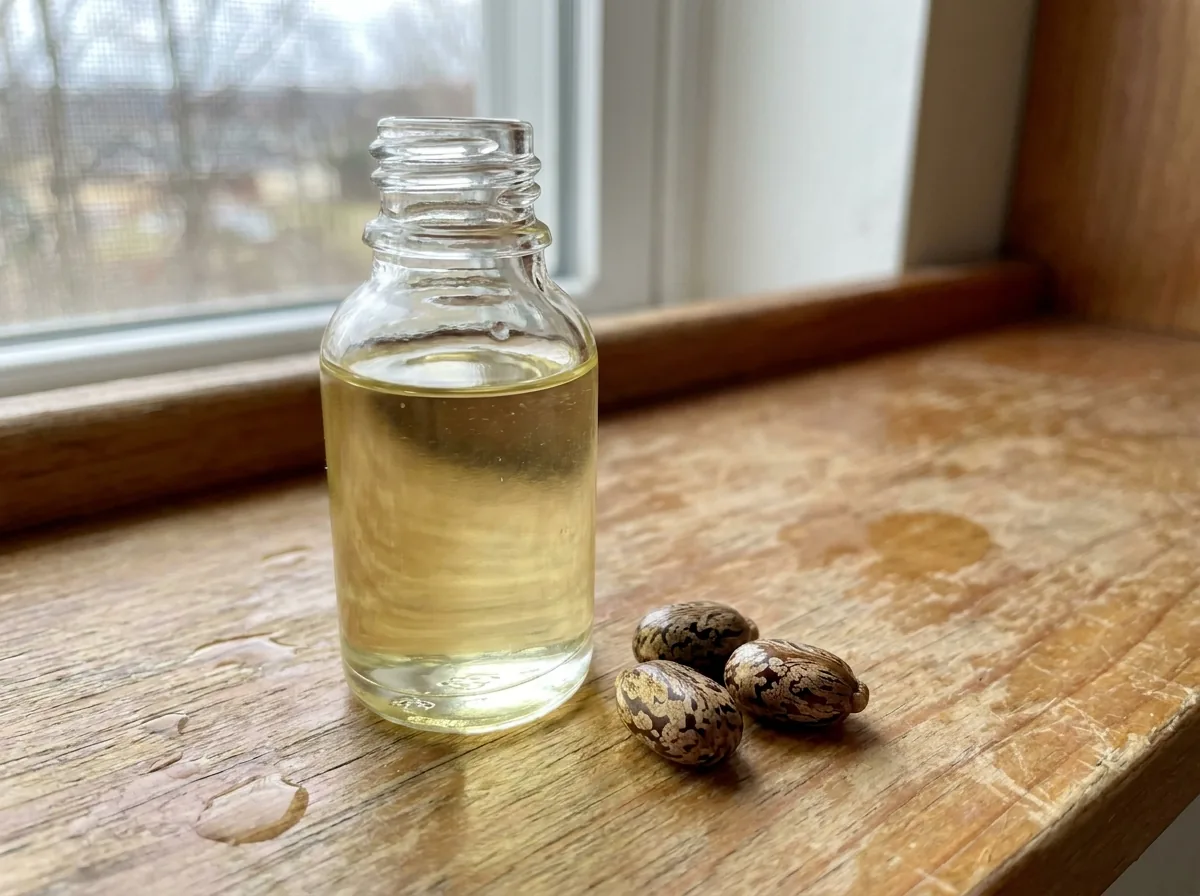
Ricin is a toxic protein in the whole seed, but it does not partition into the oil, so cosmetic and pharmacy castor oil do not contain it. Never eat or chew the seeds.
Can castor oil start labour?
Some small trials and two meta-analyses suggest it may, but the Cochrane review of three poor-quality trials could not confirm it, and all women given it felt nauseous. It is not a proven or risk-free method, so ask your midwife or doctor before trying it.
Sources (10)
- Regulator label Castor Oil USP 100% stimulant laxative, over-the-counter drug label. DailyMed, US National Library of Medicine.
- Safety assessment Final report on the safety assessment of Ricinus Communis (Castor) Seed Oil, Hydrogenated Castor Oil, Glyceryl Ricinoleate, Glyceryl Ricinoleate SE, Ricinoleic Acid, Potassium Ricinoleate, Sodium Ricinoleate, Zinc Ricinoleate, Cetyl Ricinoleate, Ethyl Ricinoleate, Glycol Ricinoleate, Isopropyl Ricinoleate, Methyl Ricinoleate, and Octyldodecyl Ricinoleate. Int J Toxicol. 2007.
- Safety assessment Fiume MM, et al. Re-Review Summary of Ricinus Communis (Castor) Seed Oil and Ricinoleates as Used in Cosmetics. Int J Toxicol. 2025.
- Systematic review Phong C, Lee V, Yale K, Sung C, Mesinkovska N. Coconut, Castor, and Argan Oil for Hair in Skin of Color Patients: A Systematic Review. J Drugs Dermatol. 2022.
- Narrative review Dinkins J, et al. Commonly used hair oils in the Black community: a narrative review in their use to treat androgenetic alopecia. Int J Dermatol. 2023.
- Cochrane review Kelly AJ, Kavanagh J, Thomas J. Castor oil, bath and/or enema for cervical priming and induction of labour. Cochrane Database Syst Rev. 2013.
- Meta-analysis Amerizadeh A, Farajzadegan Z, Asgary S. Effect and Safety of Castor Oil on Labor Induction and Prevalence of Vaginal Delivery: A Systematic Review and Meta-Analysis. Iran J Nurs Midwifery Res. 2022.
- Meta-analysis Moradi M, Niazi A, Mazloumi E, Lopez V. Effect of Castor Oil on Cervical Ripening and Labor Induction: a systematic review and meta-analysis. J Pharmacopuncture. 2022.
- Cohort study Xiong Z, et al. 2L polyethylene glycol combined with castor oil versus 4L polyethylene glycol for bowel preparation before colonoscopy among inpatients. Medicine (Baltimore). 2023.
- Market analysis Couteau C, Coiffard L. Prostaglandin analogues in cosmetic products formulated for eyelash lengthening. Ann Pharm Fr. 2026.
Last reviewed 10 October 2026 · Next review April 2027 · How we rate evidence
Reader notes
Experiences and questions from readers, read by an editor before they appear. They are personal accounts, not evidence, and are not medical advice.