
Jojoba oil
Jojoba oil is a liquid wax that is well tolerated on the skin, but almost none of its popular uses have been properly tested in people. The best human data is one uncontrolled study of clay-and-jojoba face masks in people with mild acne, where lesion counts fell by about half over 6 weeks. Claims that it grows hair, heals wounds or repairs the skin barrier rest on lab studies, reviews of those studies and tradition. Patch test it first, and do not swallow it.
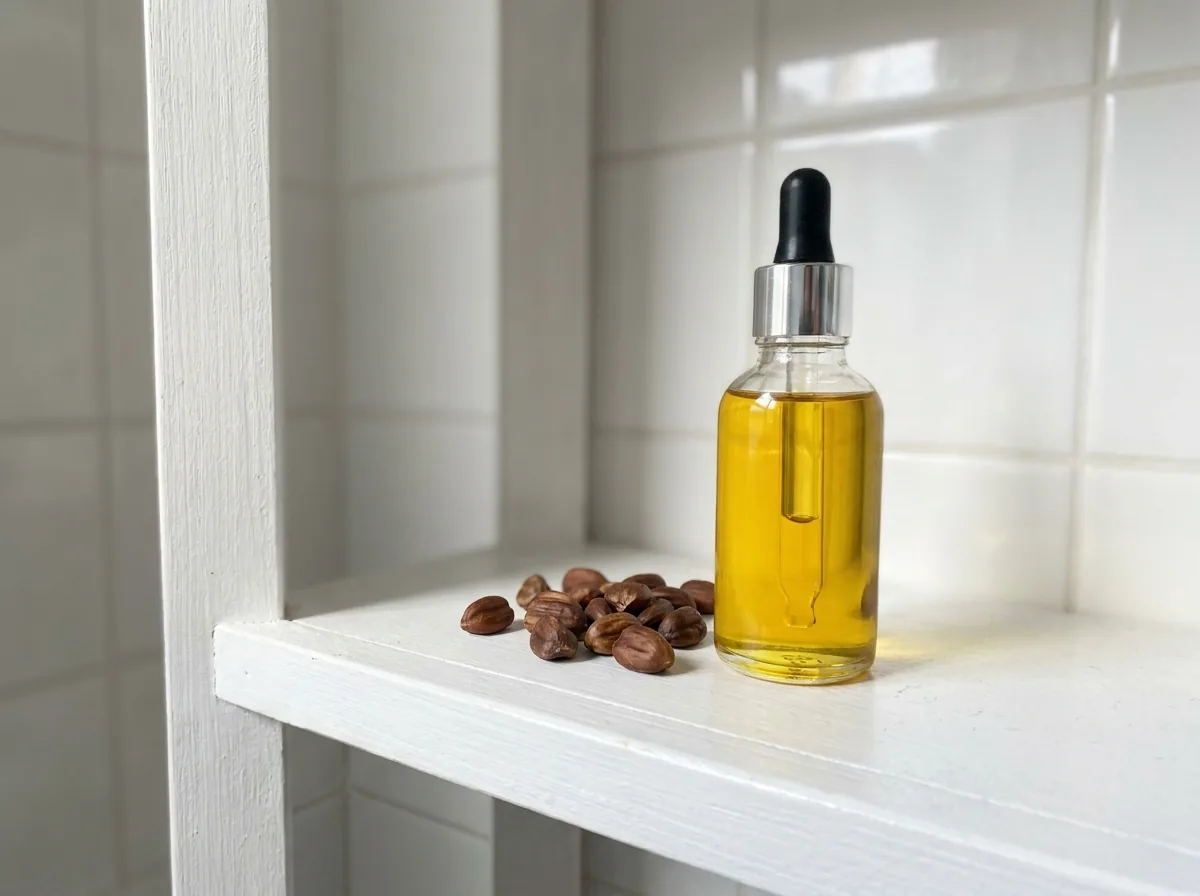
At a glance
Last reviewed 30 September 2026What it's used for
Evidence is rated per use. The same ingredient can be strong for one thing and traditional for another.
| Use | Evidence | What the research shows |
|---|---|---|
| Mild acne and blemish-prone skin (clay mask) | Limited | In an open, uncontrolled study of 194 people using a clay and jojoba oil face mask 2–3 times a week, the 133 who gave complete lesion counts had about 54% fewer lesions after 6 weeks (pustules 7 to 3, comedones 26.5 to 16 on median counts). With no comparison group and a clay in the mask, it cannot show that jojoba oil did the work, and it says nothing about using the oil on its own.1,2 |
| Dry skin and skin barrier repair | Traditional | Reviews describe jojoba oil as a useful emollient, and one calls its benefits documented preclinically and clinically while also noting discrepancies in the data and questionable study designs. We did not read the underlying human trials, so we rate this on the reviews' own caveats: a plausible moisturiser with little rigorous testing against other oils or plain creams.4,5,6,2 |
| Hair breakage | Traditional | The only hair-fibre evidence we found is a lab study on locks of hair, not people: adding jojoba oil to a chemical straightening emulsion reduced protein loss and improved resistance to breakage, and was one of the two best conditioning agents tested. It says nothing about everyday use on the scalp or frizz.8 |
| Hair growth and hair loss | Traditional | Jojoba has a folk reputation for promoting hair growth, and reviews repeat it, but we found no trial testing jojoba oil alone for hair growth. In the one randomised trial that used it (86 people with alopecia areata), jojoba and grapeseed oil were the control: they carried thyme, rosemary, lavender and cedarwood oils in the treatment group. The carrier-only group improved in 15% (6 of 41), the essential oil group in 44% (19 of 43).9,2 |
| Wounds and inflammatory skin conditions | Traditional | In cultured skin cells jojoba liquid wax sped up closure of a scratch wound and stimulated collagen production with very low toxicity. Reviews say it may suit wound healing, skin infections and ageing on that basis, but we found no human wound trial.7,3,2 |
| Carrier oil for essential oils | Traditional | A lab study of 23 essential oils in six carrier oils found jojoba oil (with aloe vera oil) lowered the cytotoxicity of the essential oils and did not blunt their antimicrobial activity. That is a cell and brine-shrimp result, not a skin-safety trial, and it does not give a safe dilution.9,10 |
How much
Ranges below are what studies used and what supplements commonly contain. They are not a recommendation for you. Start at the low end.
How people take it
Safety
Who should avoid
- Known allergy to jojoba — contact dermatitis has been reported, though rarely
- Broken or inflamed skin — patch test first on a small area
- Eyes — jojoba oil caused reversible eye irritation in rabbits
- Swallowing it — the sources we read give no safe human dose
- Pregnancy and breastfeeding — no safety data in the sources we read, so ask first
- Replacing prescribed treatment for acne, eczema, psoriasis or alopecia
Known interactions
Make it yourself
DIY guides that use jojoba oil, with quantities and safety notes.
Questions people ask
Does jojoba oil help hair grow?
There is no good evidence that it does. We found no trial testing jojoba oil alone for hair growth; in the one randomised trial that used it, in alopecia areata, jojoba and grapeseed oil were the placebo-like control. A lab study on hair locks suggests it may reduce breakage in chemically straightened hair, which is a different claim.
Is jojoba oil good for your skin and face?
It is a well-tolerated emollient, and reviews describe benefits for dry skin and skin barrier repair, but the underlying trials are limited and of questionable design. The best human data is for mild acne, from an uncontrolled study of clay and jojoba oil masks used 2–3 times a week, so it is a reasonable moisturiser to try, not a proven treatment.
Is jojoba oil comedogenic?
None of the sources we read gives a comedogenicity rating or a trial of the oil left on the skin, so we cannot give you a figure. The acne mask study found fewer lesions on average, but the mask was clay and oil together, and it does not show what a leave-on oil would do on your skin. If you break out, stop using it.
How do I use jojoba oil?
Patch test on a small area first. Reviews describe it as a liquid wax that stays largely on the skin's surface, so a few drops on damp skin or hair ends is the usual approach, though no source we read tested an amount. It is also used to dilute essential oils, and it is not intended to be swallowed.
Sources
- Observational study Meier L, Stange R, Michalsen A, Uehleke B. Clay jojoba oil facial mask for lesioned skin and mild acne — results of a prospective, observational pilot study. Forsch Komplementmed. 2012.
- Review Gad HA, Roberts A, Hamzi SH, et al. Jojoba Oil: An Updated Comprehensive Review on Chemistry, Pharmaceutical Uses, and Toxicity. Polymers (Basel). 2021.
- Review Pazyar N, Yaghoobi R, Ghassemi MR, et al. Jojoba in dermatology: a succinct review. G Ital Dermatol Venereol. 2013.
- Review Blaak J, Staib P. An updated review on efficacy and benefits of sweet almond, evening primrose and jojoba oils in skin care applications. Int J Cosmet Sci. 2022.
- Review Vaughn AR, Clark AK, Sivamani RK, Shi VY. Natural Oils for Skin-Barrier Repair: Ancient Compounds Now Backed by Modern Science. Am J Clin Dermatol. 2018.
- Review Lin TK, Zhong L, Santiago JL. Anti-Inflammatory and Skin Barrier Repair Effects of Topical Application of Some Plant Oils. Int J Mol Sci. 2017.
- Laboratory study Ranzato E, Martinotti S, Burlando B. Wound healing properties of jojoba liquid wax: an in vitro study. J Ethnopharmacol. 2011.
- Laboratory study Dias TC, Baby AR, Kaneko TM, Velasco MV. Protective effect of conditioning agents on Afro-ethnic hair chemically treated with thioglycolate-based straightening emulsion. J Cosmet Dermatol. 2008.
- Randomised trial Hay IC, Jamieson M, Ormerod AD. Randomized trial of aromatherapy. Successful treatment for alopecia areata. Arch Dermatol. 1998.
- Laboratory study Orchard A, Kamatou G, Viljoen AM, et al. The Influence of Carrier Oils on the Antimicrobial Activity and Cytotoxicity of Essential Oils. Evid Based Complement Alternat Med. 2019.
Last reviewed 30 September 2026 · Next review March 2027 · How we rate evidence
Reader notes
Experiences and questions from readers, read by an editor before they appear. They are personal accounts, not evidence, and are not medical advice.