
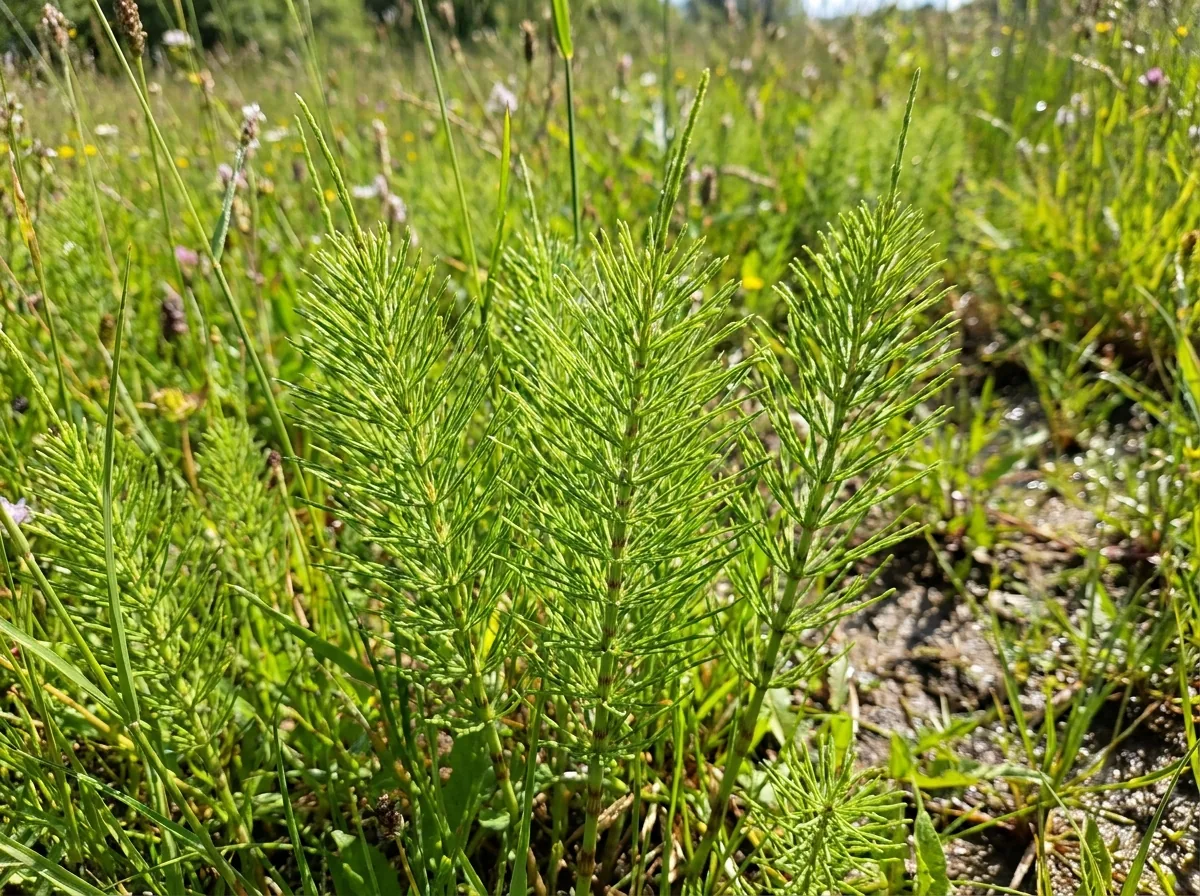
Horsetail
Horsetail has a short-term diuretic effect in one small trial of healthy men, and the EU regulator recognises it for flushing the urinary tract in minor complaints based on traditional use. The hair and nail claims on supplement labels have no human trial behind them that we could find. The main caution is that it should not be used where fluid intake has to be limited, such as severe heart or kidney disease.
At a glance
Last reviewed 10 October 2026What it's used for
Evidence is rated per use. The same ingredient can be strong for one thing and traditional for another.
| Use | Evidence | What the research shows |
|---|---|---|
| Urinary flushing (mild diuretic)Compare remedies for bladder & urinary → | Limited | In a double-blind crossover trial of 36 healthy men, 900 mg a day of a standardised dried extract for four days produced a diuretic effect greater than placebo and equivalent to hydrochlorothiazide 25 mg, without significant change in electrolyte loss. It was acute, short and in healthy men only. A separate 10-per-group study found urine electrolytes consistent with a diuretic effect. The EU regulator lists this use as traditional, not clinically proven.1,2,3,4 |
| Minor urinary complaints (adjuvant) | Traditional | The EU monograph recognises horsetail herb to increase urine volume as an adjuvant in minor urinary complaints, exclusively on long-standing use. A 7-day study in 10 healthy volunteers found an aqueous extract raised urinary Tamm-Horsfall protein by up to 300%, but this is a lab marker in healthy people, not evidence that it treats an infection or stones.1,3 |
| Superficial wounds (applied to skin) | Traditional | The EU monograph lists decoctions or juice as dressings for superficial wounds on traditional use alone. We found no clinical trial.1 |
| Hair and nail strengthCompare remedies for hair & nails → | Traditional | Horsetail is traditionally used for skin, nails and hair, and is marketed on its silica content. We found no human trial of horsetail for hair or nails, and the EU monograph does not list either use. In the urine study, silica excretion did not track the effect being measured. This rating reflects tradition only.8,3,1 |
How much
Ranges below are what studies used and what supplements commonly contain. They are not a recommendation for you. Start at the low end.
How people take it
Safety
Who should avoid
- Severe heart or kidney disease — where reduced fluid intake is advised (EU monograph)
- Pregnancy and breastfeeding — safety not established, regulator advises against
- Children under 12 — not recommended, too little data
- Thiamine (vitamin B1) deficiency, heavy alcohol use — horsetail contains thiaminase
- Antiretroviral HIV treatment — a case report of treatment failure
- Known allergy — rash and facial swelling have been reported
Known interactions
Questions people ask
Does horsetail work as a diuretic?
In one trial of 36 healthy men, 900 mg a day for four days increased urine output about as much as hydrochlorothiazide 25 mg and more than placebo. That is a small, short study in healthy men, so it says little about longer use or people with medical conditions.
Does horsetail help hair and nail growth?
We found no human trial showing it does. It is traditionally used for hair and nails and is marketed for its silica, but the EU regulator recognises it only for urinary flushing and wound dressings.
Does horsetail destroy vitamin B1?
Horsetail plants contain thiaminase, an enzyme that breaks down thiamine, and a case report links long-term use with thiamine deficiency. The evidence is limited: the plant assay we read was on a different Equisetum species, and there are no trials measuring thiamine in people taking horsetail products.
Can I take horsetail with heart or kidney problems, or with diuretic medicines?
The EU regulator says not to use it where reduced fluid intake is recommended, such as severe heart or kidney disease. Its monograph lists no drug interactions, but we found no source that studied horsetail with prescription diuretics, so ask a pharmacist or doctor first.
Sources (8)
- Regulator monograph European Medicines Agency HMPC. European Union herbal monograph on Equisetum arvense L., herba (EMA/HMPC/278091/2015). 2016.
- Randomised controlled trial Carneiro DM, Freire RC, Honório TC, et al. Randomized, double-blind clinical trial to assess the acute diuretic effect of Equisetum arvense (field horsetail) in healthy volunteers. Evid Based Complement Alternat Med. 2014.
- Clinical study Mo B, Sendker J, Herrmann F, Nowak S, Hensel A. Aqueous extract from Equisetum arvense stimulates the secretion of Tamm-Horsfall protein in human urine after oral intake. Phytomedicine. 2022.
- Narrative review Boeing T, de Souza P, Speca S, et al. Phytochemistry and pharmacology of the genus Equisetum (Equisetaceae): a narrative review of the species with therapeutic potential for kidney diseases. Evid Based Complement Alternat Med. 2021.
- Case report Cordova E, Morganti L, Rodriguez C. Possible drug-herb interaction between herbal supplement containing horsetail (Equisetum arvense) and antiretroviral drugs. J Int Assoc Provid AIDS Care. 2017.
- Case report Ortega García JA, Angulo MG, Sobrino-Najul EJ, et al. Prenatal exposure of a girl with autism spectrum disorder to 'horsetail' (Equisetum arvense) herbal remedy and alcohol: a case report. J Med Case Rep. 2011.
- Laboratory study Meyer P. Thiaminase activities and thiamine content of Pteridium aquilinum, Equisetum ramosissimum, Malva parviflora, Pennisetum clandestinum and Medicago sativa. Onderstepoort J Vet Res. 1989.
- Laboratory study Şentürk TB, Barak TH, Çağlar EŞ, et al. A bioactive emulgel formulation of Equisetum telmateia Ehrh. methanol extract: integrating antioxidant activity, skin enzyme inhibition, and permeation kinetics. Gels. 2025.
Last reviewed 10 October 2026 · Next review April 2027 · How we rate evidence
Reader notes
Experiences and questions from readers, read by an editor before they appear. They are personal accounts, not evidence, and are not medical advice.