Awaiting review. This guide is sourced but has not yet been checked by our reviewer.
How to Make Rosemary Oil for Hair at Home
Make rosemary oil by steeping dried rosemary in a carrier oil, either warmed to 82°C (180°F) for a few hours or left for two to four weeks, or by diluting rosemary essential oil in a carrier oil. Use dried herb only and keep the infusion in the fridge, because herbs in oil can support botulism bacteria. A home infusion is not the oil used in the hair-loss trial, and that trial was small, six months long and had no placebo group.
Draft, awaiting clinical review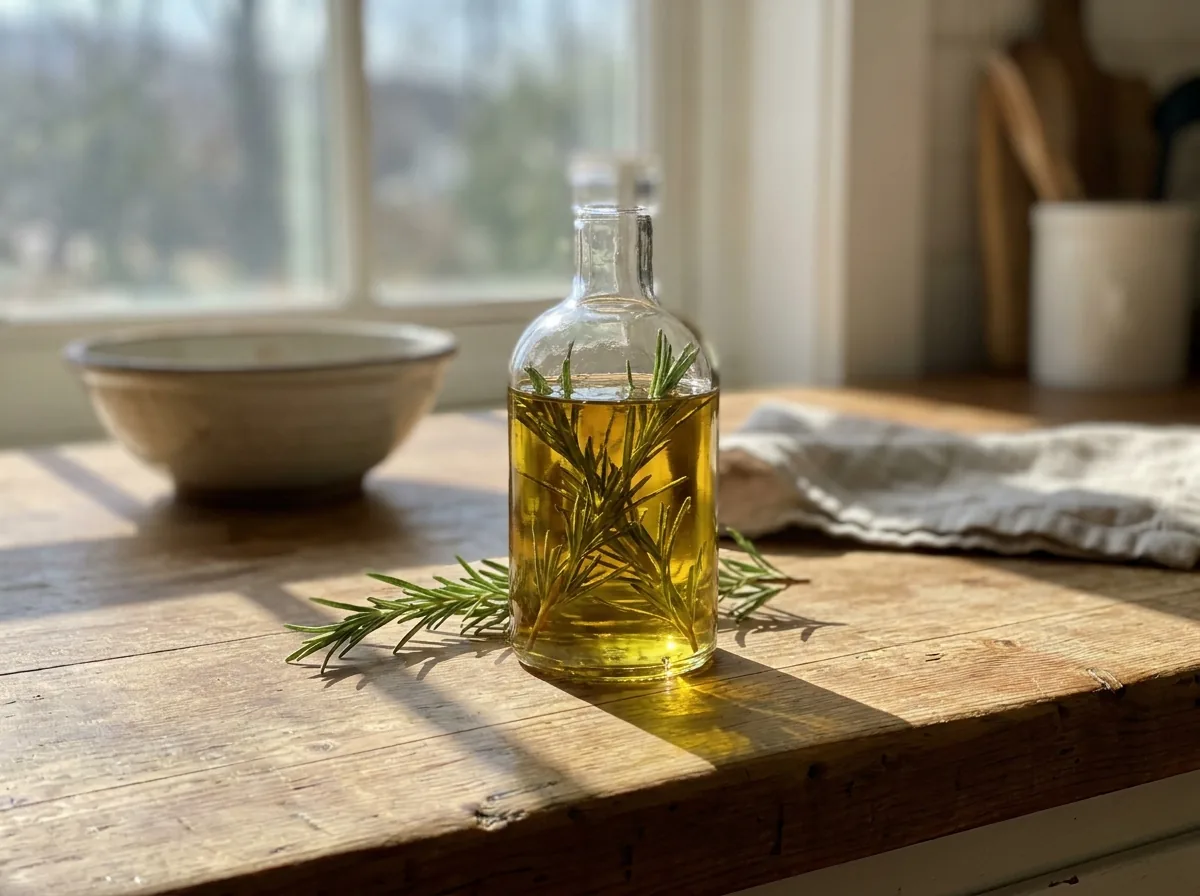
Ingredients
- 4 tbsp (about 8 g) Dried rosemary leavesDried, not fresh: the water in fresh sprigs is what makes herbs in oil risky. Crush lightly to release the oil
- 1 cup (240 ml) Olive oilChoose one carrier oil. Widely available and inexpensive
- 1 cup (240 ml) Jojoba oilAlternative carrier oil. A liquid wax rather than a triglyceride oil
- 1 cup (240 ml) Coconut oil (melted)Alternative carrier. Solid below about 24°C (75°F), so warm it before use
- About 6 drops per 30 ml (2 tbsp) of carrier oil Rosemary essential oil (dilution method only)Skip this for the infusions. 6 drops is roughly a 1% dilution if your dropper gives about 20 drops per ml, which varies by bottle
Equipment
- Clean glass jar with a lid, boiled for 10 minutes and dried
- Small saucepan and a cooking thermometer
- Fine sieve or muslin (cheesecloth)
- Small dark glass bottle for the finished oil
- Label and pen for the date
Method
Sterilise the jar and bottle
Wash the jar, lid and bottle, then boil them for 10 minutes and let them air-dry completely. Wet glass adds water, which is exactly what you are trying to keep out.3,4
Measure the dried rosemary into the jar
Put 4 tbsp (about 8 g) of dried rosemary in the jar and crush it lightly with the back of a spoon. Check the leaves are properly dry and crisp; leaves that bend or feel damp can still carry water.3
Warm infusion: heat the oil
Warm 1 cup (240 ml) of your carrier oil in a small pan to 82°C (180°F), checking with a thermometer, and no hotter. Extension food-safety advice uses this temperature for dried herbs.3,4
Warm infusion: pour, cool and steep
Pour the hot oil over the rosemary, leaving about 1 cm (half an inch) of space at the top, then cap the jar. Leave it to cool to room temperature, about 2 to 3 hours, giving it a gentle swirl now and then.4
Strain and bottle
Strain through a fine sieve lined with muslin into the clean dark bottle, pressing the leaves gently. Discard the used rosemary rather than reusing it.
Refrigerate and label
Label the bottle with the date and put it in the fridge straight away. The University of Georgia advises refrigerating an infusion made with dried or fresh herbs and heat and throwing it away after 4 days. University of Maine allows up to 3 months in a cool, dark place. We follow the stricter advice, so make small batches. Olive and coconut oil turn cloudy or solid in the fridge; let the bottle stand at room temperature for a few minutes before using.3,4
Slow infusion: the two-to-four-week version
For a cold infusion, put the dried rosemary and unheated oil in the sterilised jar, cap it and leave it for two to four weeks, shaking it every few days. Neither extension source tests this method, and heat is part of their safety advice, so keep the jar in the fridge for the whole time, strain it at the end and treat it like the warm version. If it smells sour, looks cloudy or shows any bubbles or mould, throw it away.3
Diluting rosemary essential oil instead
Measure 30 ml (2 tbsp) of carrier oil into a clean dark bottle and add about 6 drops of rosemary essential oil, then swirl to mix. This is about a 1% dilution and is our cautious starting point, not a figure from the trials. Never put essential oil on your scalp undiluted.5,6
Patch-test, then use
Dab a little on your inner forearm and wait 24 hours before putting any of it on your scalp. If it is fine, massage a small amount into your scalp, keep it away from your eyes, and shampoo it out after a while. Stop if you get itching, redness or a rash.5,6
Safety
- Use dried herb only. Fresh herbs carry moisture and, in oil, can support Clostridium botulinum, which causes botulism3,4
- Extension advice covers oils for eating, so it applies most to oral use. We apply it to hair oil as the cautious choice, as no source tests scalp oils3,4
- Even dried herbs may hold enough water for bacteria to grow, so keep the infusion cold and discard it if it smells or looks off3
- Rosemary can cause allergic reactions and contact dermatitis in some people. Patch-test first and stop if you react5,6
- Keep essential oil away from your eyes, and don't use rosemary oil in pregnancy, while breastfeeding, or on children under 18, as safety is unproven6
Variations
Use half jojoba and half olive oil for the carrier. It is a matter of texture and cost only; we found no study comparing carrier oils for hair.
Some people leave oil on overnight under a towel. We found no evidence for this, and it makes shampooing it out harder, so try a short session first.
Does it actually work?
The best human evidence is a small trial of 100 people with androgenetic alopecia (pattern hair loss), who used rosemary oil or 2% minoxidil for 6 months. Hair counts rose in both groups by 6 months, with no significant difference between them, and nothing changed at 3 months. There was no placebo group, so it cannot show that rosemary worked better than doing nothing. It also tested a rosemary oil product, not a home infusion, and it is not known whether an infusion delivers a comparable dose. An older trial of alopecia areata used a blend of four essential oils in carrier oils (thyme, rosemary, lavender, cedarwood) with 44% improved against 15% with carrier oil alone, but that is a different condition and cannot single out rosemary. The abstracts of both trials do not give the dilution used. Our /ingredients/rosemary-oil/ entry rates the evidence.1,2
Evidence ratings for what goes in: Rosemary oil, Olive oil, Jojoba oil, Coconut oil.
Questions people ask
Can I make rosemary oil with fresh rosemary?
We advise against it. Fresh herbs contain water, and herbs in oil are a known route to botulism when stored at room temperature. Extension food-safety services say dried herbs are the safer starting point, and even then the oil should be kept in the fridge.
Is homemade rosemary oil the same as rosemary essential oil?
No. A home infusion is rosemary steeped in a carrier oil; essential oil is a concentrated distillate. The hair-loss trials used a rosemary oil product, not a kitchen infusion, and we found no study testing an infusion.
Does rosemary oil regrow hair?
One small six-month trial found hair counts rose in a similar way to 2% minoxidil, but it had no placebo group, so it is not proof of regrowth. The evidence is limited, and it is not a replacement for medicines your doctor or dermatologist has prescribed.
How long does homemade rosemary oil last?
Extension sources disagree: University of Georgia says refrigerate an infusion and throw it away after 4 days, while University of Maine says up to 3 months in a cool, dark place. Both are written for oils for eating. We suggest the shorter limit, in the fridge.
Sources
- Randomised trial Panahi Y, Taghizadeh M, Marzony ET, Sahebkar A. Rosemary oil vs minoxidil 2% for the treatment of androgenetic alopecia: a randomized comparative trial. Skinmed. 2015.
- Randomised trial Hay IC, Jamieson M, Ormerod AD. Randomized trial of aromatherapy. Successful treatment for alopecia areata. Arch Dermatol. 1998.
- University extension Schwan CL. How to Safely Make Infused Oils: Best Practices for Food Safety. University of Georgia Cooperative Extension Circular 1334. 2024.
- University extension University of Maine Cooperative Extension. Bulletin #4385, Safe Homemade Flavored and Infused Oils.
- Toxicology review Ghasemzadeh Rahbardar M, Hosseinzadeh H. Toxicity and safety of rosemary (Rosmarinus officinalis): a comprehensive review. Naunyn Schmiedebergs Arch Pharmacol. 2025.
- Regulator monograph European Medicines Agency HMPC. Community herbal monograph on Rosmarinus officinalis L., aetheroleum (EMA/HMPC/235453/2009). 2010 (superseded).
Educational only. Patch-test anything new on your skin, and stop if it irritates.