Awaiting review. This guide is sourced but has not yet been checked by our reviewer.
How to Make Lip Gloss at Home
A simple lip gloss is a liquid oil thickened with a little wax and butter: here 14 g jojoba oil, 3 g beeswax and 3 g shea butter, which sets to a soft, glossy gel. For colour, use only cosmetic-grade mica, and never craft glitter or paint pigments, because colours on lips must be approved for that use.
Draft, awaiting clinical review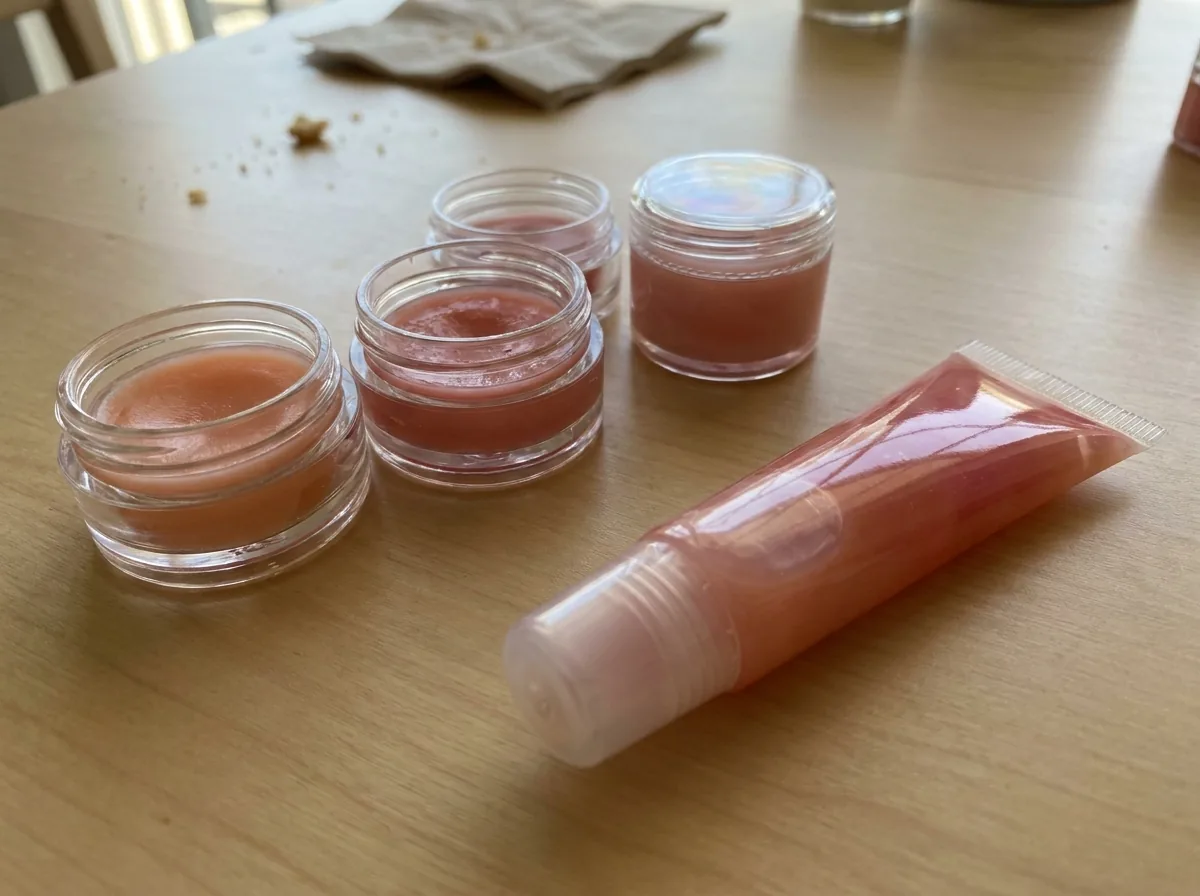
Ingredients
- 14 g (about 1 tbsp) Jojoba oilMelted coconut oil also works, but is heavier. Avoid castor oil, a known cause of lip allergy
- 3 g (about 1 tsp) Beeswax pelletsVegan swap: about 1.5 g candelilla wax, which is harder
- 3 g (about ¾ tsp, packed) Shea butterAdds body and a softer feel; cocoa butter gives a firmer gloss
- A tiny pinch, about 0.1–0.3 g, to taste Cosmetic-grade mica for lipsOptional. Buy mica labelled for cosmetics and lips, not craft mica or glitter
Equipment
- Digital scale that reads to 0.1 g if you can get one (a 1 g scale is fine for the base)
- Heatproof jug or small glass bowl
- Saucepan for a water bath (bain-marie)
- Small clean pots, squeeze tubes or lip balm tubes, new or freshly washed and dried
- Small spoon or disposable pipette for pouring
- Clean toothpick or mini whisk for mixing the colour
Method
Prepare the containers
Use new pots or tubes, or wash reusable ones in hot soapy water and dry them completely. Stand them upright on a tray so they can be filled quickly.6
Weigh the base
Weigh the jojoba oil, beeswax and shea butter into the jug: 14 g, 3 g and 3 g. That is about 15% wax and butter each, soft enough to spread like a gloss. The lip balm recipe on this site uses far more wax and butter.
Melt gently
Stand the jug in a saucepan with about 3 cm (1 in) of barely simmering water. Stir now and then until clear, usually 5 minutes. Keep water out of the jug.
Add the colour
Take the jug off the heat. Stir in a tiny pinch of cosmetic-grade mica with a toothpick, then test a drop on a cold saucer. It looks paler on the saucer than on your lips, so add a little at a time. Do not use craft glitter, eyeshadow, paint pigment or food colouring.1,2
Pour and set
Pour straight away into the pots or tubes, leaving a small gap at the top. Leave undisturbed for 30 minutes at room temperature. Stir the jug between pours if the mica settles.6
Patch-test, then use
Put a little on your inner forearm for 24 hours, then on a small area at the corner of your lips, before using it fully. Stop if you get redness, itching or swelling.4,5
Safety
- Colourants must be approved by FDA for their use, and lips are not "externally applied". Use only cosmetic-grade mica sold for lip products1,2
- No craft glitter, eyeshadow, paint pigment or food colouring. They are not made or approved for lips, which you swallow traces from1
- Patch-test first. Waxes, castor oil and fragrances have all caused allergic lip reactions, so a new gloss can still upset you4,5
- Leave out flavours and essential oils, and do not add water, honey or juice. Water-containing products need a preservative, and dirty tubs carry microbes6,7
- Hot wax and oil can scald. Keep children away, and cool a burn under running water for 20 minutes8
Variations
Leave out the mica. The base alone gives a shiny, slightly sticky clear gloss.
For a gloss that stays put and suits a tube, use 4 g wax and 4 g butter with 12 g oil. It is closer to a balm.
Swap the beeswax for about 1.5 g candelilla wax and keep the rest the same. Test a spoonful before pouring, as candelilla firmness varies.
Does it actually work?
Lip gloss mostly adds shine and a thin oily layer that softens dry lips and slows water loss. It is cosmetic. The American Academy of Dermatology lists shea butter among ingredients that help chapped lips, and notes that an ointment such as white petroleum jelly seals in water for longer than waxes or oils, so a homemade gloss is a pleasant option but not a stronger one. A softer gloss is also less protective than a balm. It has no sun protection. Learn more about the ingredients: jojoba oil, beeswax, shea butter and coconut oil.3
Evidence ratings for what goes in: Jojoba oil, Beeswax, Shea butter.
Questions people ask
What can I use to colour homemade lip gloss?
Use cosmetic-grade mica, or iron oxides sold for cosmetics and lips. FDA requires every colour additive in a cosmetic to be approved for its intended use, and lips are treated separately from ordinary skin. Craft colours, glitter and food dyes have no such approval for lips.
Can I use craft glitter in lip gloss?
No. Craft glitter is not made for skin and is not a cosmetic colourant, and traces of anything on your lips are swallowed. Use cosmetic-grade mica for shimmer instead.
Why is my lip gloss too sticky or too runny?
Too runny means too much oil, too sticky usually means too much wax or butter. Adjust by 1 g at a time, remelt and test a drop on a cold saucer. Jojoba is less tacky than many oils.
How long does homemade lip gloss last?
There is no reliable tested figure for a home recipe. A gloss with no water in it is less hospitable to microbes, but it is not sterile and oils can go rancid. Treat 6 months as a cautious guide and bin it if it smells off.
Can I add honey or flavouring?
We suggest not. Honey contains water and needs a preservative in a cosmetic, and flavours are common causes of lip allergy and irritation.
Sources
- Regulator US Food and Drug Administration. Color Additives and Cosmetics: Fact Sheet.
- Regulation 21 CFR 73.2496 - Mica. Legal Information Institute, Cornell Law School.
- Professional body American Academy of Dermatology. 7 dermatologists' tips for healing dry, chapped lips.
- Systematic review Pal B, et al. Allergic contact dermatitis to lip care cosmetic products - a systematic review. Cutaneous and Ocular Toxicology. 2024.
- Clinical reference DermNet NZ. Contact reactions to lipsticks and other lipcare products.
- Regulator US Food and Drug Administration. Microbiological Safety and Cosmetics.
- Review Halla N, et al. Cosmetics Preservation: A Review on Present Strategies. Molecules. 2018.
- Public-health body NHS. Burns and scalds.
Educational only. Patch-test anything new on your skin, and stop if it irritates.