
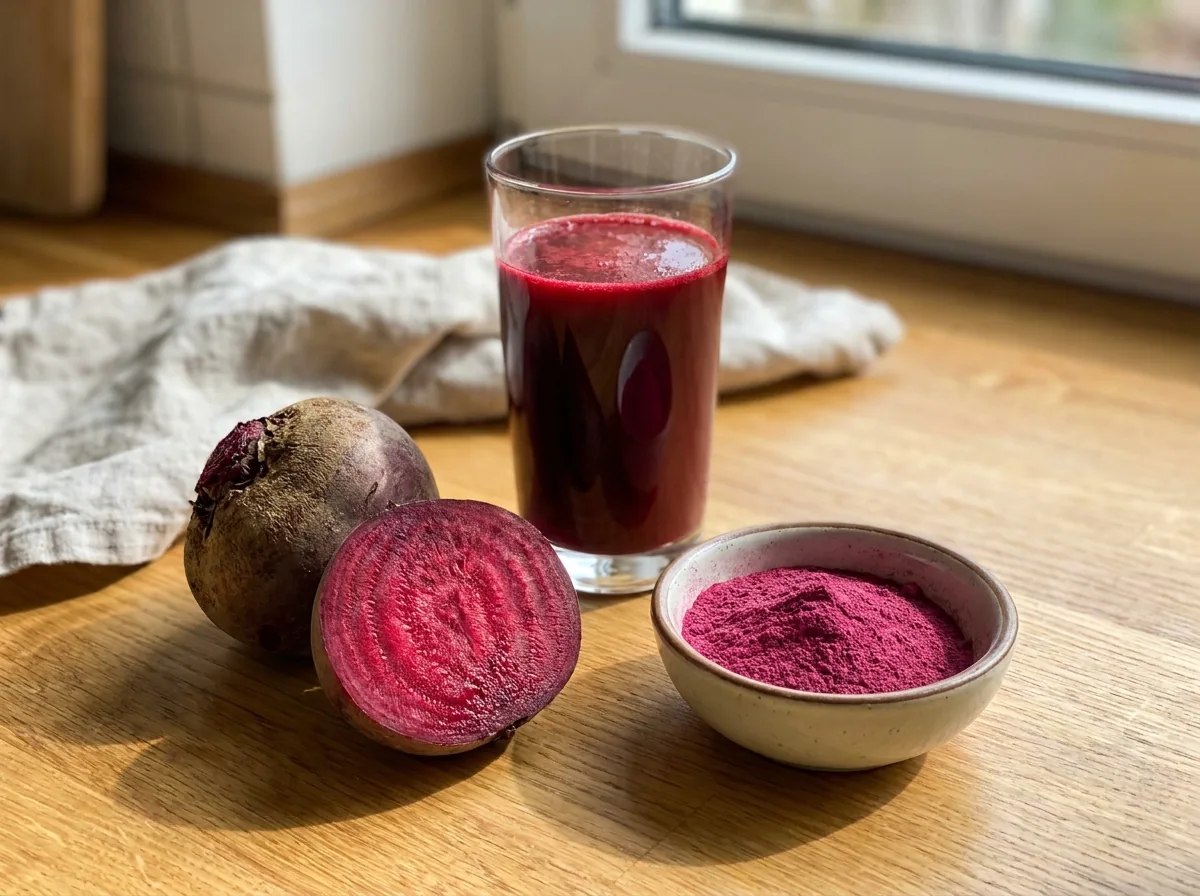
Beetroot (juice and powder)
Beetroot juice has moderate evidence for exercise performance: meta-analyses find a small to moderate gain in time to exhaustion and sprint work, though not in every test. For blood pressure the effect is about 4 to 5 mmHg off the systolic reading in clinic, but it was not seen on 24-hour monitors and the certainty is low. The one caution is oxalate, which matters if you form kidney stones; red urine (beeturia) is harmless.
Almost all trials used juice, so the evidence for powder depends on its nitrate content, which varies by product.
At a glance
Last reviewed 10 October 2026What it's used for
Evidence is rated per use. The same ingredient can be strong for one thing and traditional for another.
| Use | Evidence | What the research shows |
|---|---|---|
| Exercise performanceCompare remedies for energy and fatigue → | Moderate | A meta-analysis of 17 controlled studies (nitrate 300 to 600 mg, from beetroot juice or sodium nitrate) found a moderate benefit for time to exhaustion (effect size 0.79, 95% CI 0.23 to 1.35) but no significant effect on time trials or graded tests. A 2026 meta-analysis of 33 studies of beetroot juice found small gains in sprint performance (SMD 0.38), mean power (0.43) and VO2max (0.30) with low heterogeneity. Benefits were more common in less-trained people. A separate meta-analysis of nine training trials found that nitrate added to training did not improve VO2peak or time to exhaustion beyond training alone.1,2,3 |
| Blood pressureCompare remedies for heart health → | Limited | A meta-analysis of 11 trials (349 people with hypertension) found beetroot juice lowered clinic systolic pressure by 5.3 mmHg (95% CI 3.2 to 7.5) but not diastolic or 24-hour pressure; the authors rated the certainty of evidence low. An earlier meta-analysis of 13 trials (1 to 6 weeks) found falls of 4.1 mmHg systolic and 2.0 mmHg diastolic, but only in the clinic, not on 24-hour or home monitoring. A 2026 meta-analysis of six trials in older adults (181 people) using sodium nitrate, not juice, found no significant reduction. Clinic-only effects that vanish on ambulatory monitoring cap this at 2.4,5,6 |
| Red or pink urine after eating beetroot (beeturia) | Traditional | This is an effect rather than a remedy, included because it is a top search. It is reported in about 10 to 14% of people, is more common with iron deficiency or malabsorption, and is caused by beetroot pigments (betacyanins) passing into the urine. In a study of 100 people, 4 passed visibly red urine. It is harmless in itself, though red urine that follows no beetroot should be checked by a doctor.7 |
How much
Ranges below are what studies used and what supplements commonly contain. They are not a recommendation for you. Start at the low end.
How people take it
Safety
Who should avoid
- History of calcium oxalate kidney stones — beetroot raised urinary oxalate
- Infants — vegetable nitrate can cause methaemoglobinaemia in babies under 3 months
- Young children — beetroot may exceed the acceptable daily nitrate intake
Known interactions
Questions people ask
What are the benefits of beetroot powder?
The best-supported use is exercise performance, where meta-analyses show a small to moderate gain in time to exhaustion and sprint work. Clinic blood pressure falls by about 4 to 5 mmHg in some meta-analyses, but not on 24-hour monitoring. Most trials used juice, not powder.
Why does beetroot turn urine red, and is it harmful?
Beetroot pigments called betacyanins pass into urine in about 10 to 14% of people, a harmless effect called beeturia. It is more common in iron deficiency and malabsorption. Red urine with no beetroot eaten should be looked at by a doctor.
Does beetroot cause kidney stones?
Beetroot is one of eight foods shown to raise urinary oxalate significantly in a review of the literature, and oxalate restriction is used for people with calcium oxalate stones. The rise is not proportional to the oxalate in the food, and higher calcium intake may reduce urinary oxalate.
Anyone who forms stones should ask their doctor before using concentrated beetroot juice or powder.
Is beetroot high in nitrate, and is that a problem?
Yes: a Polish survey found a median of about 1,260 mg per kg. For most adults the trials used 200 to 800 mg nitrate a day without reported problems in the abstracts we read. The survey authors warned that beetroot can exceed the acceptable daily intake for young children, and vegetable nitrate is a risk for infants under 3 months.
Make it yourself
DIY guides that use beetroot (juice and powder), with quantities, safety notes and an honest word on what they do.
Sources (10)
- Meta-analysis Hoon MW, Johnson NA, Chapman PG, Burke LM. The effect of nitrate supplementation on exercise performance in healthy individuals: a systematic review and meta-analysis. Int J Sport Nutr Exerc Metab. 2013.
- Meta-analysis Cai C, Huang P, Cheng X, Zhou J. Effectiveness of beetroot juice on aerobic and anaerobic exercise performance: systematic review and meta-analysis. Front Nutr. 2026.
- Meta-analysis Hogwood AC, Anderson KC, Ortiz de Zevallos J, et al. Limited Effects of Inorganic Nitrate Supplementation on Exercise Training Responses: A Systematic Review and Meta-analysis. Sports Med Open. 2023.
- Meta-analysis Gronroos R, Eggertsen R, Bernhardsson S, Praetorius Bjork M. Effects of beetroot juice on blood pressure in hypertension according to European Society of Hypertension Guidelines: A systematic review and meta-analysis. Nutr Metab Cardiovasc Dis. 2024.
- Meta-analysis Ashor AW, Lara J, Siervo M. Medium-term effects of dietary nitrate supplementation on systolic and diastolic blood pressure in adults: a systematic review and meta-analysis. J Hypertens. 2017.
- Meta-analysis Forster D, Waclawovsky G, Stefani GP. Effects of chronic nitrate supplementation on blood pressure in adults: a systematic review and meta-analysis of randomized clinical trials. Nutr Res. 2026.
- Clinical study Watts AR, Lennard MS, Mason SL, Tucker GT, Woods HF. Beeturia and the biological fate of beetroot pigments. Pharmacogenetics. 1993.
- Food survey Gajda-Wyrebek J, Jarecka J, Dmitruk M. Monitoring survey of nitrate content in beetroot, radish and cabbage in Poland. Rocz Panstw Zakl Hig. 2021.
- Review Massey LK, Roman-Smith H, Sutton RA. Effect of dietary oxalate and calcium on urinary oxalate and risk of formation of calcium oxalate kidney stones. J Am Diet Assoc. 1993.
- Review Chan TY. Vegetable-borne nitrate and nitrite and the risk of methaemoglobinaemia. Toxicol Lett. 2011.
Last reviewed 10 October 2026 · Next review April 2027 · How we rate evidence
Reader notes
Experiences and questions from readers, read by an editor before they appear. They are personal accounts, not evidence, and are not medical advice.