Awaiting clinical review. This entry is sourced but has not yet been signed off by a pharmacist or clinician.
Psyllium
Psyllium husk works for chronic constipation and modestly lowers LDL cholesterol, and it is the best-supported fibre supplement for both. It probably helps irritable bowel syndrome (IBS) symptoms as part of soluble fibre, and it may lower blood sugar in people who already have type 2 diabetes. The main caution is that it must be taken with plenty of liquid: swallowed dry or with too little fluid it can block the throat, gullet or bowel.
At a glance
Last reviewed 29 September 2026What it's used for
Evidence is rated per use. The same ingredient can be strong for one thing and traditional for another.
| Use | Evidence | What the research shows |
|---|---|---|
| Chronic constipation | Strong | A 2022 meta-analysis of 16 trials (1,251 adults) found 66% of people responded to fibre versus 41% on control (RR 1.48, 95% CI 1.17–1.88), with psyllium showing a significant effect and doses above 10 g a day and at least 4 weeks working best. Results varied a lot between trials, and flatulence was more common on fibre. The EU regulator lists ispaghula husk (psyllium) as a well-established treatment for habitual constipation.1,7 |
| Lowering LDL cholesterol | Strong | A meta-analysis of 28 trials (1,924 people) found a median of about 10.2 g psyllium a day lowered LDL cholesterol by 0.33 mmol/L (95% CI 0.27–0.38) and apolipoprotein B by 0.05 g/L; the certainty of evidence was moderate for LDL because trials disagreed in size. The EU monograph puts the fall at roughly 7% and notes there are no data on heart attacks or deaths. The US FDA allows a label claim that psyllium husk as part of a diet low in saturated fat and cholesterol may reduce the risk of heart disease.2,7,8 |
| Irritable bowel syndrome | Moderate | A 2014 meta-analysis of 14 trials (906 people) found fibre reduced the chance of staying symptomatic (RR 0.86; number needed to treat 10), with the benefit confined to soluble fibre (RR 0.83; NNT 7) and none from bran. Those pooled trials were not all psyllium. A 2020 network meta-analysis found few IBS trials of soluble fibre, antispasmodics and similar treatments were at low risk of bias, so the certainty is limited. The EU monograph lists psyllium only as an adjuvant in constipation-predominant IBS.3,5,7 |
| Blood sugar in type 2 diabetes | Limited | A 2015 meta-analysis of 35 trials reported that psyllium taken before meals for several weeks lowered fasting glucose by 37 mg/dL and HbA1c by 0.97 percentage points in people with type 2 diabetes, with little effect in people with normal glucose. Its authors were employed by a psyllium manufacturer, and a 2023 network meta-analysis of soluble fibres in type 2 diabetes ranked galactomannans, not psyllium, most effective. We rate it 2 until independent psyllium-specific reviews confirm it.4,6 |
How much
Ranges below are what studies used and what supplements commonly contain. They are not a recommendation for you. Start at the low end.
How people take it
Safety
Who should avoid
- Difficulty swallowing or throat or gullet problems — choking risk
- Bowel blockage, narrowing, megacolon or faecal impaction — do not use
- Sudden change in bowel habit over 2 weeks or undiagnosed rectal bleeding
- Taking it dry or with too little fluid — can obstruct the throat or bowel
- Known allergy to psyllium; regular contact with the powder can sensitise
- Opioids and other drugs that slow the gut — only under medical supervision
- Debilitated or elderly people — medical supervision advised (EU monograph)
Known interactions
Compare with
Head-to-head pages for the pairs people search most.
Questions people ask
How much water do I need to take with psyllium?
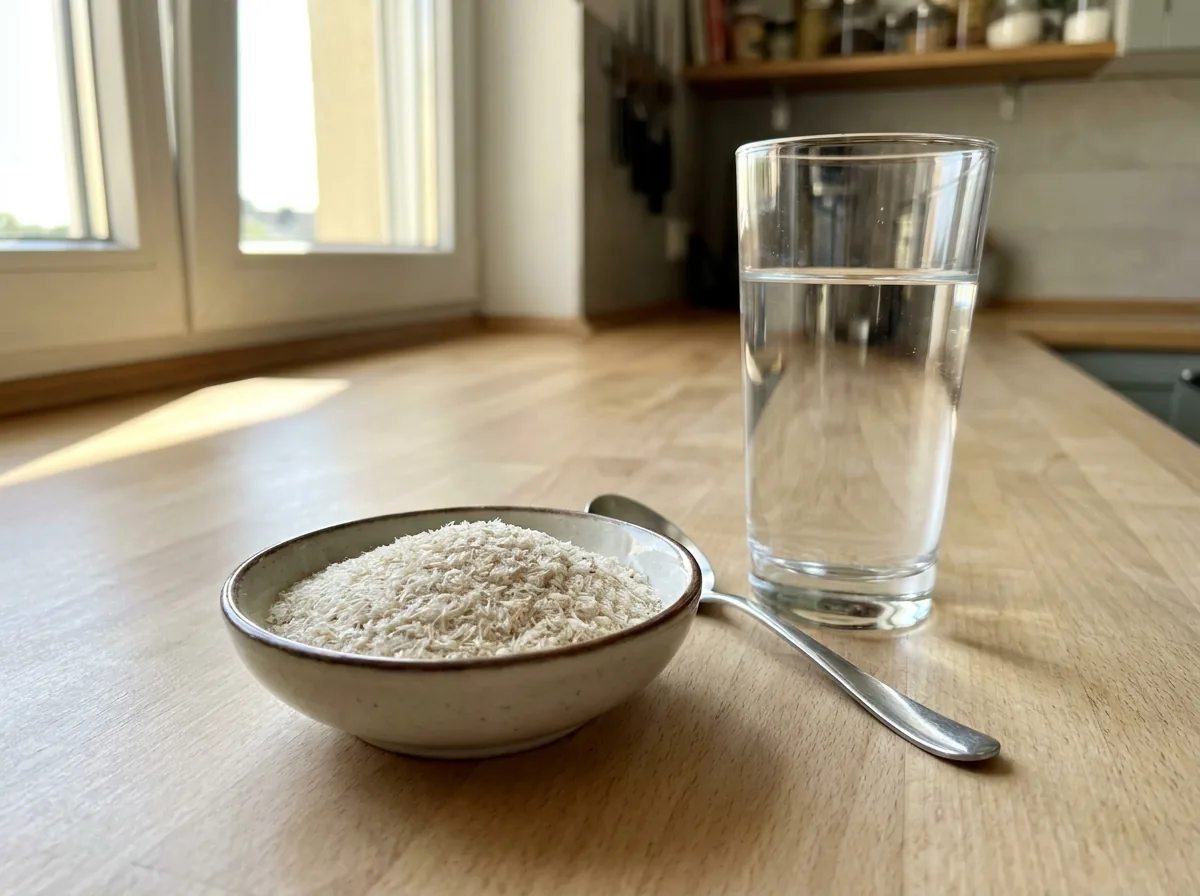
The EU regulator's minimum is 30 ml of liquid for every 1 g of husk, and you should keep drinking fluids through the day. With too little fluid, psyllium can swell and block the throat, gullet or bowel, causing choking, chest pain, vomiting or trouble breathing.
Can psyllium affect my other medicines?
It can delay the absorption of some medicines, including lithium, carbamazepine, digoxin, warfarin-type anticoagulants, and some vitamins and minerals. The EU monograph advises taking it at least half an hour to an hour before or after other medicines. People on diabetes or thyroid treatment should use it under medical supervision because doses may need adjusting.
How long does psyllium take to work?
For constipation, the EU monograph says a dose usually acts within 12–24 hours, sometimes peaking after 2–3 days. A 2022 meta-analysis found stool frequency improved mainly after 4 weeks or more at doses above 10 g a day. Cholesterol trials lasted at least 3 weeks.
Does psyllium lower cholesterol and blood sugar?
It lowers LDL cholesterol modestly, by about 0.33 mmol/L at roughly 10 g a day in a 28-trial meta-analysis, and the US FDA permits a heart-disease health claim for it. Evidence for blood sugar is weaker: one meta-analysis by manufacturer-employed authors found lower fasting glucose and HbA1c in people with type 2 diabetes, but not in people with normal glucose.
Sources
- Systematic review van der Schoot A, Drysdale C, Whelan K, Dimidi E. The Effect of Fiber Supplementation on Chronic Constipation in Adults: An Updated Systematic Review and Meta-Analysis of Randomized Controlled Trials. Am J Clin Nutr. 2022.
- Systematic review Jovanovski E, Yashpal S, Komishon A, et al. Effect of psyllium (Plantago ovata) fiber on LDL cholesterol and alternative lipid targets, non-HDL cholesterol and apolipoprotein B: a systematic review and meta-analysis of randomized controlled trials. Am J Clin Nutr. 2018.
- Systematic review Moayyedi P, Quigley EM, Lacy BE, et al. The effect of fiber supplementation on irritable bowel syndrome: a systematic review and meta-analysis. Am J Gastroenterol. 2014.
- Meta-analysis Gibb RD, McRorie JW Jr, Russell DA, Hasselblad V, D'Alessio DA. Psyllium fiber improves glycemic control proportional to loss of glycemic control: a meta-analysis of data in euglycemic subjects, patients at risk of type 2 diabetes mellitus, and patients being treated for type 2 diabetes mellitus. Am J Clin Nutr. 2015.
- Network meta-analysis Black CJ, Yuan Y, Selinger CP, et al. Efficacy of soluble fibre, antispasmodic drugs, and gut-brain neuromodulators in irritable bowel syndrome: a systematic review and network meta-analysis. Lancet Gastroenterol Hepatol. 2020.
- Network meta-analysis Juhász AE, Greff D, Teutsch B, et al. Galactomannans are the most effective soluble dietary fibers in type 2 diabetes: a systematic review and network meta-analysis. Am J Clin Nutr. 2023.
- Regulator monograph European Medicines Agency HMPC. Community herbal monograph on Plantago ovata Forssk., seminis tegumentum (EMA/HMPC/199774/2012). 2013.
- Regulator US Code of Federal Regulations, 21 CFR 101.81. Health claims: Soluble fiber from certain foods and risk of coronary heart disease (CHD).
Last reviewed 29 September 2026 · Next review March 2027 · How we rate evidence