Awaiting review. This guide is sourced but has not yet been checked by our reviewer.
DIY Hair Mask: 4 Simple Recipes for Dry or Damaged Hair
Four kitchen-cupboard masks: a coconut oil pre-wash, olive oil with honey, plain yoghurt, and aloe gel. Spread one through dry or damp hair, leave it 20 to 30 minutes, then wash it out. They can leave hair feeling smoother and more manageable, but no home mask repairs split ends or damaged hair. Mix each one fresh, because masks with water in them go off.
Draft, awaiting clinical review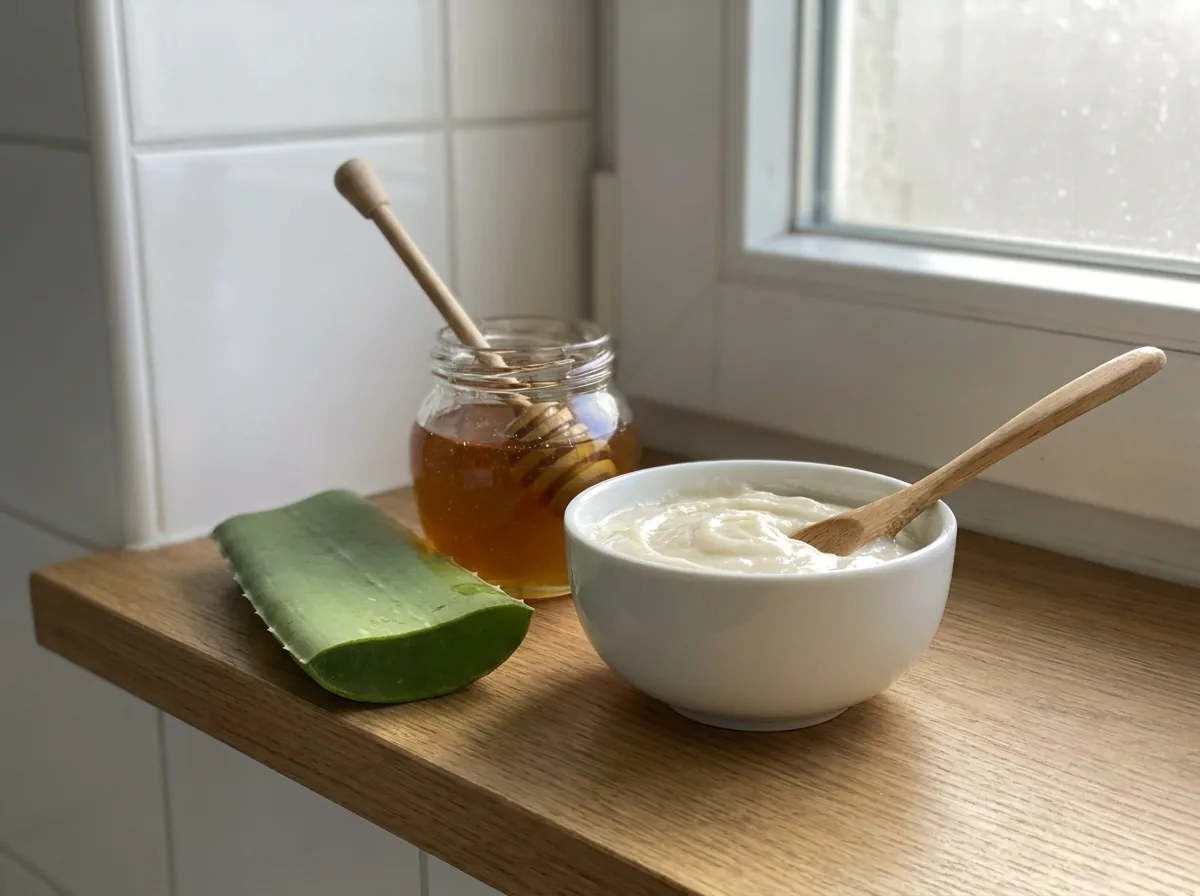
Ingredients
- 1–2 tbsp (15–30 ml), melted Coconut oil (pre-wash mask)Solid below about 24°C (75°F); warm the jar in a bowl of hot water. Use more for long hair
- 2 tbsp (30 ml) Olive oil (oil and honey mask)Argan or jojoba oil work in the same way if you prefer them
- 1 tbsp (about 20 g) Honey (oil and honey mask)Runny honey mixes more easily. Warm the jar slightly if it has set
- 4 tbsp (about 60 g), full-fat Plain yoghurt (yoghurt mask)Unsweetened and unflavoured, straight from the fridge
- 3 tbsp (45 ml) Pure aloe vera gel (aloe mask)Gel from a fresh leaf, or a bottled pure gel without fragrance or alcohol
- 1 tsp (5 ml) Argan or jojoba oil (aloe mask, optional)Adds slip. Jojoba oil is an alternative
Equipment
- Small bowl and spoon
- Wide-tooth comb
- Shower cap or clingfilm
- Old towel
- Clips for sectioning
Method
Patch-test any ingredient that is new to you
Dab a little of the mixture on your inner forearm and wait 24 hours before putting it on your scalp or hair. Honey, yoghurt and aloe can all cause reactions in people who are allergic. Stop if you get itching, redness or a rash.
Start with a comb-through
Hair is fragile when wet, so detangle it gently with a wide-tooth comb, either dry or after dampening it. Section thick hair with clips so the mask reaches every part.2
Mask 1: coconut oil pre-wash
Melt 1 to 2 tbsp of coconut oil and work it through dry hair from mid-lengths to ends, and a little at the roots if you like. Cover with a shower cap and leave it 30 minutes to an hour, then shampoo it out, and repeat the shampoo if it feels greasy. The study behind this used coconut oil before washing; it did not state quantities or times, so ours are ordinary practice.1
Mask 2: oil and honey
Stir 2 tbsp of olive oil into 1 tbsp of honey until smooth. Apply it to damp hair from the mid-lengths down, cover and leave it for 20 to 30 minutes. Shampoo it out; honey rinses away easily but the oil may need two washes.
Mask 3: yoghurt
Spread 4 tbsp of plain full-fat yoghurt through damp hair from the mid-lengths to the ends and leave it for 15 to 20 minutes. Rinse it out with cool or lukewarm water, as hot water can make yoghurt clump, then shampoo. Throw away any leftover yoghurt that has been on your hands or in the bowl.3
Mask 4: aloe gel
Mix 3 tbsp of aloe gel with 1 tsp of argan or jojoba oil, and apply it to damp hair. Leave it for 20 minutes, then rinse well; dried aloe can feel tacky if left behind. The gel is mostly water, so it goes off quickly, and it should be used fresh.3
Apply it where dry hair needs it
The AAD says that with dry or curly hair you should apply conditioner along the whole length, not only the ends. Apply masks the same way, but keep oils off a scalp that is already oily. Do not use more than you need, since it is harder to rinse out.2
Rinse and dry gently
Rinse until the water runs clear, shampoo if the recipe calls for it, and follow with your usual conditioner if you want to. The AAD advises limiting heat styling and blow drying, so let your hair air-dry when you can.2
Choose how often
Once a week is a common pattern. We found no study that tests how often a home mask works best, so start with once a fortnight and see how your hair feels.
Safety
- Patch-test honey, yoghurt or aloe on your forearm for 24 hours first. Stop if you get itching, redness or a rash
- Masks with water in them (yoghurt, aloe, honey) can grow bacteria and mould: make them fresh, use them straight away and throw away the rest3
- Keep masks away from your eyes, and rinse with lukewarm rather than hot water
- If your scalp burns, itches or flakes after a mask, or you are losing hair, see a GP or dermatologist rather than adding more masks
Variations
Use olive, jojoba or argan oil on its own on the ends, for 30 minutes before washing, as in mask 1. It is the simplest version, and coconut oil is the only one with a hair study.
Stir 1 tsp of honey into the 4 tbsp of yoghurt for a slightly thicker mask that holds better on long hair.
Use half the amounts, keep the mask off the roots and shorten the time to 15 minutes, since oil can weigh fine hair down.
Does it actually work?
Conditioning products can make hair feel smoother and easier to detangle, and the AAD says conditioner moisturises and detangles hair. That is a change in how hair feels and behaves, not repair: hair that is already split or broken does not heal, and we found no evidence that any home mask repairs split ends or damaged hair; trimming removes them. For coconut oil, our /ingredients/coconut-oil/ entry rates a study in which it reduced protein loss from hair when used before washing, but the authors worked for a coconut hair-oil maker and we found no study in people showing less breakage. We found no hair studies for honey, yoghurt or aloe gel as masks, so treat those as pleasant conditioners rather than treatments.1,2
Evidence ratings for what goes in: Coconut oil, Olive oil, Honey, Aloe Vera, Argan oil.
Questions people ask
Which DIY hair mask is best for dry hair?
There is no head-to-head test. Coconut oil before washing is the only one of the four with a hair study, and it reduced protein loss in the laboratory and on volunteers. The others are conditioning treatments, so choose by how the hair feels and what you have to hand.
Can a hair mask repair split ends?
No. We found no evidence that any home mask repairs a split end. Masks can make ends look and feel smoother for a while, but the split stays until it is cut off.
How often should I use a hair mask?
Once a week is common, but we found no study on frequency. Start with once every one to two weeks and stop if hair feels greasy, limp or your scalp gets irritated.
Can I keep leftover hair mask?
Not the ones containing yoghurt or aloe gel, or any that has water in it. Water lets bacteria and mould grow, so mix small amounts and throw away leftovers. A plain oil pre-wash can be kept from the jar, but do not put used oil back in it.
Sources
- Laboratory and in-vivo study Rele AS, Mohile RB. Effect of mineral oil, sunflower oil, and coconut oil on prevention of hair damage. J Cosmet Sci. 2003.
- Professional body American Academy of Dermatology. Tips for healthy hair.
- Review Halla N, et al. Cosmetics Preservation: A Review on Present Strategies. Molecules. 2018.
Educational only. Patch-test anything new on your skin, and stop if it irritates.