Awaiting review. This guide is sourced but has not yet been checked by our reviewer.
Natural Hair Dye: Dye Hair with Henna, Indigo and More
Pure henna powder stains hair a reddish-brown; cassia gives a pale golden tint; and indigo, applied after henna in a second step, takes hair towards brown or black. Tea, coffee and walnut rinses give at most a subtle tint. Never use anything sold as "black henna" on hair or skin, because it can contain PPD, and patch-test every batch 48 hours before you dye. Do not use henna on babies or children without asking a doctor, as it can cause severe haemolysis in G6PD deficiency.
Draft, awaiting clinical review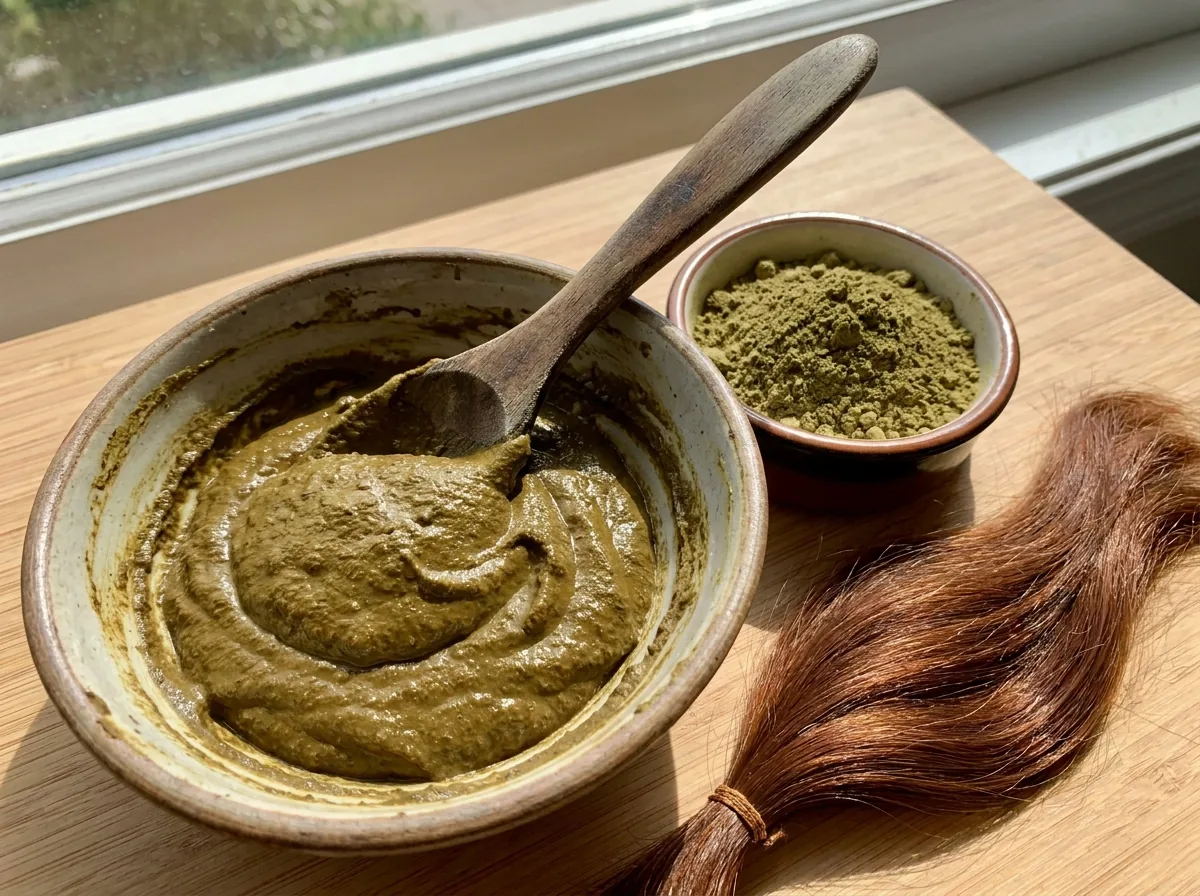
What you need
- 100 g (about 1 cup), for shoulder-length hair Pure henna powder (Lawsonia inermis)Ingredients list should say henna and nothing else. Body-art or "black henna" products are not the same thing
- About 200–250 ml (a scant cup), added a little at a time Warm water, or cooled black teaAim for a thick yoghurt texture, not runny. Tea is a common craft choice and is not needed
- 100 g, instead of or mixed with henna Cassia obovata powder (optional)Sometimes sold as neutral henna. Gives a pale golden tint on light hair, little on dark hair
- 50–100 g, after the henna step Indigo powder (Indigofera tinctoria) (for brown or black)Buy a powder labelled 100% indigo. Mix with warm water only, just before use
- About 500 ml (2 cups), cooled Strong black tea, coffee or walnut-hull tea (rinse only)For a subtle tint that builds over repeated rinses. See the note on evidence below
- 1 tbsp Coconut oilDab along the hairline and ears to reduce skin staining. Optional
Equipment
- Non-metallic bowl and spoon (glass, plastic or ceramic)
- Disposable gloves
- Old towel and old T-shirt (henna and indigo stain fabric)
- Clingfilm or a shower cap
- Tint brush or clean hands and clips for sectioning
Method
Buy the right powder and read the label
Choose powder whose ingredients list only henna (or only indigo, or only cassia). Avoid anything called "black henna", and be cautious with ready-mixed "black henna" hair colour, because black henna is henna with the dye PPD added.1,2,4
Patch-test first
Mix a teaspoon of paste, dab a small patch on your inner elbow, let it dry and wait 48 hours. Do the same again with every new packet, and dab a little on a hidden strand of hair too, to see the shade. Stop and skip the dye if you get itching, redness or swelling.1,3,5
Mix the henna and let the dye release
Put the powder in a non-metallic bowl and stir in warm water a little at a time to a thick, smooth paste. Cover it and leave at room temperature for 6 to 12 hours, until the surface darkens. This is ordinary craft practice, as the dye needs time to come out of the leaf.
Prepare your hair and skin
Start with clean, dry, product-free hair, and detangle it. Put on gloves and old clothes, and rub a little coconut oil along the hairline, ears and neck. Keep the paste out of your eyes, as hair dyes have caused eye injuries.1
Apply the henna
Work in sections from the roots outwards, coating each strand thickly, then pile the hair up and wrap in clingfilm or a shower cap. Leave it on for 2 to 4 hours: the longer, the deeper and redder the colour. Most people keep it warm, for instance under a towel.
Rinse, then wait
Rinse with lukewarm water until it runs clear, and condition if you like. Do not shampoo for the first 24 to 48 hours. The colour often looks orange at first and deepens over about two days. This is common craft experience, not something we could source.
For brown or black: the indigo step
Indigo is applied after the henna step, on dry or damp hair. Mix 50 to 100 g of indigo powder with warm water to a paste just before use (it loses strength quickly), apply it as in the previous step and leave it 1 to 2 hours, then rinse. Hair goes from the henna's red towards brown, and towards black with more indigo or a second round. Test on a strand first, since results depend on your starting colour.
Cassia for a golden tint
Mix cassia as you would henna, leave it 30 minutes to 2 hours and rinse. It gives only a pale golden tint, most visible on light or grey hair. We found no study of how cassia performs.
Tea, coffee or walnut rinses
Steep strong black tea, coffee or crushed walnut hulls in hot water, let the liquid cool, then pour it over clean hair and leave it for 15 to 30 minutes. Rinse gently. These give a subtle, temporary tint that fades with washing. Repeated rinses build it up slowly.
Safety
- Never use "black henna". It is henna with PPD added, which the FDA says can cause dangerous skin reactions and is not allowed in products for the skin2,4
- Black henna tattoos cause PPD allergy in an estimated 2.5% of people; once sensitised, you can react to PPD hair dyes and cross-react with other dyes4,1,3
- Patch-test every new product on skin 48 hours before use. Pure henna can rarely cause allergic dermatitis or immediate reactions too3,5,1
- Do not use henna on babies or children. In G6PD deficiency, henna on the skin has caused severe haemolysis, in newborns in one series of 154,6,7
- Keep dye away from eyes and never use it on eyebrows or eyelashes, as hair dyes have caused eye injuries, including blindness1
Variations
Rinse the henna, then apply indigo the same day rather than waiting. Many people do this for black; some wait a day so the henna sets. We found no study comparing timings.
For a lighter red tint, leave the henna on for 1 hour rather than 4. Shorter contact gives a subtler result on dark hair.
Use half cassia and half henna for a coppery blonde on light hair. Test a strand first.
Does it actually work?
Henna does colour hair: it stains it reddish-brown, and the FDA lists henna as approved for use on hair. Beyond that, we found no clinical trials of home henna, indigo, cassia or tea, coffee and walnut rinses for colour, so the timings, shades and how long they last come from ordinary craft experience and will vary with your hair. None of them lightens hair, and a rinse will only tint. The published research is mostly about harm: pure henna is generally safe with rare allergy, but reactions to pure henna are reported, and adulterated "black henna" is the real danger. We could not find a regulator or journal source on what happens if chemical dye or bleach goes on top of henna, so we say nothing about it. Tell your stylist you have used henna and test a strand first.2,4,5
Evidence ratings for what goes in: Coconut oil.
Questions people ask
Is henna safe to use on hair?
Pure henna powder is approved by the FDA for use on hair, and a review found it generally safe with rare allergy. Rare allergic reactions to pure henna are reported, so patch-test first. Avoid anything sold as black henna, which can contain PPD.
What is black henna and why is it dangerous?
Black henna is red henna with p-phenylenediamine (PPD) added to make it darker and faster. PPD can cause blistering and scarring, and once you are sensitised you can react to PPD hair dyes. The FDA and NHS both warn about it.
Can I use henna if I have G6PD deficiency?
Ask your doctor first. Case reports and a systematic review link henna to haemolysis in G6PD deficiency, especially in babies and children. We found no source on adults dyeing their hair, so we cannot say the risk is nil.
How do I get black hair with natural dye?
Use two steps: henna first for a red base, then indigo, which shifts it towards brown or black. The result depends on your starting colour, and you should test a strand. Do not use products sold as black henna.
How long does natural hair dye last?
Henna and indigo are usually described as long-lasting stains that grow out rather than wash out, while tea, coffee and walnut rinses fade within a few washes. We found no study measuring either, so treat this as craft experience.
Sources
- Regulator U.S. Food and Drug Administration. Hair Dyes.
- Regulator U.S. Food and Drug Administration. Temporary Tattoos, Henna/Mehndi, and "Black Henna": Fact Sheet.
- Health service NHS. Hair dye reactions.
- Review de Groot AC. Side-effects of henna and semi-permanent 'black henna' tattoos: a full review. Contact Dermatitis. 2013.
- Systematic review Ben Yahia M, et al. Allergic Contact Dermatitis to Pure Henna: A Systematic Review. Contact Dermatitis. 2026.
- Case series Kandil HH, et al. Henna (Lawsonia inermis Linn.) inducing haemolysis among G6PD-deficient newborns. A new clinical observation. Ann Trop Paediatr. 1996.
- Systematic review Lee SW, et al. Adverse effects of herbal or dietary supplements in G6PD deficiency: a systematic review. Br J Clin Pharmacol. 2017.
Educational only. Patch-test anything new on your skin, and stop if it irritates.