Standardised extracts, explained
Short answer
A standardised extract is an extract adjusted to a set amount of a marker compound, so that one batch matches the next for that marker. Trials usually test one named extract, and the result belongs to it: the lavender anxiety evidence is for Silexan, and St John’s wort extracts differ in hyperforin content[8][9]. But ‘standardised’ is not a quality guarantee[1], and a more concentrated extract can carry more risk, not less[2].
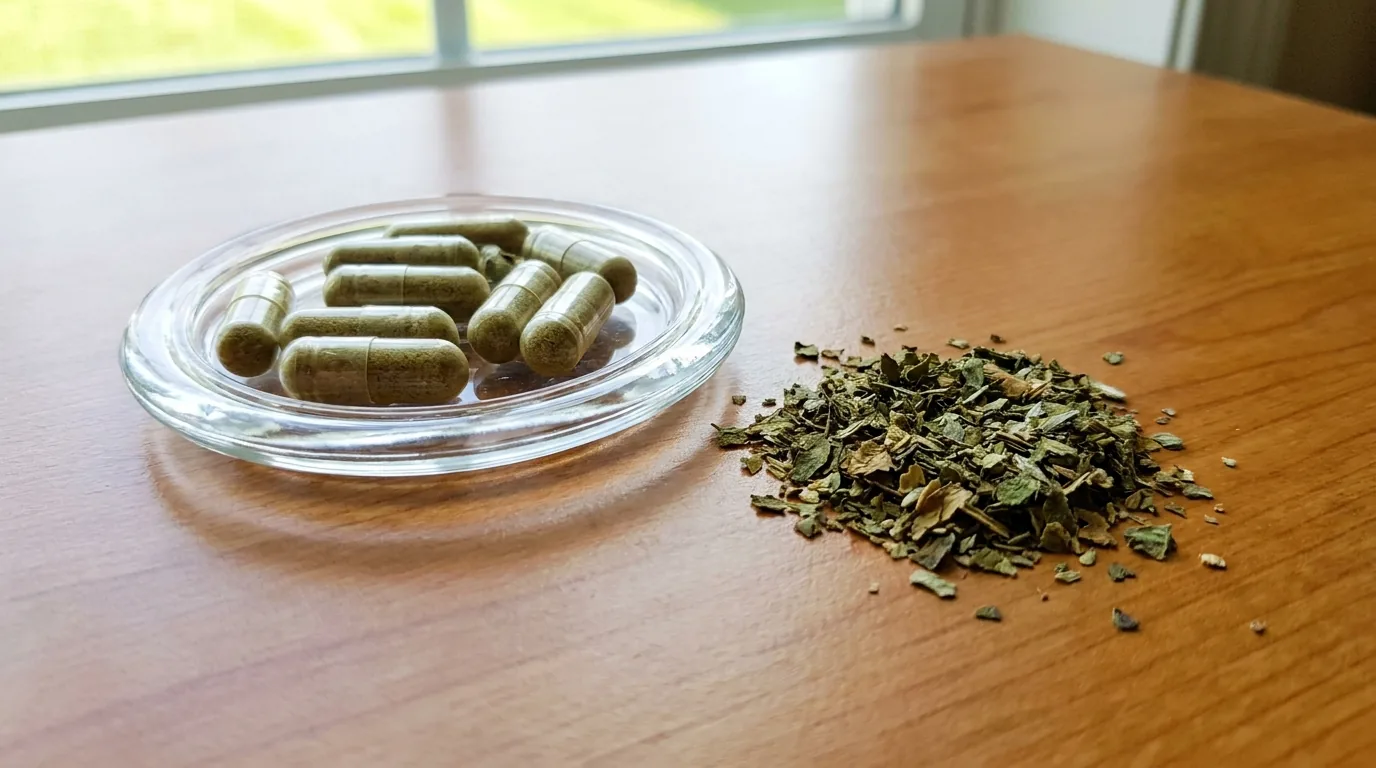
What ‘standardised’ means
A herb varies from plant to plant and harvest to harvest. An extract concentrates part of it using a solvent such as ethanol or acetone. Standardising goes one step further: the maker measures a chosen compound, the marker, and adjusts the extract so it contains a set amount or percentage of it. The aim is consistency between batches, so that capsule 1 and capsule 1,000 match for that marker.
That is different from an extract described only by its ratio, such as valerian’s 3–7.4:1 drug-to-extract ratio in the EU monograph[6], and different again from raw powder or tea. Our guide to reading supplement labels covers how to tell amount of extract, herb equivalent, ratio and marker apart on the bottle. This guide picks up from there: why it matters for evidence, and what it cannot promise.
Our ingredient entries do not always say which marker an extract was standardised to. Where they do not, this page says so rather than guess.
Why trial results belong to one extract
A trial tests one preparation at one dose. If it works, the honest reading is that that preparation worked. Lavender is the clearest case in our entries: in a 10-week trial of 539 adults with generalised anxiety disorder, Silexan 80 mg and 160 mg lowered anxiety scores by 12.8 and 14.1 points, against 9.5 for placebo[9]. The entry applies that to Silexan, not to other lavender oils, and notes that most of the key trials were industry linked[10].
St John’s wort shows a second reason. Extracts differ in hyperforin content, and the strength of the drug interactions tracks hyperforin[8]. So the extract affects safety as well as benefit. The same goes for ginkgo: the EU dose is for a specific dry extract (35–67:1, made with 60% acetone) and is not the same as raw leaf, tea or other extracts[5].
The same pattern appears for saffron, where the recent trials used a standardised stigma extract at 28–30 mg a day[11] and the entry notes that branded extracts differ and several trials were manufacturer funded[12]. Culinary saffron is a trace amount and not the studied dose.
Branded versus generic extracts
Some trial extracts are branded: Silexan for lavender, and SHR-5 for rhodiola, which our entry calls the branded extract used in the fatigue and depression trials[13][14] and warns that results from one extract may not carry over to other products. A branded extract gives you something specific to match, and a maker who has published the spec.
A generic product may be equally good, or not, and the trials cannot tell you which. That is not a criticism of generic products. It is a gap in the evidence, and it is why we rate the form that was tested. Funding matters as well: NCCIH says the lavender trials had small samples and no independent funding or testing[10]. That does not make the results wrong, but it is a reason to hold the rating at Moderate.
Extracts in our entries
What was studied, what it was standardised to where the entry says, and what the rating applies to.
| Herb | Extract studied | Standardised to | What the rating applies to |
|---|---|---|---|
| Lavender | Silexan, an oral lavender oil, 80 mg a day [9] | Described as a standardised oil; the entry does not give the marker | Moderate (3) for anxiety, for this oil only. Most key trials were industry linked [10] |
| Ginkgo | Standardised leaf extract, 120–240 mg a day [5] | EU dose is for a dry extract at a 35–67:1 ratio made with 60% acetone; the marker is not named in the entry [5] | Limited (2) for symptoms of dementia. The large prevention trial found no benefit [5] |
| St John's wort | Dry extract, 300–600 mg, 1–3 times a day [7] | Extracts differ in hyperforin content, and interaction strength tracks hyperforin [8] | Moderate (3) for mild to moderate depression, for extracts. Not shown for severe depression [7] |
| Valerian | Dry extract, 400–600 mg a dose (EU monograph) [6] | Ethanol extracts with a drug-to-extract ratio of 3–7.4:1; no marker named [6] | Limited (2) for sleep quality. The best-designed trials found no benefit [6] |
| Curcumin | Curcuminoid extracts; doses vary widely [2] | Products vary in curcumin content, and often add piperine [2] | Moderate (3) for knee osteoarthritis pain, from short, varied trials [2] |
| Green tea extract | Concentrated catechin extract; check the EGCG figure on the label [3] | Catechins, with EGCG as the figure to read; the studied range is wide [3] | Moderate (3) for a small fall in LDL cholesterol. Not shown for weight loss [3] |
What standardisation does not guarantee
- The marker is not necessarily the active compound. A marker is chosen because it can be measured. It shows the batch is consistent for that compound, not that the compound does the work. St John’s wort is an example in our entries where one constituent, hyperforin, tracks interaction strength[8].
- It is not a quality or safety guarantee. NCCIH says a manufacturer’s use of the term ‘standardized’ (or ‘verified’ or ‘certified’) does not necessarily guarantee product quality or consistency, and that what is on the label may not be what is in the product[1].
- More concentrated can mean more risk. For turmeric, NCCIH says highly bioavailable formulations of curcumin, which enhance absorption, may harm the liver, and that liver damage has been reported with them. It notes that combining curcumin with piperine is one way to improve bioavailability[2]. For green tea, NCCIH says liver injury has been reported primarily with extracts in tablet or capsule form[3], and EFSA found that 800 mg or more of EGCG a day raised liver enzymes in trials, while typical tea drinking supplies about 90–300 mg a day[4]. A cup of tea and a concentrated capsule are not the same exposure.
- Products vary. NCCIH says oral curcumin products vary in how much curcumin they contain, and often contain substances from other plants[2].
How to use this when you buy
- Find the extract on our ingredient page. The ‘forms’ and dosage sections name the extract and dose the evidence rating applies to.
- Compare your bottle with it. Is it an extract or a powder? Is the amount given as extract or as herb equivalent? For ginkgo, look for the extract ratio and solvent on the label[5]. For green tea, look for the EGCG figure[3].
- Ask the maker for the extract specification. A reputable maker can say what the extract is standardised to, the ratio and the solvent. If they cannot or will not, you cannot tell whether the trial applies.
- Do not take more because it says ‘concentrated’ or ‘high absorption’. Follow the studied dose, not a higher one.
- Show the bottle to a pharmacist if you take any medicine. This matters most for St John’s wort, which speeds the breakdown of many medicines[8]. Do not stop a prescribed medicine on your own.
A standardised extract is a description, not a verdict
The word tells you how the maker adjusted the extract. It does not tell you whether it works, whether it is safe, or whether it matches the extract in a trial. Our methodology explains how ratings are assigned, and Is a tea as effective as a capsule? covers the same form question for teas and tinctures.
Questions people ask
Is a standardised extract stronger than an ordinary one?
Not necessarily. Standardised means adjusted to a set amount of a marker compound, which makes batches more consistent for that marker. It says nothing on its own about how much is in a dose or whether the marker does the work. NCCIH says a manufacturer's use of the word "standardized" does not necessarily guarantee product quality or consistency [1].
If a trial used a branded extract, can I use a different brand?
You cannot assume the result carries over. Our lavender entry says the anxiety results apply to Silexan, not to other lavender oil products, and our St John's wort entry says extracts differ in hyperforin content, so products are not interchangeable [8][9]. A different product may still be fine, but the trial does not show it.
Is a more concentrated extract safer, or riskier?
Concentration is not a safety feature. For turmeric, NCCIH says highly bioavailable curcumin formulations may harm the liver, and that liver damage has been reported with them [2]. For green tea, NCCIH says liver injury has been reported mainly with tablet or capsule extracts, and EFSA found that 800 mg or more of EGCG a day raised liver enzymes in trials [3][4]. Tell a pharmacist or doctor about any concentrated extract you take.
Sources
- Regulator/health agency NCCIH. Using Dietary Supplements Wisely. National Center for Complementary and Integrative Health.
- Regulator/health agency NCCIH. Turmeric: Usefulness and Safety. National Center for Complementary and Integrative Health.
- Regulator/health agency NCCIH. Green Tea: Usefulness and Safety. National Center for Complementary and Integrative Health.
- Regulator opinion EFSA Panel on Food Additives and Nutrient Sources added to Food (ANS). Scientific opinion on the safety of green tea catechins. EFSA J. 2018.
- Regulator monograph European Medicines Agency HMPC. European Union herbal monograph on Ginkgo biloba L., folium (EMA/HMPC/321097/2012). 2015.
- Regulator monograph European Medicines Agency HMPC. European Union herbal monograph on Valeriana officinalis L., radix (EMA/HMPC/150848/2015). 2016.
- Regulator monograph European Medicines Agency HMPC. European Union herbal monograph on Hypericum perforatum L., herba, Final - Revision 1 (EMA/HMPC/7695/2021). 2022.
- Review Nicolussi S, Drewe J, Butterweck V, Meyer Zu Schwabedissen HE. Clinical relevance of St. John's wort drug interactions revisited. Br J Pharmacol. 2020.
- Randomised controlled trial Kasper S, Gastpar M, Müller WE, et al. Lavender oil preparation Silexan is effective in generalized anxiety disorder: a randomized, double-blind comparison to placebo and paroxetine. Int J Neuropsychopharmacol. 2014.
- Regulator/health agency NCCIH. Lavender: Usefulness and Safety. National Center for Complementary and Integrative Health.
- Meta-analysis Mahmoudi R, Mohammadi-Sartang M, Servatyari K, Rafieipour N. Effect of saffron on depression, anxiety and mood disorder: a GRADE assessed systematic review and meta-analysis of 34 randomized controlled trials. Nutr Neurosci. 2026.
- Randomised trial Schuster J, Mundhenke C, Nordsieck H, et al. Effect of a saffron extract on sleep quality in adults with moderate insomnia: a decentralized, randomized, double-blind, placebo-controlled trial. Sleep Med X. 2025.
- Randomised trial Olsson EM, von Schéele B, Panossian AG. A randomised, double-blind, placebo-controlled, parallel-group study of the standardised extract SHR-5 of the roots of Rhodiola rosea in the treatment of subjects with stress-related fatigue. Planta Med. 2009.
- Randomised trial Darbinyan V, Aslanyan G, Amroyan E, et al. Clinical trial of Rhodiola rosea L. extract SHR-5 in the treatment of mild to moderate depression. Nord J Psychiatry. 2007.
Draft, awaiting clinical review