
Titanium dioxide
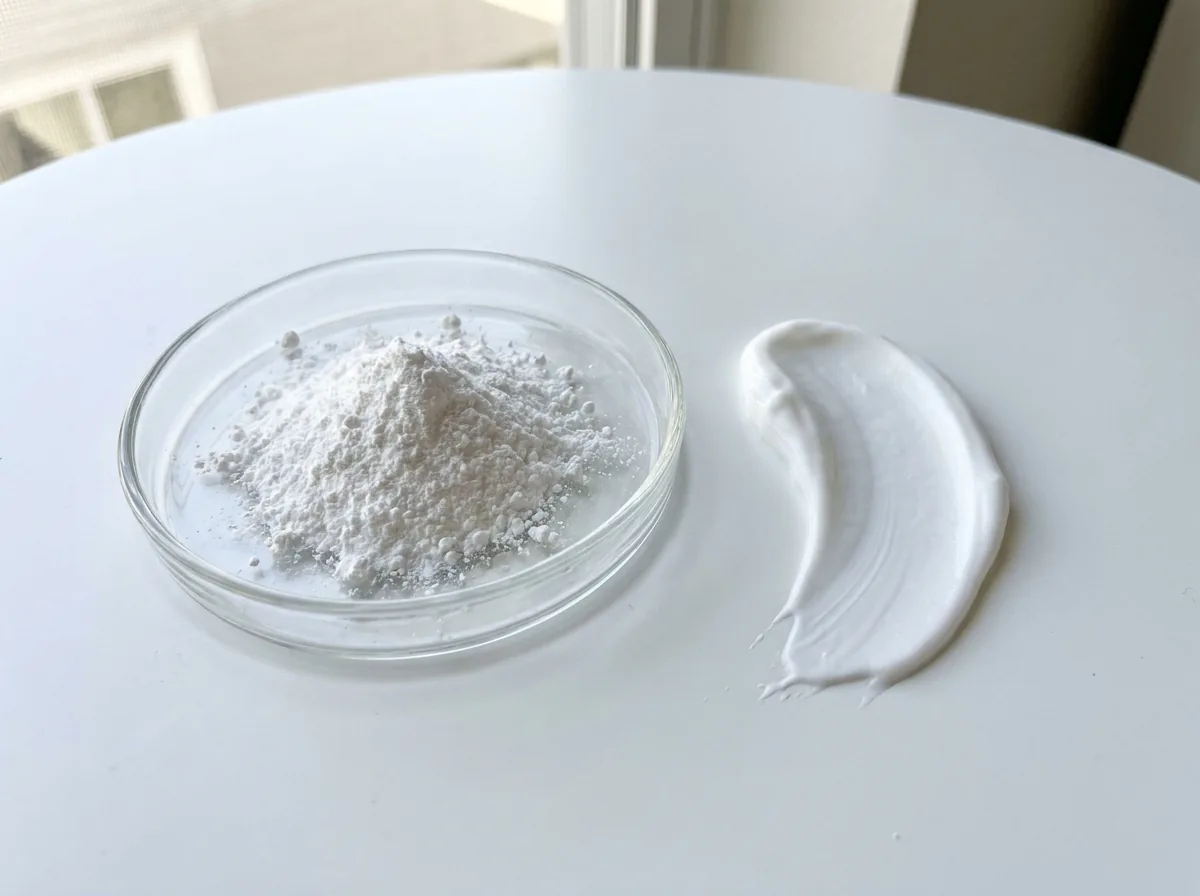
Titanium dioxide is a mineral UV filter that FDA proposed in 2019 to class as generally recognised as safe and effective (GRASE) in sunscreens at up to 25%, because it stays on the surface of the skin.
As a food whitener (E171) it is a different story: EFSA concluded in 2021 that it can no longer be considered safe because a genotoxicity concern could not be ruled out, and the EU has banned it in food since 2022, while US FDA still permits it up to 1% of a food. The one caution for sunscreen use is to avoid sprays and powders that can be breathed in.
At a glance
Last reviewed 10 October 2026What it's used for
Evidence is rated per use. The same ingredient can be strong for one thing and traditional for another.
| Use | Evidence | What the research shows |
|---|---|---|
| Sunscreen (broad-spectrum UV filter)Compare remedies for skin → | Moderate | In its 2019 proposed rule FDA proposed titanium dioxide as Category I (GRASE) at up to 25%, judging that its insolubility prevents absorption through skin beyond a de minimis amount. A 2019 review says nano-sized titanium dioxide is now the only form used as a UV filter in sunscreens, that most human and animal studies found it did not go past the outer skin layers, and that the EU's Scientific Committee on Consumer Safety found no health risk on skin at up to 25% but does not recommend it in sprays or powders that can reach the lungs (animals showed lung inflammation; human data are sparse). One of that review's authors works for a cosmetics company. The rule was a proposal, and we could not open a current FDA page confirming final status. There is no trial of titanium dioxide alone; the best sunscreen trial we found (903 adults, 4.5 years) tested broad-spectrum sunscreen of unspecified filter and found 24% less skin ageing with daily use (relative odds 0.76, 95% CI 0.59 to 0.98). We rate this 3 on the regulatory assessment plus that evidence.1,8,10 |
| Food colouring and whitener (E171), by mouth | Traditional | Not a health remedy: titanium dioxide gives no health benefit in food, so this row is here because people search for its safety. EFSA's 2021 opinion found general and organ toxicity studies showed no adverse effects up to 1,000 mg/kg body weight a day, and gut absorption of the particles is low but they may accumulate. It also concluded that the particles can cause DNA strand breaks and chromosomal damage in test systems, that a genotoxicity concern could not be ruled out, and that E171 can no longer be considered safe as a food additive. No study was available to assess carcinogenicity of the nanoparticles. The EU has prohibited E171 in food from August 2022 after a six-month transition; a 2025 review notes that other regulators have reviewed it and found insufficient evidence to justify a ban. We rate this 1 as a non-remedy.2,3,4,5 |
How much
Ranges below are what studies used and what supplements commonly contain. They are not a recommendation for you. Start at the low end.
How people take it
Safety
Who should avoid
- Sprays and powders — the EU safety committee advises against forms that can be inhaled
- Food containing E171 — EFSA says it can no longer be considered safe
- Loose-powder cosmetics containing it — same inhalation concern as sprays
Known interactions
Questions people ask
What are the side effects of titanium dioxide?
On skin, the studies we read found little: the EU's consumer safety committee rated nano-sized titanium dioxide a non-sensitiser and mild or non-irritant. The main concern is inhaling it from sprays and powders, where animal studies showed lung inflammation.
By mouth, EFSA could not rule out genotoxicity, meaning damage to DNA, which is why it no longer considers E171 safe in food.
What is titanium dioxide used for?
Mainly as a white pigment, in paint, cosmetics and, until it was banned in the EU, as the food additive E171. As a health product its use is as a UV filter in mineral sunscreens. FDA proposed it as GRASE in sunscreens at up to 25% in 2019.
Why is titanium dioxide banned in EU food but not in the US?
EFSA concluded in 2021 that it can no longer be considered safe as a food additive because genotoxicity could not be ruled out, and the EU prohibited it from August 2022.
The US FDA still lists titanium dioxide as a permitted food colour at up to 1% by weight; in 2023 it filed a petition from health and environmental groups asking it to repeal that listing, citing EFSA, and we found no published decision.
Is titanium dioxide in sunscreen safe?
The regulatory view is yes for lotions and creams: FDA proposed it as GRASE at up to 25%, and the EU committee found no health risk on skin at that level. Its advice against sprays and powders is about inhaling the particles.
Reviews say most of the particles stay on the outer skin layer, though a separate review notes conclusions on penetration into viable skin are mixed.
Make it yourself
DIY guides that use titanium dioxide, with quantities, safety notes and an honest word on what they do.
Sources (10)
- Regulator proposal US Food and Drug Administration. Sunscreen Drug Products for Over-the-Counter Human Use (proposed rule). Federal Register. 2019.
- Regulator opinion EFSA Panel on Food Additives and Flavourings (FAF). Safety assessment of titanium dioxide (E171) as a food additive. EFSA Journal. 2021.
- Regulator news release EFSA. Titanium dioxide: E171 no longer considered safe when used as a food additive. 6 May 2021.
- Review Pokharkar V, Chandak S, Pawar R, Khandke A. The implications of the EU ban on titanium dioxide: A comprehensive review of safety concerns and alternatives. Ann Pharm Fr. 2025.
- Review Dand C, Bajaj A, Wairkar S. EFSA prohibits titanium dioxide in food- should pharmaceuticals be next? Toxicology. 2025.
- Regulator notice US Food and Drug Administration. Filing of Color Additive Petition From Environmental Defense Fund, et al.; Request To Revoke Color Additive Listing for Use of Titanium Dioxide in Food. Federal Register. 2023.
- Regulation US Code of Federal Regulations. 21 CFR 73.575 Titanium dioxide. Listing of color additives exempt from certification.
- Review Dréno B, Alexis A, Chuberre B, Marinovich M. Safety of titanium dioxide nanoparticles in cosmetics. J Eur Acad Dermatol Venereol. 2019.
- Review Gulson B, McCall MJ, Bowman DM, Pinheiro T. A review of critical factors for assessing the dermal absorption of metal oxide nanoparticles from sunscreens applied to humans, and a research strategy to address current deficiencies. Arch Toxicol. 2015.
- Randomised controlled trial Hughes MC, Williams GM, Baker P, Green AC. Sunscreen and prevention of skin aging: a randomized trial. Ann Intern Med. 2013.
Last reviewed 10 October 2026 · Next review April 2027 · How we rate evidence
Reader notes
Experiences and questions from readers, read by an editor before they appear. They are personal accounts, not evidence, and are not medical advice.