
Oregano oil
There is very little evidence that oil of oregano works for anything in people: the best is one 40-person trial of an oregano extract ointment on surgical wounds, plus small or uncontrolled studies in gut infections, and its famous antibacterial effects come almost entirely from laboratory tests.
Oregano is safe in food amounts, but the essential oil irritates skin and eyes and must be diluted, should never be given to children, and has no safety data in pregnancy or breastfeeding. Anyone allergic to thyme, mint, sage or other mint-family herbs should avoid it.
At a glance
Last reviewed 10 October 2026What it's used for
Evidence is rated per use. The same ingredient can be strong for one thing and traditional for another.
| Use | Evidence | What the research shows |
|---|---|---|
| Healing small surgical wounds (ointment)Compare remedies for skin → | Limited | In a double-blind trial of 40 people after skin surgery, a 3% oregano extract ointment was compared with petroleum jelly. At day 12, 19% of wound cultures grew Staphylococcus aureus against 41% with petroleum jelly, and 1 person against 3 developed cellulitis; scar colour, pigmentation and pliability were a little better, and overall scar appearance was the same. It is a single small trial, and the abstract describes an oregano extract, not the essential oil sold in bottles.1 |
| Gut parasites such as Blastocystis (oral)Compare remedies for digestion → | Limited | In 14 adults whose stool tests showed parasites, 600 mg a day of emulsified oil of oregano for 6 weeks cleared Blastocystis hominis in 8 of 11 and the other two parasites in all 5 cases, and gut symptoms improved in 7 of the 11. There was no comparison group, so some of this may be natural clearance, and one author worked for Biotics Research Corporation, a supplement maker. We found no controlled trial.2 |
| Small intestinal bacterial overgrowth (SIBO), as part of a herbal blend | Limited | A look back through the records of 104 people at a US hospital clinic found that 17 of 37 (46%) taking 4 weeks of herbal capsules had a normal breath test afterwards, against 23 of 67 (34%) on the antibiotic rifaximin, a difference that was not statistically significant. Patients chose their own treatment, and the capsules were commercial blends of several herbs, one listing 0.1 mL of oregano oil per capsule, so the result cannot be credited to oregano. The authors call for proper prospective trials.3 |
| Sore throat, hoarseness and cough with a cold (spray blend)Compare remedies for coughs & colds → | Limited | In a double-blind trial of 60 people with upper respiratory infections, a throat spray of five essential oils (30% of the blend was Syrian oregano, Origanum syriacum, with eucalyptus, peppermint and rosemary) helped 73% within 20 minutes against 41% on placebo spray. After 3 days the difference (72% against 59%) was no longer significant. NCCIH says there is no strong evidence that oil of oregano on its own prevents or treats colds.4,5 |
| Infections generally ('natural antibiotic', thrush, Candida) | Traditional | Oregano has a record of traditional use for respiratory and digestive complaints and as an antimicrobial, but we found no controlled trial showing that oral oregano oil treats an infection in people. The killing of bacteria and fungi that is widely quoted comes from test tubes and animals, which cannot tell you whether a capsule works in the body. LactMed notes that oregano oil is promoted for thrush of the nipples while breastfeeding, but no clinical study has confirmed it works or is safe.6 |
How much
Ranges below are what studies used and what supplements commonly contain. They are not a recommendation for you. Start at the low end.
How people take it
Safety
Who should avoid
- Children and infants — essential oils are poisonous if swallowed; keep locked away
- Undiluted oil on skin, near eyes or on broken skin — irritant and possible sensitiser
- Allergy to thyme, marjoram, sage, mint or other mint-family herbs — cross-reactions reported
- Pregnancy — we found no safety data for medicinal doses
- Breastfeeding — no data; LactMed advises food amounts only
- Taking warfarin-type blood thinners — INR rose in one reported case, ask first
Known interactions
Questions people ask
Is oil of oregano a natural antibiotic?
Not on the evidence in people. Oregano oil and its main component, carvacrol, kill bacteria and fungi in laboratory tests, but we found no controlled trial showing that an oral oregano oil supplement treats an infection. Do not use it in place of an antibiotic you have been prescribed without talking to your doctor.
Is homemade oregano oil the same as oregano essential oil or an oil of oregano supplement?
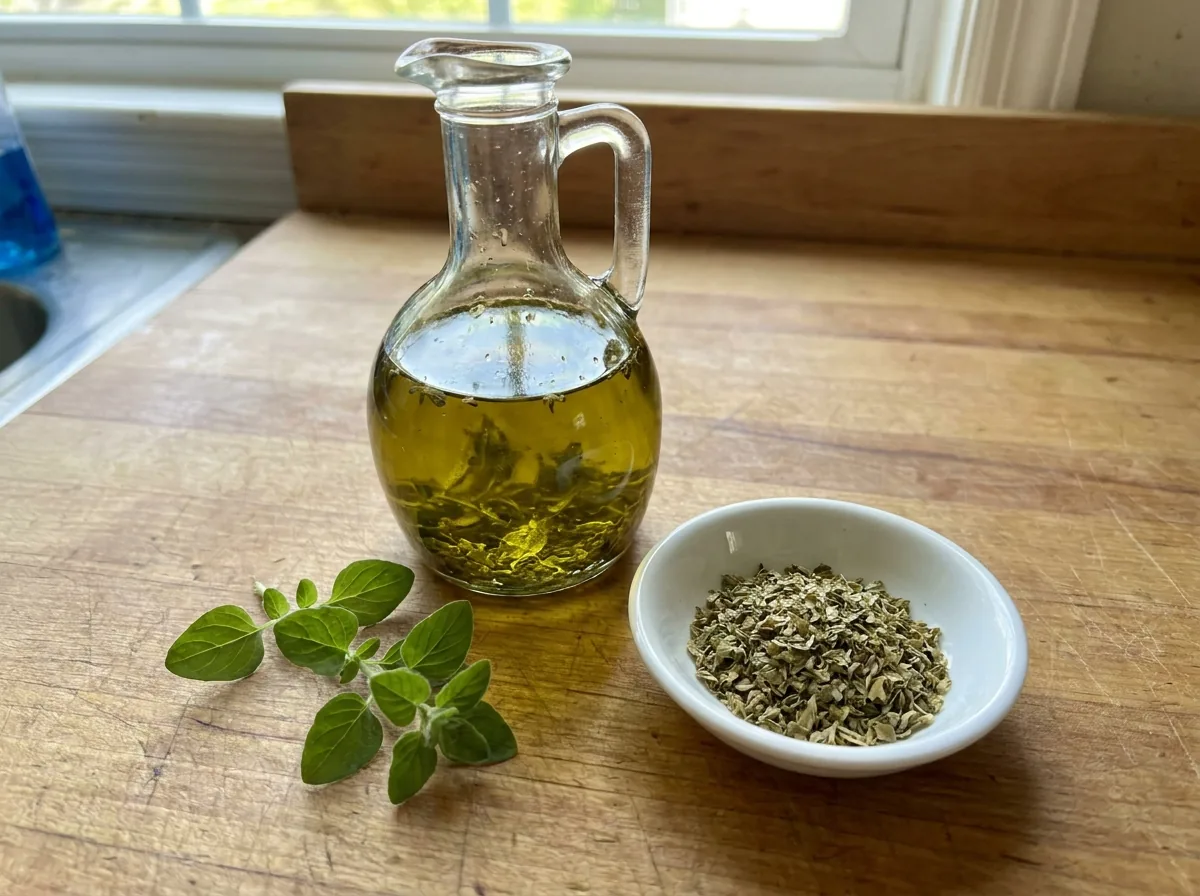
No. Homemade oregano oil is dried oregano steeped in a cooking oil, so it is an infusion with an unknown and probably small amount of the plant's volatile compounds.
Essential oil is steam-distilled and highly concentrated (the oil an EU panel assessed was 78% carvacrol), and oral supplements are usually essential oil diluted in a carrier oil. None of the studies here tested a homemade infusion, so their results do not carry over to it.
Can I put oregano oil on my skin?
Only well diluted in a carrier oil, after testing a small area, and never on broken skin or near the eyes. An EU safety panel classes the essential oil as a skin and eye irritant and a possible skin sensitiser, and people allergic to thyme or other mint-family herbs can react to oregano.
The one wound trial used a 3% oregano extract ointment, not neat oil.
Does oil of oregano help with colds?
There is no good evidence that it does on its own; NCCIH says no strong evidence supports it for preventing or treating colds. A throat spray that mixed oregano with four other essential oils eased sore throat or cough within 20 minutes in one trial, but the benefit had faded by day 3.
Make it yourself
DIY guides that use oregano oil, with quantities, safety notes and an honest word on what they do.
Sources (10)
- Randomised controlled trial Ragi J, Pappert A, Rao B, Havkin-Frenkel D, Milgraum S. Oregano extract ointment for wound healing: a randomized, double-blind, petrolatum-controlled study evaluating efficacy. J Drugs Dermatol. 2011.
- Uncontrolled study Force M, Sparks WS, Ronzio RA. Inhibition of enteric parasites by emulsified oil of oregano in vivo. Phytother Res. 2000.
- Retrospective study Chedid V, Dhalla S, Clarke JO, et al. Herbal therapy is equivalent to rifaximin for the treatment of small intestinal bacterial overgrowth. Glob Adv Health Med. 2014.
- Randomised controlled trial Ben-Arye E, Dudai N, Eini A, Torem M, Schiff E, Rakover Y. Treatment of upper respiratory tract infections in primary care: a randomized study using aromatic herbs. Evid Based Complement Alternat Med. 2011.
- Regulator/health agency National Center for Complementary and Integrative Health. Travel-Related Ailments and Complementary Health Approaches: What the Science Says (Clinical Digest). 2024.
- Regulator/health agency Drugs and Lactation Database (LactMed), National Institute of Child Health and Human Development. Oregano. Updated 2024.
- Regulator opinion EFSA Panel on Additives and Products or Substances used in Animal Feed (FEEDAP). Safety and efficacy of an essential oil from Origanum vulgare ssp. hirtum (Link) Ietsw. for all animal species. EFSA J. 2019.
- Poison centre National Capital Poison Center (Poison Control). Essential oils: Poisonous when misused.
- Case report Benito M, Jorro G, Morales C, Peláez A, Fernández A. Labiatae allergy: systemic reactions due to ingestion of oregano and thyme. Ann Allergy Asthma Immunol. 1996.
- Case report Beghriche I, Belhachem A, Hamidene I, Fendri AH. Origanum vulgare and hemorrhagic risk, about a case. Ann Cardiol Angeiol (Paris). 2025.
Last reviewed 10 October 2026 · Next review April 2027 · How we rate evidence
Reader notes
Experiences and questions from readers, read by an editor before they appear. They are personal accounts, not evidence, and are not medical advice.