
How to Make Oregano Oil at Home (Infused Oil)
Homemade oregano oil is dried oregano steeped in a carrier oil such as olive oil, poured over at 82°C (180°F) and left to cool for a few hours. Use dried oregano, keep the oil in the fridge and use it within 4 days, because herbs in oil can support botulism bacteria. It is a flavoured cooking or massage oil, not the concentrated essential oil or the 'oil of oregano' sold as a supplement, and lab results for carvacrol do not apply to it.
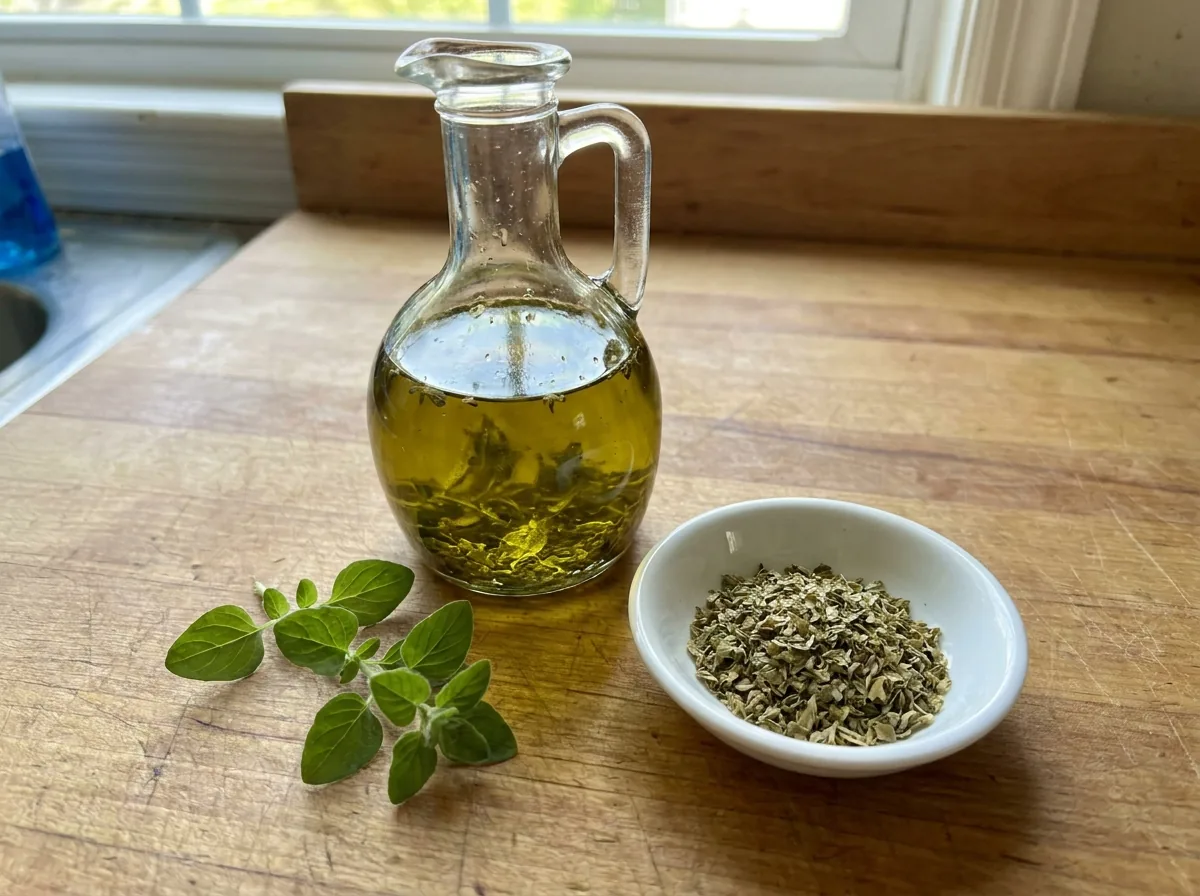
Ingredients
- 3 tbsp (about 5 g) Dried oreganoDried, not fresh: the water in fresh leaves is what makes herbs in oil risky. Rub it between your palms to release the aroma
- 1 cup (240 ml) Olive oilExtra virgin for cooking and dressings, or a lighter olive oil for a milder flavour
- 1 cup (240 ml) Sunflower or other neutral oilAlternative carrier if you want the oregano to dominate. Use one carrier oil, not both
Equipment
- Clean glass jar with a lid, boiled for 10 minutes and dried
- Small saucepan and a cooking thermometer
- Fine sieve or muslin (cheesecloth)
- Small clean bottle (dark glass if you have one)
- Label and pen for the date
Method
Sterilise the jar and bottle
Wash the jar, lid and bottle, boil them for 10 minutes and let them air-dry completely. Wet glass adds water, which is exactly what you are trying to keep out.3
Put the dried oregano in the jar
Add 3 tbsp (about 5 g) of dried oregano to the jar and crush it lightly with the back of a spoon. Check it is crisp and dry; dried herbs can still hold small pockets of moisture.3
Heat the oil to 82°C (180°F)
Warm 1 cup (240 ml) of olive oil in a small pan until a thermometer reads 82°C (180°F), and no hotter. Both extension services use this temperature for infusing oil.3,4
Pour, seal and cool
Pour the hot oil over the oregano, leaving about 1 cm (half an inch) of space at the top, and cap the jar. Tip it on its side for at least 5 minutes so the hot oil reaches the lid, then stand it upright and leave it to cool, about 2 to 3 hours.4
Strain and bottle
Strain through a sieve lined with muslin into the clean bottle, pressing the leaves gently. Throw the used oregano away.
Label, refrigerate and use within 4 days
Write the date on the bottle and put it in the fridge straight away. The University of Georgia advises refrigerating oils infused with dried or fresh herbs and heat, and discarding them 4 days after making, or freezing them. University of Maine allows up to 3 months in a cool, dark place for dried herbs; we follow the stricter advice, so make small batches.3,4
Use it
Drizzle it over pizza, bread, roasted vegetables or salads. Olive oil turns cloudy or thick in the fridge, so let the bottle stand for a few minutes before pouring. If it smells sour or looks cloudy at room temperature, or shows bubbles or mould, throw it away.
For massage, patch-test first
If you want to use it on skin, rub a little on your inner forearm and wait 24 hours. Oregano can cause allergic skin reactions in a few people; stop if you get redness, itching or a rash.5,7
Safety
- Use dried oregano. Herbs in oil can carry Clostridium botulinum spores, and oil plus moisture is the oxygen-free setting where they make toxin3,4
- Keep the oil in the fridge and discard it after 4 days, or freeze it. Don't keep this oil at room temperature3
- Oregano essential oil is far stronger than this infusion. Never put it on skin undiluted; it has caused irritant contact dermatitis6
- Oregano is in the mint family (Lamiaceae). If you react to thyme, basil, sage, mint or marjoram, avoid it or ask an allergist first5
- Keep concentrated oregano oils away from babies. While pregnant or breastfeeding, stick to food amounts: there are no safety data for more7
Variations
Add 1 tsp of dried chilli flakes with the oregano for a pizza oil. Use dried flakes only, for the same reason as the oregano, and keep it in the fridge.
Add 1 tsp of dried garlic granules. Fresh garlic is the classic cause of botulism in home oils, so leave it out unless you follow a tested acidification method.
Does it actually work?
As a flavoured oil, yes: it tastes of oregano. Claims that homemade oregano oil fights infections borrow from lab research on carvacrol, a compound concentrated in oregano essential oil, which kills bacteria such as E. coli and Salmonella in test tubes and foods.
Human trials of carvacrol are still lacking, and no study has tested a kitchen infusion, so it is not known how much carvacrol it contains. Its antimicrobial reputation does not protect it from botulism either: the extension services treat oregano like any other herb in oil. Our /ingredients/oregano-oil/ entry covers the evidence for the essential oil and supplements.1,2,3
Evidence ratings for what goes in: Oregano oil, Olive oil.
Questions people ask
Is homemade oregano oil the same as oil of oregano?
No. Homemade oregano oil is dried oregano steeped in olive oil, so it is a flavoured cooking oil. Oil of oregano supplements and oregano essential oil are concentrated, usually steam-distilled, and are much stronger. The lab studies on carvacrol were done with the concentrated oil or the pure compound, not with infusions.
Can I make oregano oil with fresh oregano?
We advise against it for a simple recipe. Fresh herbs add water, and herbs in oil are a known route to botulism. The University of Georgia gives a tested method that first soaks fresh herbs, including oregano, in a citric acid solution for 24 hours; otherwise use dried oregano and keep the oil in the fridge for no more than 4 days.
How long does homemade oregano oil last?
The University of Georgia says to refrigerate a heat-infused herb oil and throw it away after 4 days, or freeze it. University of Maine allows up to 3 months in a cool, dark place for dried herbs. Both are written for oils for eating, and we suggest the shorter limit.
Can I take homemade oregano oil for a cold or infection?
There is no evidence that it helps. Carvacrol's antibacterial effects come from lab and animal studies, and human trials are lacking. If you think you have an infection, see a doctor or pharmacist rather than relying on an oil.
Can I use oregano oil on my skin?
A home infusion is mild, but patch-test it on your inner arm for 24 hours first, and avoid it if you are allergic to mint-family herbs. Never apply oregano essential oil undiluted: it has caused irritant contact dermatitis.
Sources (7)
- Review Sharifi-Rad M, Varoni EM, Iriti M, et al. Carvacrol and human health: A comprehensive review. Phytother Res. 2018.
- Review Friedman M. Chemistry and multibeneficial bioactivities of carvacrol (4-isopropyl-2-methylphenol), a component of essential oils produced by aromatic plants and spices. J Agric Food Chem. 2014.
- University extension Schwan CL. How to Safely Make Infused Oils: Best Practices for Food Safety. University of Georgia Cooperative Extension Circular 1334. 2024.
- University extension University of Maine Cooperative Extension. Bulletin #4385, Safe Homemade Flavored and Infused Oils.
- Case report Benito M, Jorro G, Morales C, Peláez A, Fernández A. Labiatae allergy: systemic reactions due to ingestion of oregano and thyme. Ann Allergy Asthma Immunol. 1996.
- Case report Lauriola MM, Sena P, De Bitonto A, Corazza M. Irritant contact dermatitis after a curious therapeutic use of oregano essential oil. Contact Dermatitis. 2020.
- Government database Drugs and Lactation Database (LactMed). Oregano. National Institute of Child Health and Human Development. Updated 2024.
Educational only. Patch-test anything new on your skin, and stop if it irritates.
Reader notes
Experiences and questions from readers, read by an editor before they appear. They are personal accounts, not evidence, and are not medical advice.