
Liquorice root
Liquorice root has limited evidence for indigestion and heartburn: the trials that exist tested a proprietary deglycyrrhizinated (DGL) extract, are small and have not been repeated by independent groups. Ordinary liquorice that still contains glycyrrhizin is a different matter, because it can raise blood pressure and lower potassium at low daily intakes and has caused dangerous heart rhythm problems.
If you have high blood pressure, heart, kidney or liver disease, or are pregnant, avoid glycyrrhizin-containing liquorice, and check the label for "deglycyrrhizinated" before buying.
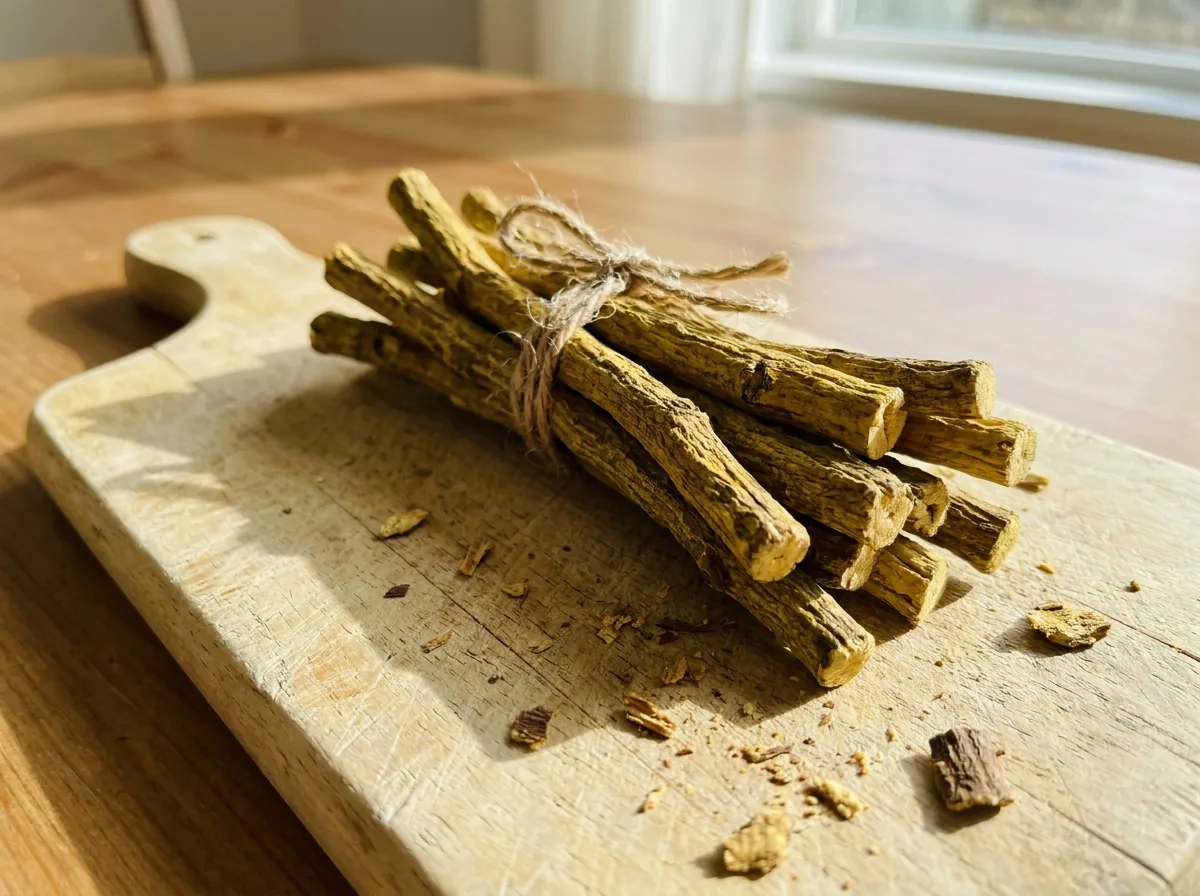
At a glance
Last reviewed 10 October 2026What it's used for
Evidence is rated per use. The same ingredient can be strong for one thing and traditional for another.
| Use | Evidence | What the research shows |
|---|---|---|
| Functional indigestion (dyspepsia)Compare remedies for digestion → | Limited | One randomised placebo-controlled trial of 50 people with functional dyspepsia found that a Glycyrrhiza glabra extract (75 mg twice daily for 30 days) reduced total symptom scores at days 15 and 30 compared with placebo. The 2023 Cochrane review of non-Chinese herbal medicines rated this single-study result as moderate-certainty, but a single small trial cannot settle the question. NCCIH says it is unclear whether liquorice alone has an effect on digestive symptoms.1,2,7 |
| Heartburn and reflux symptomsCompare remedies for acid reflux & heartburn → | Limited | One 200-person, 28-day placebo-controlled trial of a deglycyrrhizinated extract (glycyrrhizin 3% or less) reported earlier relief of heartburn and regurgitation, and better reflux-related quality of life, than placebo. It is a single-centre trial of one branded extract and we found no independent replication.3 |
| Cough with a coldCompare remedies for coughs & colds → | Traditional | The EU herbal regulator lists liquorice root as a traditional expectorant for cough with a cold, and for digestive burning and dyspepsia, on the basis of long-standing use alone, not clinical trials. We did not find or review modern cough trials.6 |
| Recurrent mouth ulcers (rinse or gargle) | Limited | NCCIH reports that a liquorice mouth rinse or gargle might reduce ulcer size and pain in recurrent canker sores, but states there is not enough high-quality evidence to support liquorice for any health condition. We did not read the individual trials, so this rests on NCCIH's summary.7 |
How much
Ranges below are what studies used and what supplements commonly contain. They are not a recommendation for you. Start at the low end.
How people take it
Safety
Who should avoid
- High blood pressure, heart, kidney or liver disease — EU regulator advises against
- Low potassium — glycyrrhizin lowers it further
- Pregnancy — EU regulator advises against; heavy intake linked to earlier birth
- Breastfeeding — EU regulator advises against, effect on infants unknown
- Under 18 — not established, too little data
- With diuretics, digoxin, corticosteroids or stimulant laxatives — EU regulator advises against
- Long-term use — EU limit is 4 weeks for digestive symptoms
- High salt intake — even small amounts of glycyrrhizin linked to serious effects (NCCIH)
Known interactions
Questions people ask
What is the difference between DGL and ordinary liquorice?
DGL is deglycyrrhizinated: most of the glycyrrhizin has been removed. Glycyrrhizin is the compound that raises blood pressure and lowers potassium. NCCIH says DGL products might be safe for up to 4 months, whereas glycyrrhizin-containing products have caused serious effects, so check the label.
Does liquorice work for acid reflux or indigestion?
There is limited evidence. One 50-person trial and one 200-person trial of a DGL extract found better symptoms than placebo over 4 weeks or so, but they are small, short and not independently replicated. NCCIH says it is unclear whether liquorice alone helps digestive symptoms.
How much liquorice is too much?
There is no reliably safe amount for everyone. In one trial, 100 mg of glycyrrhizic acid a day, the level once thought unlikely to cause harm, raised blood pressure within 2 weeks in healthy young adults.
NCCIH says even small amounts have been linked to severe effects in people who eat a lot of salt or who have high blood pressure, heart or kidney conditions.
Is liquorice safe in pregnancy?
The EU regulator advises against it. In a Finnish study of 1,049 women, heavy glycyrrhizin intake (500 mg a week or more) was linked to a higher chance of birth before 38 weeks (odds ratio 2.5). NCCIH gives about 250 g of liquorice a week as an unsafe amount.
Sources (8)
- Systematic review Báez G, Vargas C, Arancibia M, Papuzinski C, Franco JV. Non-Chinese herbal medicines for functional dyspepsia. Cochrane Database Syst Rev. 2023.
- RCT Raveendra KR, et al. An Extract of Glycyrrhiza glabra (GutGard) Alleviates Symptoms of Functional Dyspepsia: A Randomized, Double-Blind, Placebo-Controlled Study. Evid Based Complement Alternat Med. 2012.
- RCT Raj JP, Saxena U, Belhekar MN, Mamde A, Darak H, Pawar S. Efficacy and Safety of GutGard in Managing Gastroesophageal Reflux-Related Symptoms: A Phase III, Single-Centre, Double-Blind, Randomized Placebo-Controlled Trial. Complement Med Res. 2025.
- Systematic review Penninkilampi R, Eslick EM, Eslick GD. The association between consistent licorice ingestion, hypertension and hypokalaemia: a systematic review and meta-analysis. J Hum Hypertens. 2017.
- RCT Af Geijerstam P, Joelsson A, Rådholm K, Nyström FH. A low dose of daily licorice intake affects renin, aldosterone, and home blood pressure in a randomized crossover trial. Am J Clin Nutr. 2024.
- Regulator monograph European Medicines Agency HMPC. European Union herbal monograph on Glycyrrhiza glabra L.; Glycyrrhiza inflata Bat.; Glycyrrhiza uralensis Fisch., radix (EMA/HMPC/108399/2024). Final, revision 1, 2026.
- Regulator/health agency NCCIH. Licorice Root: Usefulness and Safety. National Center for Complementary and Integrative Health (last updated April 2025).
- Cohort study Strandberg TE, Järvenpää AL, Vanhanen H, McKeigue PM. Birth outcome in relation to licorice consumption during pregnancy. Am J Epidemiol. 2001.
Last reviewed 10 October 2026 · Next review April 2027 · How we rate evidence
Reader notes
Experiences and questions from readers, read by an editor before they appear. They are personal accounts, not evidence, and are not medical advice.