
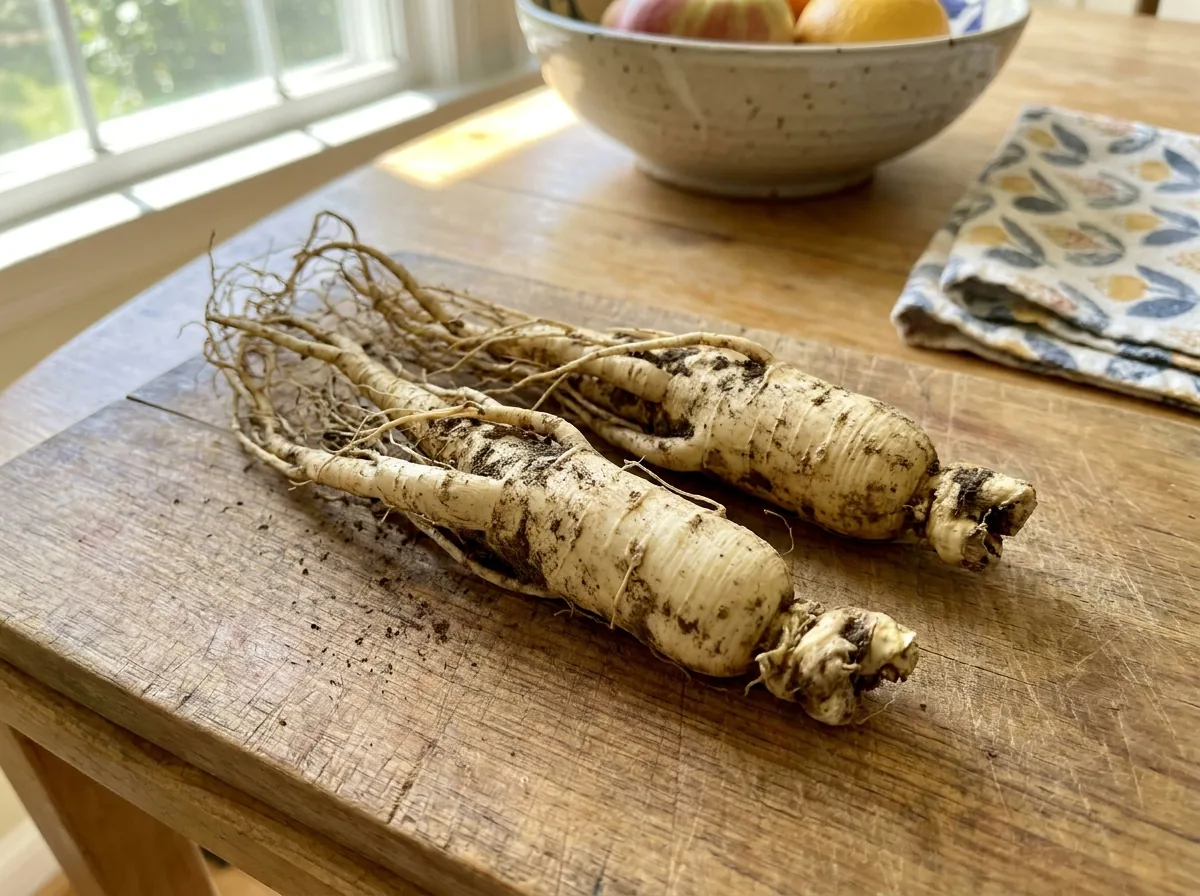
Ginseng
Ginseng has small, inconsistent effects in trials: a 2023 meta-analysis found no significant overall reduction in fatigue, and reviews of cognition, blood sugar and erectile dysfunction find modest or trivial benefits at best.
Short-term oral use appears safe for most adults, and insomnia is the most common side effect. The main caution is that it may lower blood sugar and, in one trial, weakened the effect of warfarin, so anyone on diabetes medication or warfarin should ask a clinician first.
At a glance
Last reviewed 10 October 2026What it's used for
Evidence is rated per use. The same ingredient can be strong for one thing and traditional for another.
| Use | Evidence | What the research shows |
|---|---|---|
| General fatigueCompare remedies for energy and fatigue → | Limited | A meta-analysis of 19 randomised trials found no significant overall reduction in fatigue (SMD −0.36, 95% CI −0.82 to 0.11). Subgroups did better: general, non-disease fatigue improved (SMD −0.48, 95% CI −0.71 to −0.25) and ginseng herbal formulas helped chronic fatigue (SMD −0.30), with small effect sizes. The pooled trials mix ginseng types and products, so the result does not apply to one preparation.2,7 |
| Memory and cognitionCompare remedies for focus and concentration → | Limited | A 2024 meta-analysis of 15 trials (671 people, mixed healthy and clinical groups) found a small memory gain (SMD 0.19, 95% CI 0.02 to 0.36), larger at high doses, but no benefit for overall cognition, attention or executive function. NCCIH says any cognitive benefit is preliminary and seen in middle-aged adults, not young adults.3,7 |
| Fasting blood sugarCompare remedies for blood sugar → | Limited | A meta-analysis of 16 trials of Panax ginseng and related species found fasting glucose fell by 0.31 mmol/L (95% CI −0.59 to −0.03) in people with and without diabetes. Fasting insulin, HbA1c and insulin resistance did not change overall, most trials lasted under 12 weeks, and NCCIH calls the evidence in diabetes inconclusive.4,7 |
| Erectile dysfunctionCompare remedies for men’s health → | Limited | A 2021 Cochrane review of 9 placebo-controlled trials (587 men, up to 12 weeks, eight testing Korean red ginseng) found a mean 3.5-point gain on the 30-point IIEF erectile function score (95% CI 1.79 to 5.25), below the 4-point threshold the reviewers treated as clinically meaningful. Men were more likely to report being able to have intercourse (RR 2.55), but the certainty was low and there were no comparisons with standard drugs such as sildenafil.1 |
| Tiredness and weakness (traditional use) | Traditional | The EU herbal regulator's monograph lists Panax ginseng root as a traditional herbal medicine for symptoms of asthenia such as fatigue and weakness, on the basis of long-standing use alone, not clinical proof.8 |
How much
Ranges below are what studies used and what supplements commonly contain. They are not a recommendation for you. Start at the low end.
How people take it
Safety
Who should avoid
- Pregnancy and breastfeeding — safety not established, EU regulator advises against
- Children and adolescents under 18 — not recommended, too little data
- Diabetes treated with medication — may lower blood sugar, check with a clinician
- Warfarin or other blood thinners — mixed evidence of an effect on clotting
- Autoimmune disorders — NCCIH says it may worsen them
- Sleep problems — insomnia is the most common side effect
- Known allergy to ginseng
Known interactions
Questions people ask
Does ginseng work for fatigue?
Only weakly. A 2023 meta-analysis of 19 trials found no significant overall reduction in fatigue, though non-disease fatigue and chronic fatigue subgroups improved slightly. Effects were small and the trials mixed different ginseng products.
What is the difference between Asian and American ginseng?
They are different species: Asian or Korean ginseng is Panax ginseng, American ginseng is Panax quinquefolius.
Most of the evidence here is for P. ginseng, especially Korean red ginseng; the only American ginseng evidence we cite is a warfarin interaction trial, so the fatigue, cognition, blood sugar and erectile results should not be assumed to carry over.
Does ginseng help erectile dysfunction?
It may help slightly. A 2021 Cochrane review found a 3.5-point improvement on a 30-point scale, below the threshold the authors treated as meaningful, and low-certainty evidence that men more often reported being able to have intercourse. It was not compared with standard drugs.
Is it safe with warfarin or diabetes medication?
Ask a clinician first. One trial found American ginseng weakened warfarin's effect and another found Panax ginseng did not, and NCCIH says ginseng may lower blood sugar. Do not start or stop a prescription because of this.
Sources (8)
- Cochrane review Lee HW, Lee MS, Kim TH, Alraek T, Zaslawski C, Kim JW, Moon DG. Ginseng for erectile dysfunction. Cochrane Database Syst Rev. 2021.
- Meta-analysis Li X, Yang M, Zhang YL, Hou YN, Smith CM, Korenstein D, Mao JJ. Ginseng and Ginseng Herbal Formulas for Symptomatic Management of Fatigue: A Systematic Review and Meta-Analysis. J Integr Complement Med. 2023.
- Meta-analysis Zeng M, Zhang K, Yang J, Zhang Y, You P, Yan L, Weng Y. Effects of Ginseng on Cognitive Function: A Systematic Review and Meta-Analysis. Phytother Res. 2024.
- Meta-analysis Shishtar E, Sievenpiper JL, Djedovic V, et al. The effect of ginseng (the genus panax) on glycemic control: a systematic review and meta-analysis of randomized controlled clinical trials. PLoS One. 2014.
- Randomised trial Yuan CS, Wei G, Dey L, et al. Brief communication: American ginseng reduces warfarin's effect in healthy patients: a randomized, controlled trial. Ann Intern Med. 2004.
- Randomised trial Lee SH, Ahn YM, Ahn SY, Doo HK, Lee BC. Interaction between warfarin and Panax ginseng in ischemic stroke patients. J Altern Complement Med. 2008.
- Regulator/health agency NCCIH. Asian Ginseng: Usefulness and Safety. National Center for Complementary and Integrative Health (last updated February 2025).
- Regulator monograph European Medicines Agency HMPC. Community herbal monograph on Panax ginseng C.A. Meyer, radix (EMA/HMPC/321233/2012 Corr. 1). 2014 (now marked superseded).
Last reviewed 10 October 2026 · Next review April 2027 · How we rate evidence
Reader notes
Experiences and questions from readers, read by an editor before they appear. They are personal accounts, not evidence, and are not medical advice.