Awaiting clinical review. This entry is sourced but has not yet been signed off by a pharmacist or clinician.
Guarana
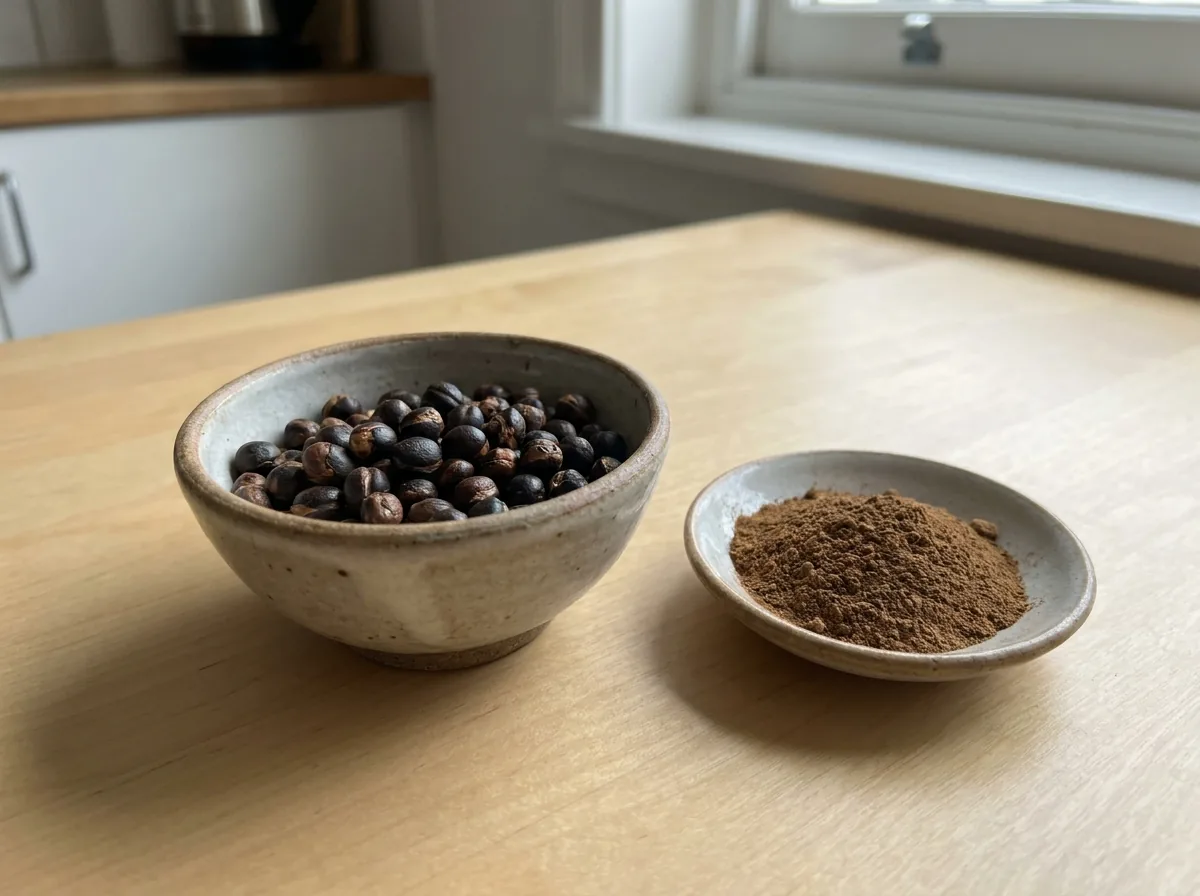
Guarana is a caffeine-rich seed, and whatever alertness it gives you is most likely the caffeine. A 2023 meta-analysis found only a small speed-up in response time and no change in accuracy, and guarana did not beat placebo for cancer-related fatigue. The main caution is hidden caffeine: labels can be vague, so add it to your daily total (EFSA's no-concern level for healthy adults is 400 mg a day from all sources).
At a glance
Last reviewed 29 September 2026What it's used for
Evidence is rated per use. The same ingredient can be strong for one thing and traditional for another.
| Use | Evidence | What the research shows |
|---|---|---|
| Cognitive performance (reaction speed) | Limited | A meta-analysis of eight placebo-controlled trials (328 people, single doses of 37.5–500 mg guarana) found a trivial overall effect (Hedges' g 0.076, p = 0.14). Response times were slightly faster (g 0.202, p = 0.005) while accuracy was unchanged (g −0.077, p = 0.4). Effect did not track the dose, and it is unknown whether the caffeine or something else in guarana was responsible.1 |
| Everyday tiredness and alertness | Limited | We found no trial reviewed here of guarana in otherwise healthy tired adults. A pharmacy review concludes there is no evidence for guarana's effects beyond those attributable to its caffeine, and EFSA says caffeine increases alertness and reduces sleepiness, with effects starting 15 to 30 minutes after a dose. We therefore rate this on the caffeine evidence, not on guarana-specific trials.4,7 |
| Cancer-related fatigue | Limited | A 2021 systematic review of seven studies (427 patients) pooled three breast cancer trials and found no difference from placebo (mean difference −0.02, 95% CI −1.54 to 1.50), with very low quality evidence. An earlier crossover trial of 50 mg twice daily in breast cancer chemotherapy patients reported better fatigue scores, but two later trials of a purified extract (PC-18) were not better than placebo.2,3,5 |
How much
Ranges below are what studies used and what supplements commonly contain. They are not a recommendation for you. Start at the low end.
How people take it
Safety
Who should avoid
- Pregnancy and breastfeeding — keep total caffeine under 200 mg a day (EFSA)
- Close to bedtime — 100 mg caffeine can disturb sleep in some adults
- If you already have coffee, tea, cola or energy drinks — add up the caffeine
- Children and adolescents — EFSA's caffeine limit is 3 mg per kg of body weight
- Heart rhythm problems, anxiety or high blood pressure — ask your clinician first
Known interactions
Questions people ask
Is guarana stronger than coffee?
Guarana's main active constituent is caffeine, and a pharmacy review notes it has a high caffeine content. But the amount per serving depends on the product, so the label, not the plant name, is what matters.
Does guarana improve focus?
Slightly at best. A meta-analysis of eight trials found faster response times but no change in accuracy, and the overall effect was trivial. It is unclear whether guarana does anything that the same amount of caffeine would not.
How much guarana is safe?
There is no guarana-specific limit in the sources we read. A 2019 safety review found no serious risks when caffeine guidelines are respected. EFSA's caffeine levels are up to 400 mg a day for healthy adults (200 mg at once) and 200 mg a day in pregnancy, counting every source.
Does guarana help with cancer fatigue?
Not reliably. The 2021 systematic review found no benefit over placebo, and the evidence was rated very low quality. Speak to your oncology team before taking any supplement during treatment.
Sources
- Systematic review Hack B, Penna EM, Talik T, Chandrashekhar R, Millard-Stafford M. Effect of Guarana (Paullinia cupana) on Cognitive Performance: A Systematic Review and Meta-Analysis. Nutrients. 2023.
- Systematic review de Araujo DP, Pereira PTVT, Fontes AJC, et al. The use of guarana (Paullinia cupana) as a dietary supplement for fatigue in cancer patients: a systematic review with a meta-analysis. Support Care Cancer. 2021.
- RCT de Oliveira Campos MP, Riechelmann R, Martins LC, et al. Guarana (Paullinia cupana) improves fatigue in breast cancer patients undergoing systemic chemotherapy. J Altern Complement Med. 2011.
- Review Woods DJ. Guarana: Paullinia cupana, P. sorbilis; also known as Brazilian cocoa and 'zoom'. J Prim Health Care. 2012.
- RCT Sette CVM, Ribas de Alcântara BB, Schoueri JHM, et al. Purified Dry Paullinia cupana (PC-18) Extract for Chemotherapy-Induced Fatigue: Results of Two Double-Blind Randomized Clinical Trials. J Diet Suppl. 2018.
- Analytical study Andrews KW, Schweitzer A, Zhao C, et al. The caffeine contents of dietary supplements commonly purchased in the US: analysis of 53 products with caffeine-containing ingredients. Anal Bioanal Chem. 2007.
- Regulator summary EFSA. EFSA explains risk assessment: Caffeine (summary of the 2015 EFSA NDA Panel scientific opinion on the safety of caffeine).
- Safety review Patrick M, Kim HA, Oketch-Rabah H, Marles RJ, Roe AL, Calderón AI. Safety of Guarana Seed as a Dietary Ingredient: A Review. J Agric Food Chem. 2019.
Last reviewed 29 September 2026 · Next review March 2027 · How we rate evidence