
How to Make Kimchi at Home: Easy Napa Cabbage Recipe
Kimchi is napa cabbage salted, rinsed and coated in a paste of gochugaru (Korean chilli powder), garlic, ginger and usually fish sauce, then left to ferment. In Colorado State University's recipe the cut cabbage is rubbed with coarse salt for 3–6 hours, rinsed and drained, mixed with the paste and packed into a jar only two-thirds full, then fermented for just 1–2 days at about 20°C (68°F) before going into the fridge.
Keep it at 5°C (41°F) or below after that first day or two, leave room for the gas it makes, and throw it out if you see mould or it smells wrong.
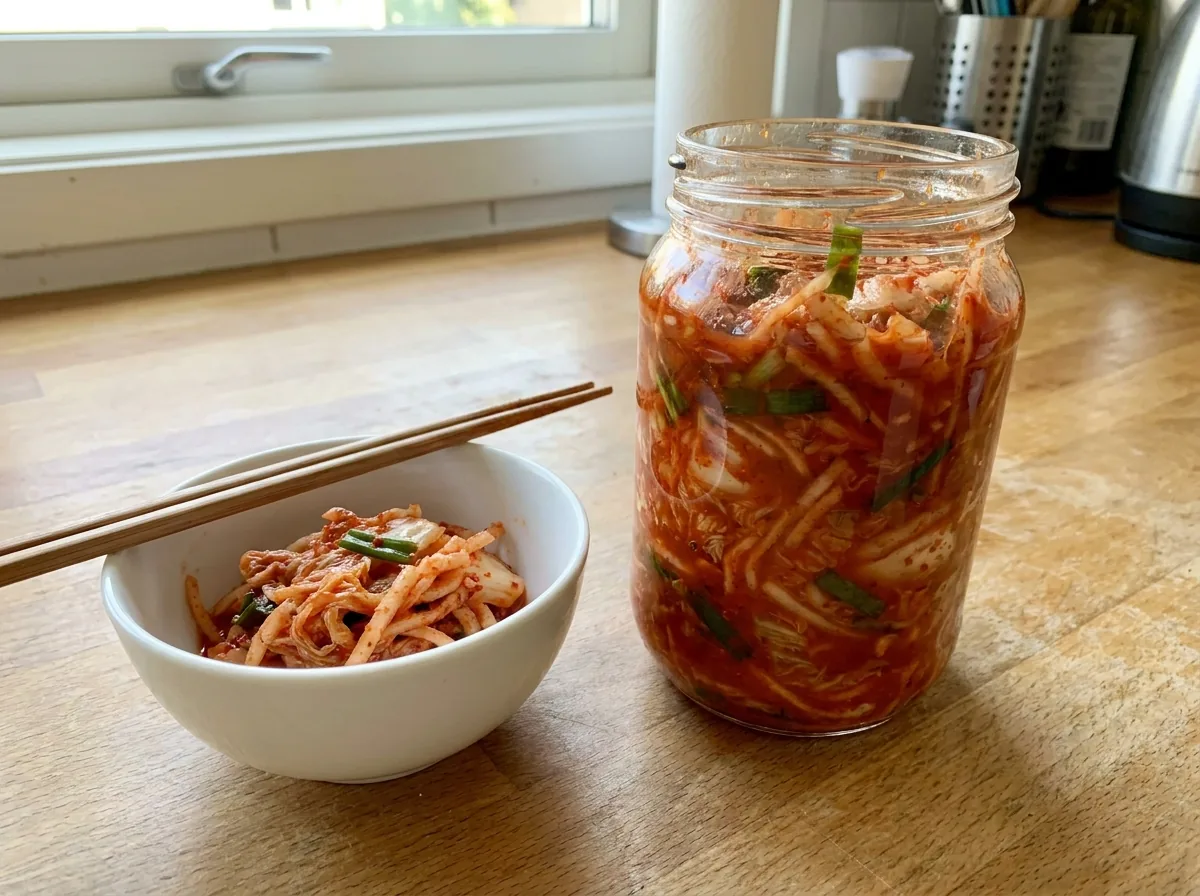
Ingredients
- 1 medium head, about 1.4–1.8 kg (3–4 lb) Napa (Chinese) cabbagePale green, compact and heavy for its size
- ¾ cup (180 ml) in total, divided Coarse non-iodised salt¼ cup for the soaking brine and ½ cup to rub into the cabbage. Coarse sea salt is the usual choice; most of it is rinsed off
- About 2 litres (8 cups), plus 60 ml (¼ cup) Cold waterThe 2 litres is for the soaking brine; the 60 ml is for the rice paste
- 1 tbsp Sweet (glutinous) rice flourThickens the paste so it clings. Optional; plain kimchi works without it
- 1–5 cloves, to taste Garlic
- 1–2 thin slices (about 5 g) Fresh ginger
- ½ cup (about 45 g) Gochugaru (Korean red pepper powder)Choose one sold for kimchi. Use less for a milder batch
- About 250–350 g (½–¾ lb) Korean radish or daikon
- 5 Spring onions
- ½ Asian pear (optional)Adds a little sweetness
- ½ tsp, or up to 1 tbsp for a stronger flavour Fish sauce (optional)For a vegan kimchi leave it out or use light soy sauce (which contains soy and wheat)
Equipment
- Large sharp knife and chopping board
- Large glass, plastic or stainless-steel bowl and a colander
- Small saucepan
- Food-handling gloves (gochugaru stings skin and eyes)
- Glass jars or a food-grade plastic container with a lid, big enough to be only two-thirds full. No metal containers, and no cracked or chipped earthenware
- A plate or shallow bowl to stand the jar on
- pH test strips covering about 3.0–5.5 (optional but recommended)
Method
Clean and sanitise
Wash your hands with soap for at least 20 seconds. Wash knives, boards, bowls and jars in hot soapy water, then sanitise them by submerging in water of at least 71°C (160°F) for 30 seconds. The vegetables are never cooked, so clean equipment matters.2
Cut the cabbage
Rinse the head under cold water and drain it. Cut away any damaged spots, quarter it lengthways, cut out the core and chop the quarters into 5 cm (2 in) pieces.1
Salt the cabbage for 3–6 hours
Dissolve ¼ cup of the salt in the 2 litres of cold water, dip the cabbage pieces in it briefly, then drain and discard that brine. Sprinkle the remaining ½ cup of salt over the cabbage, massage it in, cover and leave at room temperature for 3–6 hours, turning it every 30 minutes or so; the longer it sits, the saltier it gets.1,2
Rinse and drain
Rinse the cabbage 3–4 times in cold water to wash off the excess salt, then leave it in a colander to drain for at least 30 minutes. Taste a piece: it should be pleasantly salty, not harsh.1
Make the rice paste
While the cabbage drains, whisk the sweet rice flour into 60 ml (¼ cup) water in the small pan, bring it to the boil, stirring, and set it aside to cool.1
Make the seasoning paste
Finely mince the garlic and ginger, or blend them with a splash of water, and stir them into the cooled rice paste with the gochugaru. Cut the radish, spring onions and pear, if using, into matchsticks about 2.5 cm (1 in) long, then, wearing gloves, mix them into the paste with the fish sauce or its swap. Add more salt only if it needs it.1
Combine
With gloves on, add the drained cabbage to the paste and rub it in until every piece is coated.1
Pack the jar two-thirds full
Pack the kimchi tightly into the jar, pressing it down to push out air and draw up the juices. Fill it only about two-thirds full: the bacteria make carbon dioxide, and the kimchi bubbles and rises.1
Cover loosely and catch drips
Put the lid on without over-tightening, so gas can escape but insects and mould spores stay out, and stand the jar on a plate or in a bowl to catch any overflow.1
Ferment for 1–2 days at room temperature
Leave it in a well-ventilated spot at a steady room temperature, ideally about 20°C (68°F), for 1–2 days. Press it down and taste it daily; bubbling is normal. If you have pH strips, Colorado State advises fermenting until it reads 4.6 or lower. In hot weather you can skip this and let it ferment slowly in the fridge for 3–4 days instead.1,2,3
Move it to the fridge
Refrigerate it at 5°C (41°F) or below, kept pressed under its juices with the lid on. It keeps fermenting slowly and gets more sour; it is best eaten within 2 weeks.1,2
Safety
- Don't leave it at room temperature beyond 1–2 days. Early on it isn't acidic enough to hold back harmful bacteria; refrigerate at 5°C (41°F) or below1,2
- Fill jars only two-thirds full and don't screw lids on tight: the gas it makes can push juice over the top. Stand jars on a plate1
- Throw it out if you see mould, if it smells off rather than sour, or if the texture turns strange or slimy1,2
- Fish sauce, shrimp paste and anchovies are fish and shellfish allergens; soy sauce contains soy and wheat. Check before serving others2
- It is salty, about 0.5 g of salt per ¼ cup (40 g) for typical kimchi. On a low-salt diet, eat small amounts or ask your doctor2,6
Variations
Leave out the fish sauce, or use a little light soy sauce in its place. The rest of the method is the same.
Halve the gochugaru and add the Asian pear for sweetness. It will be paler and gentler but ferments the same way.
Skip the room-temperature stage and let the packed jar ferment slowly in the fridge for 3–4 days. Useful in hot weather.
Add a grated carrot along with the radish and spring onions for colour and crunch.
Does it actually work?
Unheated kimchi contains live lactic acid bacteria, mainly Weissella and Lactobacillus species, and that is a large part of its appeal. What eating it does for health in people is much less clear.
University of Georgia Extension notes that most of the evidence comes from test-tube and animal studies and more clinical trials are needed, and a 2019 review of fermented foods found no randomised trials of kimchi for gut health at all; one tiny non-randomised study gave 6 people with H. pylori infection 60 g or 300 g of kimchi a day for 4 weeks, and the infection cleared in none of them.
The best-known trial of fermented foods in general, from Stanford in 2021, randomised 36 healthy adults to a high-fibre or a high-fermented-food diet for 10 weeks. The fermented-food group went from under 1 to about 6 servings a day of foods such as yoghurt, kefir, kimchi, sauerkraut and kombucha; the diversity of their gut bacteria rose and 19 of 93 inflammatory proteins in the blood fell.
Its main immune measure didn't change in either group, it had no usual-diet control group, and 6 servings a day is a lot. The probiotic evidence on /ingredients/probiotic-lactobacillus/ is for specific strains in capsules, not kimchi.
The ginger is there for flavour: a few grams of fresh root spread through the whole batch is far below the doses tested in trials (see /ingredients/ginger/).
Salt matters too. USDA data put kimchi at 498 mg sodium per 100 g, about 1.25 g of salt, against the NHS adult limit of 6 g a day. In a meta-analysis of 60 observational studies, people who ate pickled vegetables had about 50% higher odds of stomach cancer, and nearly double the odds in Korean studies; the studies varied a lot and can't prove cause, and a Korean case-control study found different results for different types of kimchi.
Eat it as a flavourful side dish, not as medicine.1,2,4,5,6,7
Questions people ask
How long should kimchi ferment at room temperature?
Only 1–2 days, ideally at about 20°C (68°F), tasting it daily. Kimchi ferments far faster than sauerkraut. After that, move it to the fridge, where it keeps souring slowly.
Why is my kimchi bubbling and overflowing?
The bacteria are making carbon dioxide, which is normal. That is why jars should be no more than two-thirds full, with the lid not screwed down tight and a plate underneath. Press the kimchi back down under its juices after it settles.
Can I make kimchi without fish sauce?
Yes. Fish sauce is optional in the extension recipe: leave it out or use a little light soy sauce for a vegan version. Bear in mind soy sauce contains soy and wheat.
How long does homemade kimchi last?
Colorado State University Extension advises eating it within 2 weeks for best quality, and Oregon State's guidance says within a week. It doesn't suddenly spoil, but it becomes increasingly sour and soft. Throw it out if you see mould or it smells off.
Is kimchi good for your gut?
It contains live lactic acid bacteria, but there are no good randomised trials showing that kimchi itself improves gut health. One small Stanford trial found that eating about 6 servings a day of mixed fermented foods increased gut bacterial diversity, which is promising but not proof of benefit.
Sources (7)
- University extension Colorado State University Extension. Understanding and Making Kimchi.
- University extension Mahida M, Cullinan S, Ingmundson K, et al. Homemade Kimchi: A Science-Based Guide to Safe Fermentation. UGA Extension Circular 1362. 2025.
- University extension Oehler N. Kimchi basics. Oregon State University Extension Service SP 50-1007. 2020 (reviewed 2024).
- Review Dimidi E, Cox SR, Rossi M, Whelan K. Fermented Foods: Definitions and Characteristics, Impact on the Gut Microbiota and Effects on Gastrointestinal Health and Disease. Nutrients. 2019.
- Randomised trial Wastyk HC, Fragiadakis GK, Perelman D, et al. Gut-microbiota-targeted diets modulate human immune status. Cell. 2021.
- Public health body NHS. Salt in your diet.
- Meta-analysis Ren JS, Kamangar F, Forman D, Islami F. Pickled food and risk of gastric cancer--a systematic review and meta-analysis of English and Chinese literature. Cancer Epidemiol Biomarkers Prev. 2012.
Educational only. Patch-test anything new on your skin, and stop if it irritates.
Reader notes
Experiences and questions from readers, read by an editor before they appear. They are personal accounts, not evidence, and are not medical advice.