
How to Make Kefir at Home with Milk Kefir Grains
Put about 1 tablespoon of milk kefir grains in a clean jar with 500 ml (2 cups) of pasteurised milk, cover it loosely and leave it at room temperature, ideally 20–25°C (68–77°F), for about 24 hours until it thickens and tastes tangy. Strain out the grains, chill the kefir and drop the grains into fresh milk to start the next batch.
Use pasteurised milk and clean equipment; homemade kefir contains a little alcohol and live microbes, so University of Florida Extension advises children, pregnant women and people with weakened immune systems to avoid it.
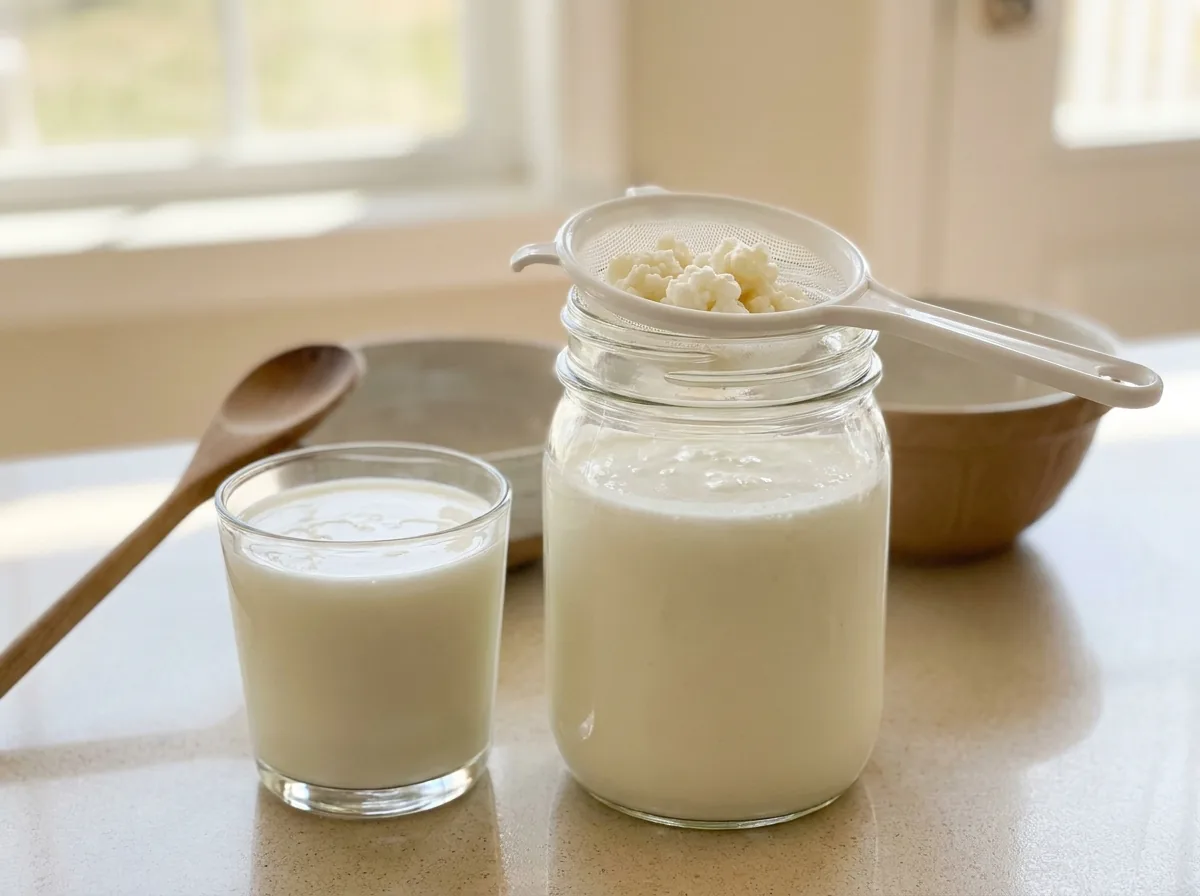
Ingredients
- 1 tbsp (roughly 10–15 g) Milk kefir grainsSoft, white, cauliflower-like clusters of bacteria and yeast, not cereal grains. Water kefir grains are a different culture
- 500 ml (2 cups) Pasteurised milkWhole or semi-skimmed cow's milk is easiest; goat's or sheep's milk also works. Not raw milk
Equipment
- Clean glass jar of about 750 ml–1 litre
- Breathable cover (cloth or coffee filter with a rubber band) or a loosely set lid
- Fine plastic or stainless-steel sieve
- Spoon or spatula and a jug or bowl
- Clean bottle or jar with a lid for the finished kefir
Method
Clean everything
Wash your hands, jar, sieve and spoon in hot soapy water and rinse well. Fermenting at room temperature gives unwanted microbes a chance too, so start clean.
Add the grains to the milk
Put about 1 tablespoon of kefir grains in the jar and pour in 500 ml (2 cups) of pasteurised milk, ideally at room temperature, 20–25°C (68–77°F). Unlike yoghurt, kefir doesn't need the milk heated first.1
Cover and leave for about 24 hours
Cover the jar with a cloth and rubber band or a loose lid and leave it out of direct sun at room temperature, ideally 20–25°C (68–77°F). This is how kefir has been made for centuries: grains moved from one batch to fresh milk and left at room temperature.1,2
Check it is ready
After about 24 hours the milk should be thicker, like pouring cream or thin yoghurt, with a fresh sour smell and taste. In a warm kitchen it can be ready in 12–18 hours; in a cold one it may take up to 48. If it has split into curds and clear whey, it has gone a little far: shake it and shorten the next batch.
Strain out the grains
Tip the kefir into the sieve over a jug and stir gently with a spoon or spatula so the thick kefir passes through and the grains stay behind. Don't rinse the grains; they go straight into the next batch.
Chill the kefir
Pour the strained kefir into a clean bottle or jar, put the lid on and refrigerate it at 5°C (41°F) or below. It keeps fermenting slowly in the fridge and gets tangier, so drink it within about a week.1
Start the next batch, or rest the grains
Put the grains back into the clean jar with fresh milk and repeat. To take a break, cover the grains with fresh milk, put a lid on and keep them in the fridge, changing the milk about once a week. As the grains grow, give spares away or remove some, otherwise the kefir sours faster.
Optional: a second ferment
For a milder, more flavoured kefir, add a strip of lemon or orange peel or a little fruit to the strained kefir, seal it and leave it at room temperature for a few hours to a day, then refrigerate. This is common practice rather than tested guidance; pressure and alcohol both build up, so open it carefully.
Safety
- Use pasteurised milk and good-quality grains. Raw milk can carry Listeria, Salmonella and E. coli O157:H7, and these can survive in kefir1,5
- UF Extension advises infants, pregnant women, older adults and people with weakened immunity or chronic illness to consider avoiding homemade kefir1
- Kefir contains a little alcohol from its yeasts; UF Extension says it isn't appropriate for children or pregnant women. Second ferments make more1,2
- Throw out the kefir and the grains if you see fuzzy mould or pink or orange patches, or if it smells rotten rather than sour
- Keep finished kefir in the fridge at 5°C (41°F) or below, never at room temperature once it is strained1
Variations
Let it ferment a few hours longer, then strain the finished kefir through cheesecloth in the fridge for a few hours for a thick, spoonable kefir that is good with fruit or as a dip.
Blend chilled kefir with banana, berries and a few oats. Add fruit after straining, never to the jar with the grains.
Add a strip of unwaxed lemon or orange peel to sealed, strained kefir for a few hours at room temperature, then chill. It takes the edge off the sourness.
Whisk kefir with lemon juice, a little olive oil, chopped herbs and salt for a quick buttermilk-style salad dressing.
Does it actually work?
Kefir is a tangy fermented milk with lots of live bacteria and yeasts, but the evidence that drinking it improves health is thin. A 2023 systematic review found 16 randomised trials testing milk kefir on any health outcome; 12 had a high risk of bias, and the authors said high-quality trials are needed before any recommendation, though it appears safe for generally healthy people.
The clearest result is for lactose: in a small trial of 15 adults with lactose maldigestion, plain kefir cut breath hydrogen (a marker of undigested lactose) from 224 to 87 ppm·h compared with milk and eased wind, about as well as yoghurt. A 2026 review of eight human studies found only modest, inconsistent changes in gut bacteria.
Homemade grains vary from kitchen to kitchen, so nobody knows exactly what is in your jar. Claims about cholesterol, blood pressure, immunity or cancer rest mostly on laboratory and animal work. For what specific probiotic strains can and can't do in trials, see our probiotics entry.3,4,6,2
Evidence ratings for what goes in: Probiotics (Lactobacillus).
Questions people ask
How much kefir grains to milk?
A common starting point is about 1 tablespoon of grains to 500 ml (2 cups) of milk for about 24 hours. More grains or a warmer room make it ferment faster and taste sourer; if it separates before 24 hours, use fewer grains or more milk.
Does homemade kefir contain alcohol?
Yes, a small amount, because the yeasts in the grains ferment some of the milk sugar. University of Florida Extension says that makes it unsuitable for children and pregnant women. Longer ferments and sealed second ferments raise it.
Is kefir good for lactose intolerance?
It may help. In one small trial, plain kefir caused much less undigested lactose and wind than milk in adults with lactose maldigestion, similar to yoghurt. Tolerance varies, so start with a small glass.
Can I make kefir without grains?
Yes. Kefir can also be made from freeze-dried starter cultures or by using some finished kefir as the starter, though those starters usually can't be reused as many times as grains. Follow the instructions on the starter.
How do I know if kefir has gone bad?
Good kefir smells clean and sour, a bit like yoghurt, and may be slightly fizzy. Fuzzy mould, pink or orange patches, or a rotten smell mean it has gone off: throw out the kefir and the grains.
Sources (6)
- University extension Skinner JR. Fermented Foods: Kefir. UF/IFAS Extension FSHN24-2/FS457. 2024.
- Review Bourrie BC, Willing BP, Cotter PD. The Microbiota and Health Promoting Characteristics of the Fermented Beverage Kefir. Front Microbiol. 2016.
- Systematic review Kairey L, Leech B, El-Assaad F, et al. The effects of kefir consumption on human health: a systematic review of randomized controlled trials. Nutr Rev. 2023.
- Randomised trial Hertzler SR, Clancy SM. Kefir improves lactose digestion and tolerance in adults with lactose maldigestion. J Am Diet Assoc. 2003.
- Regulator U.S. Food and Drug Administration. Raw Milk Misconceptions and the Danger of Raw Milk Consumption.
- Systematic review Hamsho M, Ranneh Y, Kaddour B, et al. Kefir: A Potential Gut Microbiota Modulator: A Systematic Review of Human Interventional Studies. Microbiologyopen. 2026.
Educational only. Patch-test anything new on your skin, and stop if it irritates.
Reader notes
Experiences and questions from readers, read by an editor before they appear. They are personal accounts, not evidence, and are not medical advice.