
How to Make Kombucha at Home Safely
Kombucha is sweet tea fermented by a SCOBY (a culture of bacteria and yeast). The University of Georgia's tested recipe uses 3.8 litres (1 US gallon) of water, black and green tea, 200 g (1 cup) of sugar and a SCOBY with acidic starter liquid, fermented in a covered glass jar at 20–25°C (68–77°F) for 7–10 days, then bottled and chilled.
Brew it only in glass or food-grade plastic, never ceramic or metal, check the starter is pH 4.0 or lower, and throw the batch out if you see mould.
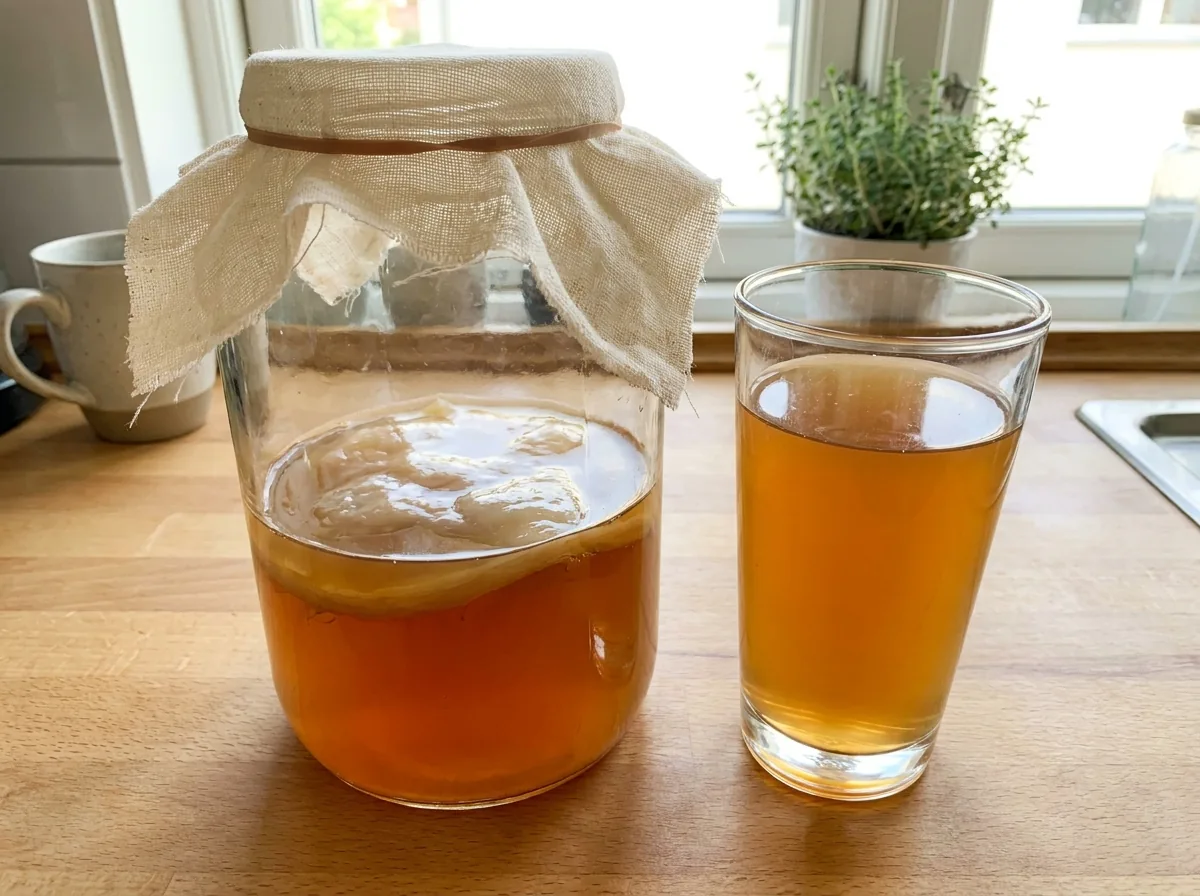
Ingredients
- 3.8 litres (1 US gallon, 16 cups), divided WaterClean drinking water; filtered water if yours tastes strongly of chlorine
- 6 tea bags (or 3 tbsp loose tea) Black teaPlain commercial tea, not flavoured or homegrown. Decaffeinated works
- 13 tea bags (or ⅓ cup plus 2 tbsp loose tea) Green teaThe tested recipe uses both teas together
- 200 g (1 US cup) Granulated white sugarThe yeast feeds on it, so most is used up. Other sugars weren't tested
- 1 SCOBY plus about 750 ml (3 cups) of starter SCOBY with starter liquidStarter is acidic kombucha from a previous batch, or the liquid sold with a SCOBY. It must test pH 4.0 or lower
Equipment
- Glass jar of at least 5.7 litres (1.5 US gallons), or a food-grade plastic one. Never ceramic, lead crystal or metal
- Large saucepan
- Food thermometer
- pH test strips (range covering 2.5–4.5)
- Paper coffee filter, paper towel or clean cheesecloth, and a rubber band
- Masking tape and a pen for the date
- Funnel and clean glass bottles or jars with lids for the finished kombucha
Method
Clean and sanitise everything
Wash your hands for at least 20 seconds. Wash the jar, pan, spoon and bottles in hot soapy water and rinse well, then sanitise them by submerging in water of at least 77°C (171°F) for 30 seconds. Rinse off all soap, as residue can upset the culture.1,2
Test the starter liquid
Put 1 tablespoon of the starter liquid in a small cup and dip a pH strip in it, then throw that spoonful away. If it reads 4.0 or lower, carry on. If it reads higher, don't use it: the starter's acidity is what protects the new batch from harmful bacteria while it gets going.1,2
Steep the tea
Heat 950 ml (4 cups) of the water to 71–77°C (160–170°F), checking with the thermometer, and add the black and green tea. Steep for 2 minutes only, then remove the bags or strain out the loose tea.1
Dissolve the sugar and cool
Pour the hot tea into the glass jar, add the 200 g of sugar and stir until it dissolves. Add the remaining 2.85 litres (12 cups) of cold water and stir. Check the temperature: it must be below 35°C (95°F) before the SCOBY goes in, or the heat can harm the culture.1
Add the SCOBY and starter
Add the SCOBY and the starter liquid and stir well for about 10 seconds. Don't make a half batch with a whole SCOBY: UGA Extension warns it can over-acidify or ferment poorly.1,2
Cover and ferment for 7–10 days
Dry the rim, cover the jar with a coffee filter, paper towel or cheesecloth and secure it with a rubber band, so air gets in but flies don't. Label it with the date (day 0). Leave it at room temperature, ideally 20–25°C (68–77°F), out of direct sun and away from vents and busy spots.1,2
Check it is ready
After 7 days, taste a little with a clean spoon: it should be tangy and only lightly sweet, and a new pale layer of SCOBY often forms on top. If you have pH strips, the finished brew should read 4.2 or lower (Virginia Tech Extension also says not below 2.5). Bottle by day 10; longer fermentation makes more alcohol.2,4
Save the SCOBY and starter
With clean hands, lift out the SCOBY and keep it with about 20% of the brew, roughly 750 ml, as starter for the next batch. Store them in a clean jar covered with a coffee filter or cheesecloth, not an airtight lid, for up to 30 days.2
Bottle and refrigerate
Funnel the rest into clean, sanitised bottles or jars and put them straight in the fridge at 4°C (40°F) or below, which slows the fermentation. Use within 30 days. Kept airtight, kombucha builds up carbon dioxide and a bottle can burst, so check and open them regularly.1,2
Optional: a second fermentation for fizz
This step is not part of the tested recipe. Many brewers add a little fruit or ginger to bottles made for carbonated drinks, seal them and leave them at room temperature for 1–2 days before chilling. Pressure and alcohol both build up, so open each bottle daily over the sink to release gas, and refrigerate as soon as it is fizzy; UGA advises drinking flavoured kombucha within 2 days.1,2,3
Safety
- Brew only in glass or food-grade plastic. Never ceramic, lead crystal or metal: acidic kombucha leached lead from a ceramic pot and poisoned two people3,4,5,6
- Use starter that tests pH 4.0 or lower; the finished brew should be 4.2 or lower. If the starter isn't acidic enough, don't brew with it1,4
- Dry, fuzzy patches on the SCOBY or the surface, white or coloured, are mould. Throw out the tea and SCOBY, then clean and sanitise the jar3
- Sealed bottles build up carbon dioxide and can burst. Keep them in the fridge and release the pressure regularly, especially after a second ferment1
- Not advised in pregnancy or breastfeeding, with a weakened immune system or for children: the risks are unknown. Healthy adults: up to 120 ml a day2,3
- Alcohol rises the longer it ferments and can exceed 0.5%, the US limit for non-alcoholic drinks. Skip it if you need to avoid alcohol2,3
Variations
Stir fresh grated or dried ginger and a little honey into the finished kombucha and serve over ice. Once flavoured, keep it in the fridge and drink it within 2 days.
Muddle fresh mint or lemon balm in a glass, add chilled kombucha and ice, and garnish with cucumber slices. Add flavours only after fermentation, never to the brewing jar.
Blend or mash strawberries with a few basil leaves, mix with kombucha and serve over ice, or blend kombucha with any fruit you like. Drink it the same day or the next.
If you avoid caffeine, use decaffeinated black and green tea in the same amounts. UGA Extension says the tested recipe still applies.
Does it actually work?
Most claims for kombucha come from laboratory and animal studies. A 2019 systematic review that screened 310 articles found only one reporting empirical results in people.
Since then, one small pilot trial gave 12 adults with type 2 diabetes 240 ml of kombucha or a placebo drink daily for 4 weeks each: fasting blood sugar fell from 164 to 116 mg/dL on kombucha and from 162 to 141 mg/dL on placebo. The analysis compared each drink with its own baseline rather than with each other, the drinks were donated by a kombucha company, and that kombucha held 1.5% alcohol.
That is a reason for a bigger trial, not evidence that kombucha lowers blood sugar, and it should never replace diabetes treatment. Kombucha does contain live bacteria and yeast, but nobody has shown what a glass of home brew does for gut health. Enjoy it as a tangy drink.7,8
Questions people ask
How long does kombucha take to ferment?
In the tested recipe, 7–10 days at room temperature, ideally 20–25°C (68–77°F). Cooler rooms slow it down and warmer rooms speed it up. Longer than 10 days makes it more acidic and raises the alcohol.
Is homemade kombucha safe to drink?
It can be, if you use a tested recipe, sanitise everything, use acidic starter liquid and a glass or food-grade plastic jar, and throw out any mouldy batch.
Two serious illnesses in Iowa in 1995, one fatal, were investigated as possibly linked to kombucha, but no causal link was established. It isn't advised for children, during pregnancy or breastfeeding, or with a weakened immune system.
Does homemade kombucha contain alcohol?
Yes, a little, because the yeast turns sugar into alcohol. UGA Extension says its recipe, fermented for 7–10 days, may have trace amounts, under 0.016%, but alcohol rises with longer fermentation and second fermentations, and kombucha can exceed 0.5%. One commercial kombucha used in a trial held 1.5%.
What does mould on a SCOBY look like?
Mould is dry and fuzzy, sitting on top of the SCOBY or the liquid, and can be white or coloured. A healthy SCOBY is smooth, rubbery and pale, and brown stringy strands hanging from it are normal. If you see fuzz, throw out both the tea and the SCOBY.
Can I make a smaller batch of kombucha?
UGA Extension advises against halving its recipe, because the same amount of SCOBY with half the sweet tea can over-acidify or stall. Make the full 3.8-litre batch and keep what you don't drink in the fridge for up to 30 days.
Sources (8)
- University extension National Center for Home Food Preservation, University of Georgia. Kombucha Tea.
- University extension University of Georgia Cooperative Extension. Crafting Kombucha at Home: Frequently Asked Questions. 2026.
- University extension Cullinan S, Mahida M, Ingmundson K, et al. What's the Word on Homemade Kombucha? UGA Extension Circular C 1312. 2024 (revised 2026).
- University extension Eifert J, Boyer R, Pomfrey Wells E, Saunders T, Yang L. What do I need to know to sell kombucha at the farmers market? Virginia Cooperative Extension FST-297P.
- Public health report Centers for Disease Control and Prevention. Unexplained severe illness possibly associated with consumption of Kombucha tea--Iowa, 1995. MMWR Morb Mortal Wkly Rep. 1995.
- Case report Phan TG, Estell J, Duggin G, Beer I, Smith D, Ferson MJ. Lead poisoning from drinking Kombucha tea brewed in a ceramic pot. Med J Aust. 1998.
- Systematic review Kapp JM, Sumner W. Kombucha: a systematic review of the empirical evidence of human health benefit. Ann Epidemiol. 2019.
- Randomised controlled trial Mendelson C, Sparkes S, Merenstein DJ, et al. Kombucha tea as an anti-hyperglycemic agent in humans with diabetes - a randomized controlled pilot investigation. Front Nutr. 2023.
Educational only. Patch-test anything new on your skin, and stop if it irritates.
Reader notes
Experiences and questions from readers, read by an editor before they appear. They are personal accounts, not evidence, and are not medical advice.