
How to Make Yogurt at Home (No Machine Needed)
Heat 1 litre of milk slowly to 82–85°C (180–185°F), cool it to 42–46°C (108–115°F), stir in 2 tablespoons of plain yoghurt with live cultures, then keep it covered at that warmth for 6–10 hours until it sets. That is the University of Illinois Extension method; chill the yoghurt once it has gelled and eat it within 14 days.
Start with pasteurised milk, not raw milk, and use a fresh starter, because the bacteria in it have to be alive to make yoghurt.
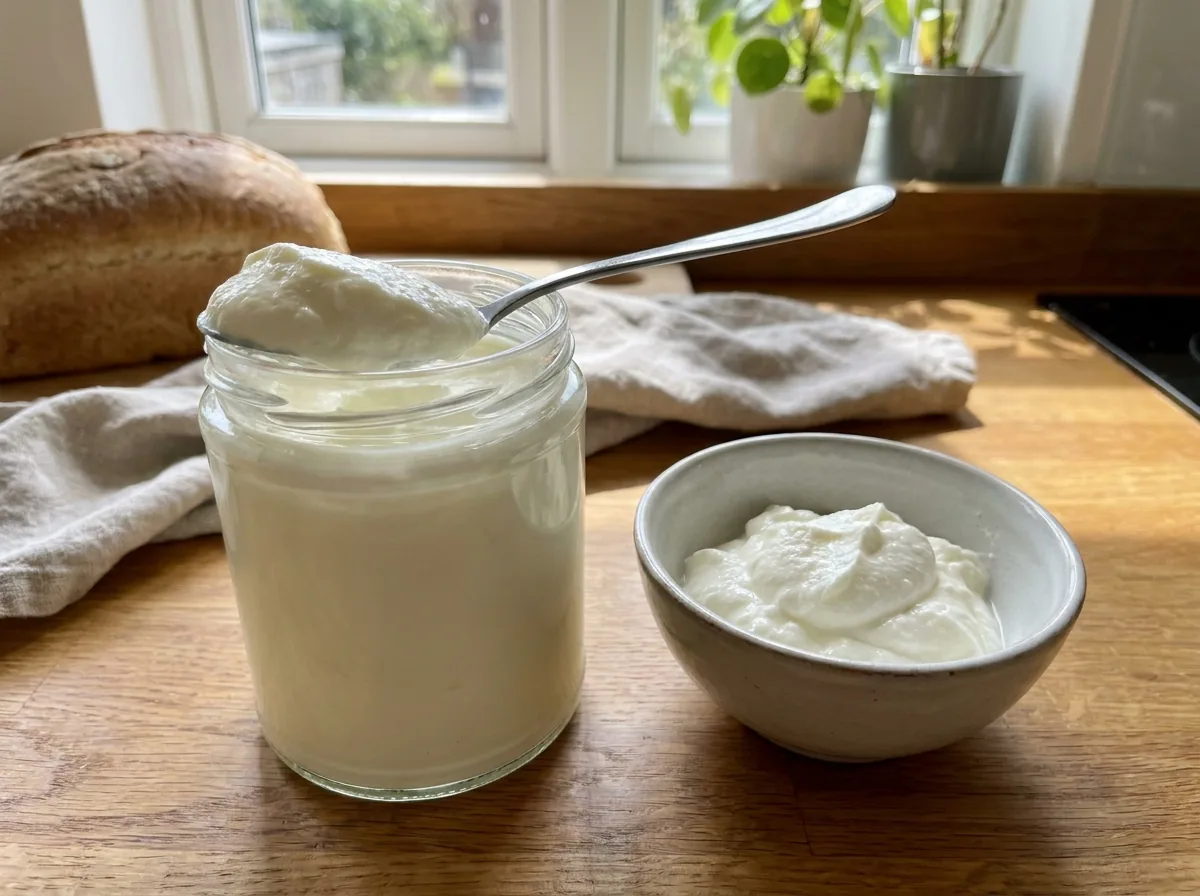
Ingredients
- 1 litre (about 1 US quart, 4 cups) Pasteurised milkThe tested recipe uses 1% milk; whole milk gives a richer, creamier yoghurt. Not raw milk
- 2 tbsp (about 30 g) Plain yoghurt with live culturesUnflavoured, with 'live' or 'active' cultures on the label, used before its date; or 2 tbsp of your last homemade batch within 5–7 days
- ¼ cup (about 20 g) Skimmed milk powder (optional)Makes a thicker yoghurt, especially from skimmed milk. Stir it into the cold milk before heating
Equipment
- Heavy 2-litre saucepan
- Food or sugar thermometer
- Ladle and small bowl
- Glass, food-safe plastic or metal containers with lids: one 1.5-litre pot or eight 250 ml jars
- Somewhere to keep it warm: an insulated cool box or slow cooker with warm water, or a yoghurt maker
- Cheesecloth or muslin and a sieve, for Greek-style yoghurt
Method
Wash up and warm the milk
Wash your hands and equipment well, as dirty equipment is a common cause of off-flavours and thin yoghurt. Pour the milk into the pan (whisk in the milk powder now if using) and heat it slowly, stirring now and then so it doesn't catch on the bottom.1
Heat to 82–85°C (180–185°F)
Use the thermometer: the milk will steam and small bubbles form at the edge of the pan. Turn off the heat as soon as it reaches 82–85°C (180–185°F). University of Illinois Extension lists under-heated milk as a cause of yoghurt that separates.1
Cool to 42–46°C (108–115°F)
Take the pan off the hob and let the milk cool to 42–46°C (108–115°F). Standing the pan in a sink of cold water speeds this up; stir and keep checking, because milk that is too hot or too cold when the culture goes in gives a soft set.1
Stir in the starter
Ladle about 250 ml (1 cup) of the warm milk into a small bowl, stir in the 2 tablespoons of yoghurt until smooth, then pour it back into the pan and stir to combine. More starter is not better: it is the live bacteria that matter, so fresher yoghurt works best.1
Keep it warm for 6–10 hours
Pour into your containers, put the lids on and keep them at 42–46°C (108–115°F), undisturbed, for 6–10 hours. One tested way: stand the containers in a cool box or slow cooker (switched off) half-filled with water at about 49°C (120°F), close it and wrap it in a towel, topping up with warm water if needed. Small jars set faster than one big pot.1
Check the set
Tilt a container gently: the yoghurt should hold together like a soft custard. If it is still liquid, give it longer and check every hour or two. Longer incubation makes it tangier, but leaving it far too long can make it separate.1
Chill it
Refrigerate the yoghurt at 4°C (40°F) or below as soon as it has gelled, which stops it souring further, and let it firm up for a few hours before eating. Eat it within 14 days. Keep 2 tablespoons back as the starter for your next batch and use it within 5–7 days.1
Optional: strain for Greek-style yoghurt
Line a sieve with a double layer of cheesecloth or muslin over a bowl, spoon in the yoghurt, cover and refrigerate. Drain for 2–4 hours for Greek-style yoghurt, or 8–24 hours for a spreadable yoghurt cheese. The liquid that drains off is whey.1
Safety
- Use pasteurised milk. Raw milk can carry E. coli O157:H7, Salmonella, Listeria and Campylobacter; children, pregnant women and older people are most at risk2
- Refrigerate as soon as it sets, at 4°C (40°F) or below, and eat within 14 days. Throw out yoghurt that smells off or shows mould1
- If you have a weakened immune system, ask your doctor about foods with live cultures: NCCIH says live microbes carry more risk with serious illness4
- Hot milk scalds and boils over fast. Use a deep pan, stay with it while it heats, and keep children away from the hob
Variations
Strain the finished yoghurt in the fridge for 2–4 hours through cheesecloth for a thick, Greek-style texture, or 8–24 hours for a soft yoghurt cheese you can spread like cream cheese.
Stir ¼ cup (about 20 g) of skimmed milk powder into the cold skimmed milk before heating. Without it, skimmed-milk yoghurt tends to be thin.
University of Illinois Extension's drinkable version heats the milk to 79–82°C (175–180°F), incubates for about 3 hours until it is like thin pudding, then blends in fruit and a spoonful of honey or sugar. Keep it in the fridge and drink it within 14 days.
Sweeten and flavour yoghurt after it has set and chilled, not before: stir in fruit, honey or jam by the bowlful so the main batch stays plain and can start your next one.
Does it actually work?
Yoghurt with live cultures has one well-supported benefit: it helps people who struggle to digest lactose to digest the lactose in the yoghurt itself. That is an authorised health claim in Great Britain and the EU, based on a 2010 EFSA opinion, and it applies to yoghurt with at least 100 million live Lactobacillus delbrueckii subsp. bulgaricus and Streptococcus thermophilus per gram.
In one small trial of 15 adults with lactose maldigestion, plain yoghurt cut breath hydrogen (a marker of undigested lactose) to about a third of milk's and reduced wind. Nobody measures the bacteria in a homemade batch, but the same cultures do the work.
Beyond that, be cautious: the probiotic benefits people read about, such as fewer cases of diarrhoea with antibiotics, come from trials of specific strains in capsules and sachets, not yoghurt, and NCCIH notes that different probiotics have different effects. See our probiotics entry for what those trials found. Homemade yoghurt is a good source of protein and calcium; it isn't a treatment.3,5,4,2
Evidence ratings for what goes in: Probiotics (Lactobacillus).
Questions people ask
Why didn't my homemade yoghurt set?
The usual causes are a starter without live cultures, milk that was too hot or too cold when the starter went in, or an incubation temperature that drifted. Check your thermometer, keep it at 42–46°C (108–115°F), and use fresh plain yoghurt labelled with live cultures.
Why do you heat the milk to 82°C first?
The tested method heats the milk to 82–85°C (180–185°F) before cooling, and University of Illinois Extension lists under-heated milk as a cause of yoghurt that separates. Heating it changes the milk proteins so they set into a firmer gel.
How long does homemade yoghurt last?
Up to 14 days in the fridge at 4°C (40°F) or below. If you want to use it as the starter for a new batch, do so within 5–7 days, while the bacteria are most active.
Can I make yoghurt with raw milk?
We don't recommend it. The FDA warns that raw milk can carry harmful bacteria including Listeria, Salmonella and E. coli O157:H7, and that pasteurisation is what reliably kills them. Use pasteurised milk from the shop.
Can people with lactose intolerance eat homemade yoghurt?
Many can. Live yoghurt cultures help digest the lactose in the yoghurt, an authorised health claim, and a small trial found plain yoghurt caused far less undigested lactose than milk. Tolerance varies, so start with a small bowl.
Sources (5)
- University extension University of Illinois Extension. Making Yogurt at Home. Best Practice Guide. Modified May 2024.
- Regulator U.S. Food and Drug Administration. Raw Milk Misconceptions and the Danger of Raw Milk Consumption.
- Regulator Department of Health and Social Care. Great Britain nutrition and health claims (NHC) register (entry: Live yoghurt cultures; EFSA Journal 2010;8(10):1763).
- Regulator/health agency NCCIH. Probiotics: Usefulness and Safety. National Center for Complementary and Integrative Health.
- Randomised trial Hertzler SR, Clancy SM. Kefir improves lactose digestion and tolerance in adults with lactose maldigestion. J Am Diet Assoc. 2003.
Educational only. Patch-test anything new on your skin, and stop if it irritates.
Reader notes
Experiences and questions from readers, read by an editor before they appear. They are personal accounts, not evidence, and are not medical advice.