
How to Make Sauerkraut at Home in a Jar
Sauerkraut is shredded cabbage fermented in its own salty juice. The tested ratio is 2–2.5% salt by weight, about 3 tbsp of canning or pickling salt per 2.27 kg (5 lb) of cabbage, or 4½ tsp for the 1.1 kg (2½ lb) that fills a 2-litre jar, packed under the brine and fermented at 21–24°C (70–75°F) for 1–2 weeks in a jar or 3–4 weeks in a crock.
Never cut the salt, keep the cabbage under the brine, and throw it out if it turns slimy or grows more than a few small spots of mould.
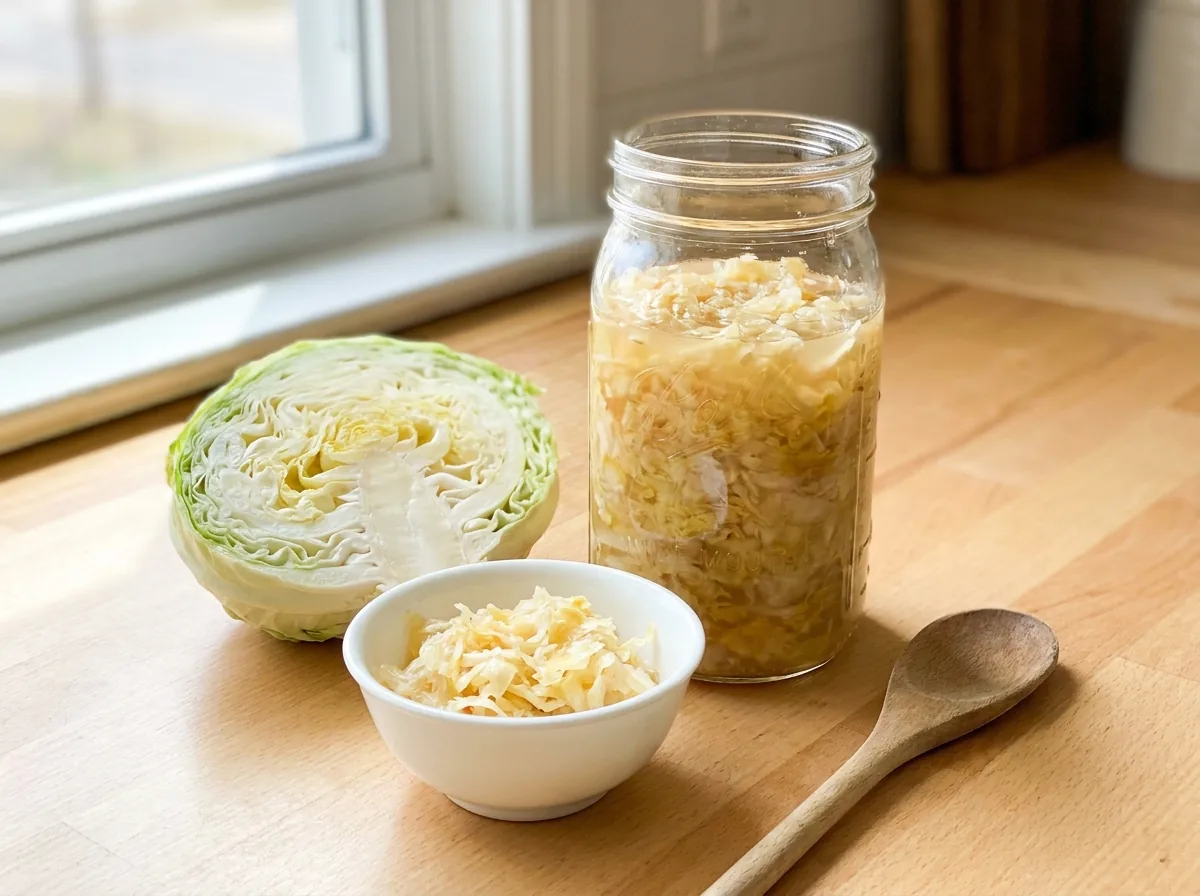
Ingredients
- 1.1 kg (2½ lb) once trimmed and cored, about 1 large head Firm white (green) cabbageFresh, heavy heads make crisper kraut. Red cabbage works too
- 4½ tsp (about 25 g) Canning or pickling saltNon-iodised, with no anti-caking agent. Better still, weigh it: 2–2.5% of the cabbage's weight, so 22–28 g for 1.1 kg. Other additive-free salts vary in grain size, so weigh those
- 1⅛ tsp salt dissolved in 240 ml (1 cup) water Extra brine, only if neededBoil the water, dissolve the salt and let it cool before use
Equipment
- 2-litre (half-gallon) wide-mouth glass jar, or a food-grade plastic tub or sound crock. No metal, and nothing cracked or chipped
- Large bowl (glass, food-grade plastic or stainless steel)
- Sharp knife, mandoline or food processor
- Kitchen scale
- A weight that fits inside the jar: a glass fermenting weight, a stainless-steel spring, or a small freezer bag filled with brine
- Fermenting lid, or a clean cloth and rubber band if you use a brine bag
- Plate or tray to stand the jar on
Method
Clean everything
Wash your hands, then wash the jar, weight, bowl and knife in hot soapy water and rinse well with very hot water. Clean equipment and surfaces help keep spoilage and harmful microbes out of a food that is never cooked.2
Trim and weigh the cabbage
Pull off and discard the outer leaves, rinse the head under cold running water and drain it. Cut it into quarters, cut out the core and any damaged bits, then weigh it so you can measure the salt.1,3
Shred it thinly
Slice the cabbage into long, thin shreds about 2 mm thick with a knife, mandoline or food processor. Even shreds ferment evenly.3
Salt and massage
Put the cabbage in the bowl, sprinkle the salt evenly over it and mix it through with clean hands. Leave it 5–10 minutes to wilt, then squeeze and massage hard until the cabbage is limp and sitting in its own juice. Don't reduce the salt: it holds back spoilage organisms while the souring bacteria take over.2,3
Pack the jar firmly
Pack the cabbage in a handful at a time, pressing each layer down hard with your fist or a tamper to push out air pockets. Pour in the juice from the bowl. Leave 7.5–10 cm (3–4 in) of space at the top of the jar, and make sure the cabbage is covered by about 2.5 cm (1 in) of brine; if it isn't, top up with the extra brine.2,3
Weigh it down and cover
Wipe the rim, put the weight on top so the cabbage stays under the liquid, and fit a fermenting lid (or, with a brine bag, a cloth). Stand the jar on a plate: if juice leaks out, wipe it up and don't pour it back in.2,3
Ferment at 21–24°C (70–75°F)
Leave the jar somewhere at 21–24°C (70–75°F). A jar is usually fully fermented in 1–2 weeks at that temperature, or 2–3 weeks at 16–18°C (60–65°F); a big crock takes 3–4 weeks, or 5–6 weeks when cooler. Below 16°C (60°F) it may not ferment, and above 24°C (75°F) it can go soft.1,3
Check it every day
Small batches ferment fast, so look daily. Bubbling is normal and usually settles after the first 2–3 days. Push the cabbage back under the brine if it rises, and lift off any white or pink yeast scum on the surface; the kraut underneath is fine.2,3,4
Taste to see if it is ready
Start tasting after about a week with a clean fork. It is ready when it smells and tastes like sauerkraut rather than salted cabbage, the shreds are still firm, and it doesn't smell of wine. Stop when you like the sourness.2,3
Store it
Swap the fermenting lid for an ordinary lid and keep the kraut in the fridge, where it lasts several months. For longer storage, freeze it, or bottle it in a boiling-water canner: hot-packed jars need 10 minutes for 500 ml (pint) jars and 15 minutes for 1-litre (quart) jars below 300 m (1,000 ft), longer at altitude. Canning heat-treats it, so the live bacteria are only in raw kraut.1,2,3
Safety
- Never cut the salt. At under about 1.7% the kraut goes soft or slimy; 2–2.5% of the cabbage's weight is the tested range2,3,4
- Keep the cabbage under the brine. Exposed cabbage is where mould and rot start; white or pink yeast scum can be skimmed off2,4
- Throw the batch out if it is slimy, or if there is more than a few small patches of mould. Small patches can be skimmed off; if in doubt, discard4
- Ferment only in glass, food-grade plastic or a sound crock. Don't use metal containers or anything cracked or chipped2
- It is salty: a ¼ cup (about 40 g) serving holds roughly 0.9 g of salt, about a sixth of the NHS limit of 6 g a day for adults7
Variations
Use red cabbage in the same amounts, or mix red and white. It turns a deep pink-purple as it sours.
Swap a small part of the cabbage for grated carrot, beetroot or turnip, and weigh it with the cabbage when you work out the salt.
Mix in a couple of sliced garlic cloves or a little chopped hot chilli before packing.
Add 1 tsp juniper berries or caraway seeds for a classic German-style flavour.
Does it actually work?
Raw, unheated sauerkraut contains live lactic acid bacteria, mostly Leuconostoc, Lactobacillus and Pediococcus species, but there is little evidence that eating it does anything specific for your health.
A 2019 review of fermented foods found a single randomised trial of sauerkraut for gut symptoms: 58 people with irritable bowel syndrome ate 75 g a day of either live or pasteurised sauerkraut for 6 weeks, and symptoms improved equally in both groups with no difference in their gut bacteria, so the live bacteria weren't what helped.
The best-known trial of fermented foods in general, from Stanford in 2021, randomised 36 healthy adults to a high-fibre or a high-fermented-food diet for 10 weeks. The fermented-food group went from under 1 to about 6 servings a day of yoghurt, kefir, kimchi, sauerkraut, kombucha and similar foods; the diversity of their gut bacteria rose and 19 of 93 inflammatory proteins measured in the blood fell.
But its main immune measure didn't change in either group, it had no usual-diet control group, and 6 servings a day is far more than most people eat. The probiotic evidence on our probiotics (Lactobacillus) page, /ingredients/probiotic-lactobacillus/, is for specific strains in capsules and doesn't carry over to a jar of kraut.
Salt is the other side of the ledger. In a meta-analysis of 60 observational studies, mostly from China, Korea and Japan, people who ate pickled vegetables had about 50% higher odds of stomach cancer; the link was strongest in Korea and China and not significant elsewhere, the studies varied a lot, and they can't prove cause. Enjoy sauerkraut as a tangy, salty side, not a supplement.5,6,8
Questions people ask
How long does sauerkraut take to ferment?
In a jar at 21–24°C (70–75°F), usually 1–2 weeks; at 16–18°C (60–65°F), 2–3 weeks. A large crock takes longer, about 3–4 weeks at 21–24°C. Taste it from about a week in and refrigerate when you like the flavour.
Is the white film on my sauerkraut mould?
A flat white or pinkish film on the brine is usually yeast scum, which you can skim off; the kraut underneath is still fine. Fuzzy mould is different: skim off a few small spots, but throw the batch out if there is a lot of it, or if the kraut is slimy.
Why did my sauerkraut go soft?
Usually too little salt (under about 1.7%), salt that wasn't mixed in evenly, air pockets from loose packing, or fermenting above 24°C (75°F). Soft kraut is poor quality but safe to eat if it smells and tastes cleanly sour; slimy kraut is spoiled.
How long does homemade sauerkraut last?
Fully fermented sauerkraut keeps for several months tightly covered in the fridge. For longer storage you can freeze it or can it in a boiling-water canner, which keeps it on a cool, dark shelf.
Does shop-bought or canned sauerkraut have probiotics?
Canned and other heat-treated sauerkraut has been heated after fermenting, so it doesn't carry the live bacteria found in raw kraut. Look for raw or unpasteurised sauerkraut in the chiller cabinet if live cultures matter to you, though their health benefit is unproven.
Sources (8)
- University extension National Center for Home Food Preservation, University of Georgia. Sauerkraut (adapted from the USDA Complete Guide to Home Canning).
- University extension Colorado State University Extension. Understanding and Making Sauerkraut.
- University extension Oehler N. Small batch sauerkraut tips. Oregon State University Extension Service SP 50-1009. 2025.
- University extension Oehler N. Sauerkraut: problems and solutions. Oregon State University Extension Service SP 50-745. Revised 2025.
- Review Dimidi E, Cox SR, Rossi M, Whelan K. Fermented Foods: Definitions and Characteristics, Impact on the Gut Microbiota and Effects on Gastrointestinal Health and Disease. Nutrients. 2019.
- Randomised trial Wastyk HC, Fragiadakis GK, Perelman D, et al. Gut-microbiota-targeted diets modulate human immune status. Cell. 2021.
- Public health body NHS. Salt in your diet.
- Meta-analysis Ren JS, Kamangar F, Forman D, Islami F. Pickled food and risk of gastric cancer--a systematic review and meta-analysis of English and Chinese literature. Cancer Epidemiol Biomarkers Prev. 2012.
Educational only. Patch-test anything new on your skin, and stop if it irritates.
Reader notes
Experiences and questions from readers, read by an editor before they appear. They are personal accounts, not evidence, and are not medical advice.