
DIY Face Masks: 5 Simple Recipes with Kitchen Ingredients
Each of these masks is a spoonful or two of a kitchen ingredient (oats, clay, yoghurt or aloe gel) mixed to a spreadable paste, left on for 10 to 15 minutes and rinsed off. Patch-test every ingredient first and make a fresh batch each time, because a water-containing mask has no preservative. Leave out lemon juice, baking soda and cinnamon, which can burn, irritate or cause allergy on the face.
Reviewed by Healthy and Herbal editors · 30 September 2026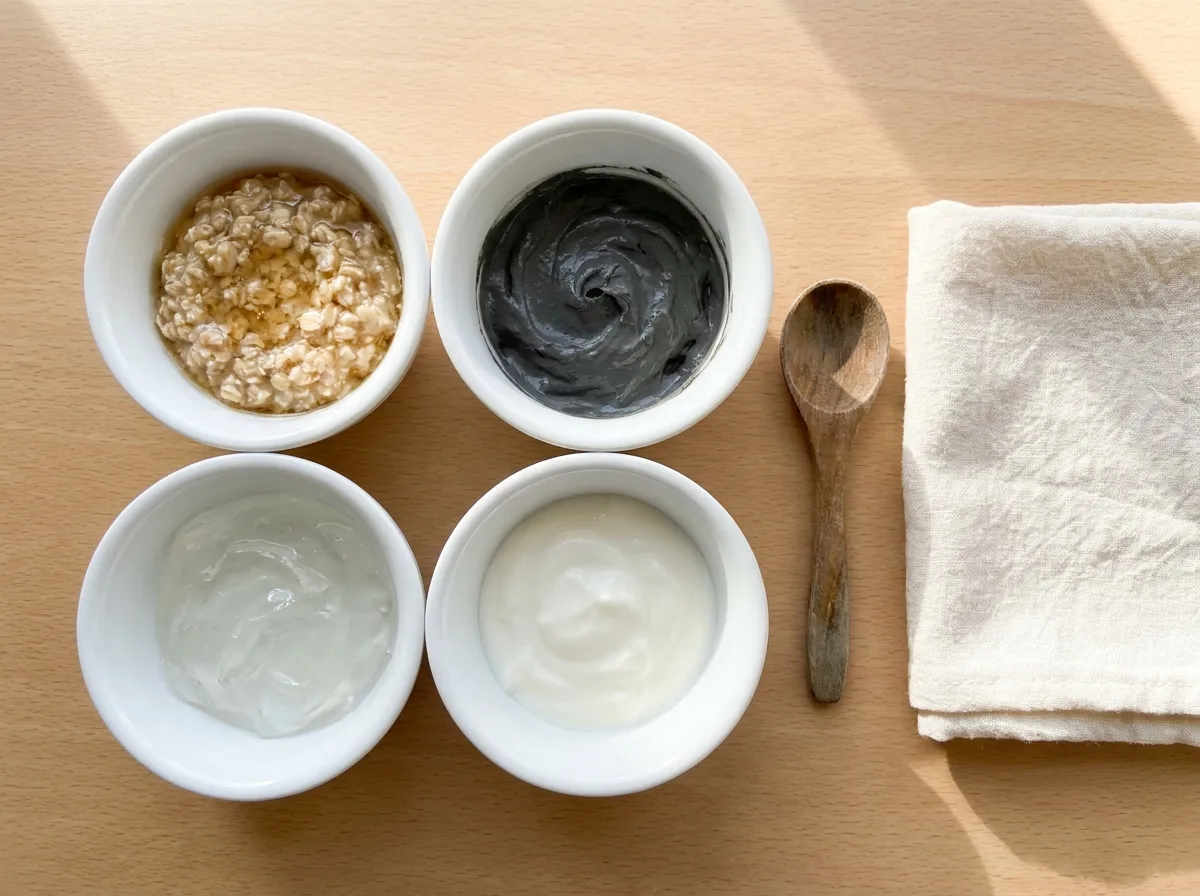
Ingredients
- 2 tbsp (about 15 g) ground oats Rolled oats, ground to a fine powder (oatmeal and honey mask)Grind in a clean coffee grinder or blender until powdery. Mix with 1 tbsp honey and 1–2 tbsp warm water
- 1 tbsp (about 20 g) Runny honey (oatmeal mask)Skip honey if you are allergic to bee products. Never give honey to a baby under 12 months
- 1 tbsp (about 8 g) Bentonite clay powder (clay mask for oily skin)Stir into 2 tbsp (30 ml) water. It swells, so add the water a little at a time. Stronger drying, so use it on oily skin only
- 2 tbsp (about 16 g) Kaolin clay powder (gentler clay mask)Mix with 1–2 tbsp water to a thick cream. Kaolin is milder than bentonite and suits combination or normal skin
- 2 tbsp (about 30 g) Plain unsweetened yoghurt (yoghurt mask)Full-fat plain yoghurt with no sugar or flavouring. Nothing else is needed
- 2 tbsp (about 30 g) Pure aloe vera gel (aloe gel mask)Scrape the clear inner gel from a fresh leaf, or use a pure gel with no added fragrance or alcohol
Equipment
- Small clean bowl and spoon (a fresh one for each batch)
- Measuring spoons, and a scale if you have one
- Clean coffee grinder or blender (for the oats)
- Soft flannel or clean cloth for rinsing off
- Hairband or towel to keep your hair back
Method
Patch-test each ingredient
Pick a spot the size of a coin on the inside of your arm or the crook of your elbow. Dab on a little of the mask and repeat twice a day for 7 to 10 days. Do not use the mask if the skin turns red, itchy or swollen.1
Prepare your skin and workspace
Wash your hands and the bowl with hot soapy water. Tie your hair back and cleanse your face with your usual gentle cleanser, then pat it dry.
Mix the oatmeal and honey mask
Stir 2 tbsp finely ground oats with 1 tbsp honey and 1–2 tbsp warm water into a thick, spreadable paste. This is the gentlest of the five and the one to start with if your skin is dry or easily upset.
Mix a clay mask
For oily skin, stir 1 tbsp bentonite into 2 tbsp water a little at a time until smooth. For a milder version, mix 2 tbsp kaolin with 1–2 tbsp water. It should spread like thick cream and not run.
Or use yoghurt or aloe
For the yoghurt mask, use 2 tbsp plain yoghurt straight from the fridge. For the aloe mask, use 2 tbsp pure aloe gel. Neither needs mixing with anything else.
Apply and wait 10 to 15 minutes
Spread a thin, even layer over your face and neck with clean fingers, keeping clear of your eyes, lips and nostrils. Lie back for 10 to 15 minutes. Rinse off a clay mask while it is still slightly damp, since a fully dried clay mask pulls on skin and can leave it tight.
Rinse and moisturise
Rinse with lukewarm water and a soft flannel, then pat dry. Follow with your usual moisturiser, especially after a clay mask, which can feel drying.
Throw away leftovers
Do not keep any spare mask for another day, even in the fridge. Make a new batch each time.6
Safety
- Patch-test first: a coin-sized spot on your inner arm, twice a day for 7 to 10 days. Stop if you see red, itchy or swollen skin1
- Never put lemon or lime juice on your face. Citrus juice plus sunlight can cause blistering and dark marks that last for months2
- Leave out baking soda. It is alkaline, and alkaline cleansers raise the skin's naturally acidic pH and can weaken its barrier4
- Leave out cinnamon. Its main flavour compound, cinnamal, is a recognised cause of contact allergy5
- Make a fresh mask each time. Products containing water and food need a preservative, and a home mask has none, so bin any leftovers6
Variations
If you react to honey, mix 2 tbsp ground oats with 2–3 tbsp warm water and leave the honey out.
For a creamier clay mask, use plain yoghurt in place of the water: 1 tbsp kaolin with 1 tbsp yoghurt. It is gentler than bentonite and water.
Mix 2 tbsp ground oats with 2 tbsp pure aloe gel for a cooling, honey-free mask that is easy to rinse.
Does it actually work?
Mostly these masks feel pleasant, and that is a fair reason to make one. Colloidal oatmeal, which is oats milled to a very fine powder, is a recognised US skin protectant for soothing itch and irritation, and it holds water and has anti-inflammatory properties. But most of that evidence is from standardised products, not porridge oats ground in a kitchen, and our oatmeal entry finds that it is not clearly better than a plain moisturiser. Honey has limited evidence, mostly for wound dressings, and we found no trials of honey as a face mask. Clay has one study in 75 adults with oily skin, using a formulated clay mask twice weekly for four weeks, which found lower sebum and fewer acne lesions, but the abstract describes no comparison group and it does not show a kitchen mix does the same. For yoghurt we found no evidence at all. NCCIH says aloe gel on skin is generally well tolerated, with occasional burning, itching or rash, and the evidence for skin conditions is limited. No mask has been shown to detox skin, draw out toxins or shrink pores. Learn more about the ingredients: oatmeal, honey, aloe vera, bentonite clay and kaolin clay.3,7,8
Evidence ratings for what goes in: Oats, Honey, Bentonite clay, Kaolin clay, Aloe Vera.
Questions people ask
How often can I use a DIY face mask?
Once or twice a week is a common routine, and we found no trials to support a set schedule. Stop if your skin feels tight, stings or looks red, and leave longer between clay masks if your skin is dry.
Is a homemade face mask safe for sensitive skin?
Not automatically. Natural ingredients such as honey and aloe can still cause allergy or irritation, so patch-test each one first. If you have eczema or a skin condition being treated, ask your doctor or pharmacist before trying a new mask.
Why can't I use lemon juice on my face?
Lemon and lime juice contain plant chemicals called furocoumarins. On skin exposed to sunlight, they can cause a blistering rash that leaves dark patches for weeks or months. Nothing about a face mask needs citrus juice.
Which clay is best, bentonite or kaolin?
Bentonite is stronger and more drying, so it is aimed at oily skin. Kaolin is milder and suits combination or normal skin. We found no head-to-head trials, so start with kaolin if you are unsure.
Can I store leftover mask in the fridge?
We suggest not. A mask made with water, yoghurt or honey has no preservative, and a fridge slows microbes without stopping them. Make only what you need and bin the rest.
Sources
- Professional body American Academy of Dermatology. How to test skin care products.
- Poison centre America's Poison Centers. Lime juice and sun can cause skin rashes.
- Review Kurtz ES, Wallo W. Colloidal oatmeal: history, chemistry and clinical properties. Journal of Drugs in Dermatology. 2007.
- Review Blaak J, Staib P. The Relation of pH and Skin Cleansing. Current Problems in Dermatology. 2018.
- Case series Ackermann L, Aalto-Korte K, Jolanki R. Occupational allergic contact dermatitis from cinnamon including one case from airborne exposure. Contact Dermatitis. 2009.
- Regulator US Food and Drug Administration. Microbiological Safety and Cosmetics.
- Government health body NCCIH. Aloe Vera: Usefulness and Safety.
- Clinical study Zhang X, Zhang Z, Tao H. Comprehensive assessment of the efficacy and safety of a clay mask in oily and acne skin. Skin Research and Technology. 2023.
Educational only. Patch-test anything new on your skin, and stop if it irritates.
Reader notes
Experiences and questions from readers, read by an editor before they appear. They are personal accounts, not evidence, and are not medical advice.