Awaiting review. This guide is sourced but has not yet been checked by our reviewer.
How to Make Soap at Home (Cold Process)
Cold-process soap is made by mixing sodium hydroxide (lye) solution with oils, then leaving it to set and cure. The recipe below uses 500 g olive oil, 300 g coconut oil, 200 g palm oil, 142.6 g lye and 285 g water, which leaves about 5% of the oil unreacted. Lye burns skin and eyes, so goggles, gloves and adding lye to water (never the reverse) are not optional.
Draft, awaiting clinical review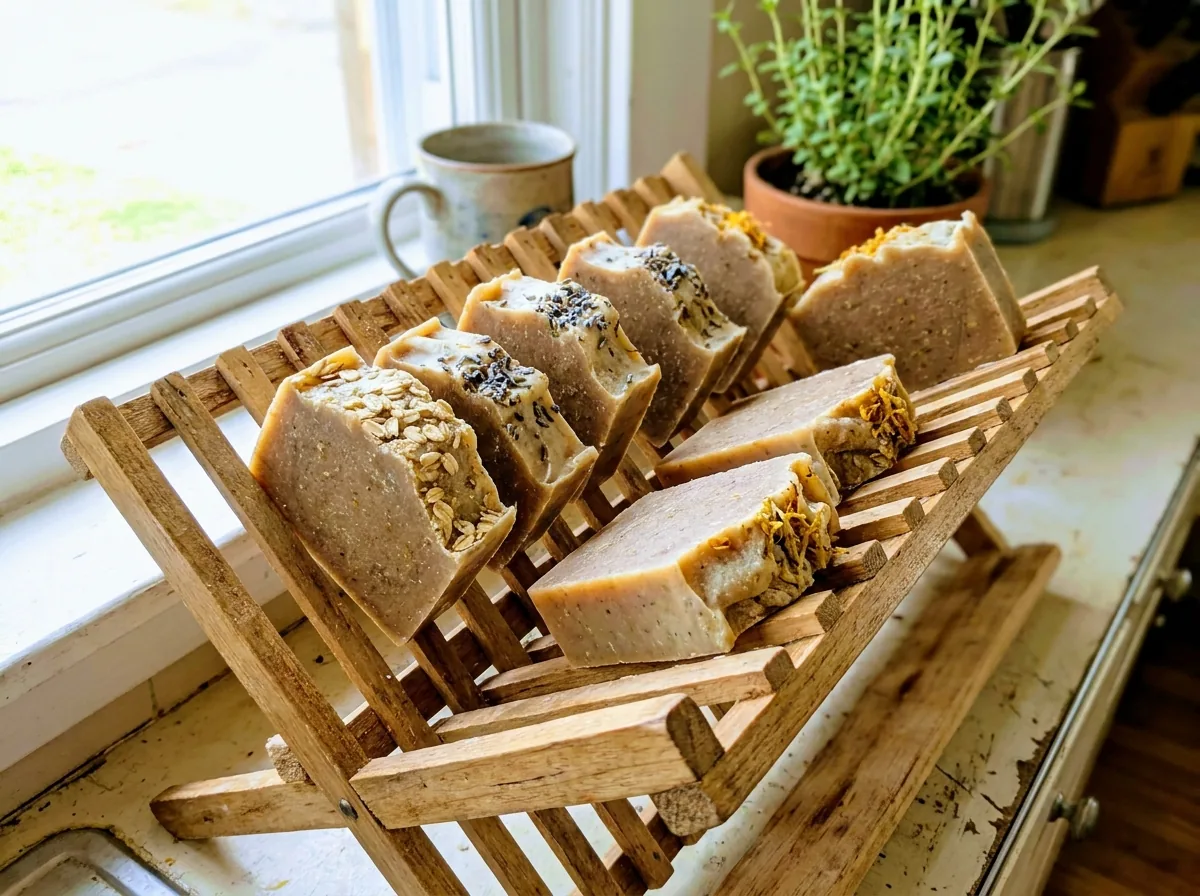
Ingredients
- 500 g Olive oilSAP value used: 0.134 g NaOH per g of oil
- 300 g Coconut oilSAP value used: 0.183 g NaOH per g of oil. Solid below about 24 °C, so melt it before weighing
- 200 g Palm oil (or palm-based hard fat)SAP value used: 0.141 g NaOH per g of oil. Makes a firmer bar; check how it is sourced
- 142.6 g Sodium hydroxide (lye), flakes or beadsSodium hydroxide only, sold as caustic soda. Not drain cleaner, which can contain other chemicals
- 285 g Water, coolAbout twice the weight of the lye, a 33% lye solution. Weigh it; do not measure by volume
Equipment
- Digital scale reading to 0.1 g (1 g at the very least)
- Splash goggles, long rubber or nitrile gloves, long sleeves, apron
- Heatproof jug for the lye solution (stainless steel or heatproof plastic, never aluminium)
- Large stainless steel or heatproof plastic pot or bucket for the oils
- Stick blender and a silicone spatula, kept for soap only
- Thermometer that reads 20–60 °C (70–140 °F)
- Loaf mould holding at least 1.5 litres, lined with baking paper or a silicone mould
- pH test strips (range covering 6–12)
Method
Clear the space and suit up
Work in a ventilated room, or by an open window with the extractor on, with children and pets shut out. Put on goggles, gloves and long sleeves before you open the lye, and keep them on until every jug, spoon and surface is rinsed.1,2
Check the lye sum
Each oil needs its weight times its sodium hydroxide saponification value: olive 500 × 0.134 = 67.0 g, coconut 300 × 0.183 = 54.9 g, palm 200 × 0.141 = 28.2 g, a total of 150.1 g for full conversion. At 5% superfat you use 95% of that, 150.1 × 0.95 = 142.6 g. Change any oil and this sum changes, so run the new recipe through a lye calculator before you weigh anything.2,3,4
Weigh everything
Weigh the water and lye into separate, dry containers, and weigh the oils into the large pot. Melt the coconut and palm oil gently first if they are solid, then add the olive oil.
Add the lye to the water
Slowly pour the lye into the water, stirring gently with a heatproof spoon. Never pour water onto lye: the solution heats up quickly and gives off vapour, so keep your face turned away and do not breathe it in. Leave the jug somewhere safe, out of reach, to cool.1,2
Cool both to 38–49 °C (100–120 °F)
The lye solution and the melted oils should both come down to roughly 38–49 °C. Keep them within about 10 °C of each other, which makes the batter easier to control.
Blend to trace
Pour the lye solution into the oils in a steady stream, then blend in short bursts with the stick blender, stirring between bursts, until the batter is like thin custard. Trace is reached when a line drizzled on the surface leaves a faint trail. Fragrance, if you add any, goes in now.2
Pour into the mould
Pour the batter into the lined mould and tap out air bubbles. Cover with a board and wrap in a towel to keep the heat in. The batter is still caustic, so keep gloves and goggles on until it is set.
Wait 24–48 hours, then cut
Leave the soap somewhere safe for 24–48 hours, until firm enough to unmould without denting. Cut into bars with gloves on, since fresh soap can still contain unreacted lye.2
Cure for 4–6 weeks and check the pH
Stand the bars on a rack in a cool, airy place, turning them now and then, for 4–6 weeks. Before using one, moisten a pH strip and rub it on the bar: a reading of 10 or below is what a university lab guide treats as safe to use, while a higher reading means it needs longer or was made wrongly.2
Safety
- Lye burns skin and eyes. Wear goggles, gloves and long sleeves throughout, and keep children and pets out of the room until you have cleaned up.1,2
- Always add lye to water, never water to lye. The mixture heats up fast and gives off vapour, so work in a well-ventilated space and do not breathe it in.1,2
- Skin splash: take off affected clothing and rinse with running water for at least 15 minutes. Eyes: rinse for at least 30 minutes, then get urgent medical help.1
- If lye or raw batter is swallowed, do not make the person vomit. Call emergency services or a poison centre straight away.1
- Never use aluminium: lye reacts with aluminium, tin and zinc. Use stainless steel or heatproof plastic, and keep the utensils for soap only.1
- Do not use a bar until a moistened pH strip reads 10 or below; a higher reading suggests free lye that can burn skin.2
Variations
Shea butter or castor oil are popular swaps, but each has its own saponification value. Whenever you change an oil or its weight, run the whole recipe through a lye calculator; do not reuse the lye figure above.
Scale every weight, including the lye and water, by the same factor. Half a batch is 250 g olive, 150 g coconut, 100 g palm, 71.3 g lye and 142.5 g water.
Does it actually work?
Soap cleans because each molecule has a water-loving head and an oil-loving tail, so it wraps oily dirt in tiny droplets called micelles that rinse away with water. Handmade soap keeps the glycerin the reaction produces, which one university guide says can be left in for a creamier bar; we found no trial showing a handmade bar is kinder to skin than another. Soap of any kind is alkaline and, in the reviews we read, tends to strip skin lipids and shift skin pH more than synthetic detergent cleansers. The word natural has no definition in the laws FDA enforces, and every true soap is made with lye: none is left in a properly made bar.2,5,6
Evidence ratings for what goes in: Olive oil, Coconut oil.
Questions people ask
Can I make soap without lye?
Not from scratch. Soap is, by definition, the product of fats or oils and an alkali such as lye. "Lye-free" methods start from a ready-made soap base that someone else has already made with lye; see our guide to soap without lye.
How long before I can use homemade soap?
Leave it 24–48 hours in the mould before cutting, then cure for 4–6 weeks. A moistened pH strip reading of 10 or below is the check a university lab guide uses before treating a bar as safe.
Why is there 5% superfat?
Using slightly less lye than the oils could use up leaves some oil unreacted, so there is no lye left over to burn skin. Five per cent is a common choice, not a fixed rule.
Can I change the oils in this recipe?
Only if you recalculate the lye. Each oil needs a different amount of sodium hydroxide, and too much leaves a caustic bar. Put the new recipe into a lye calculator and check the numbers before weighing.
Sources
- Regulator guidance ATSDR. Sodium Hydroxide: Medical Management Guidelines. Toxic Substances Portal.
- University lab guide North Carolina State University. The Soapmaking Factory Lab (lesson plan).
- International standard Codex Alimentarius. Standard for Named Vegetable Oils, CODEX STAN 210-1999 (saponification values for coconut and palm oil).
- International standard Codex Alimentarius. Standard for Olive Oils and Olive Pomace Oils, CODEX STAN 33-1981 (saponification value for olive oil).
- Regulator guidance US Food and Drug Administration. Frequently Asked Questions on Soap.
- Review Mijaljica D, Spada F, Harrison IP. Skin Cleansing without or with Compromise: Soaps and Syndets. Molecules. 2022.
Educational only. Patch-test anything new on your skin, and stop if it irritates.