Awaiting review. This guide is sourced but has not yet been checked by our reviewer.
How to Make Soap Without Lye (Melt and Pour)
You cannot make true soap without lye, because soap is what forms when fat meets an alkali such as lye. Melt-and-pour soap base has already gone through that reaction at the factory, so you only melt it, add a little colour or texture, and set it in a mould. The one safety point is heat: melted base is a hot liquid that can scald.
Draft, awaiting clinical review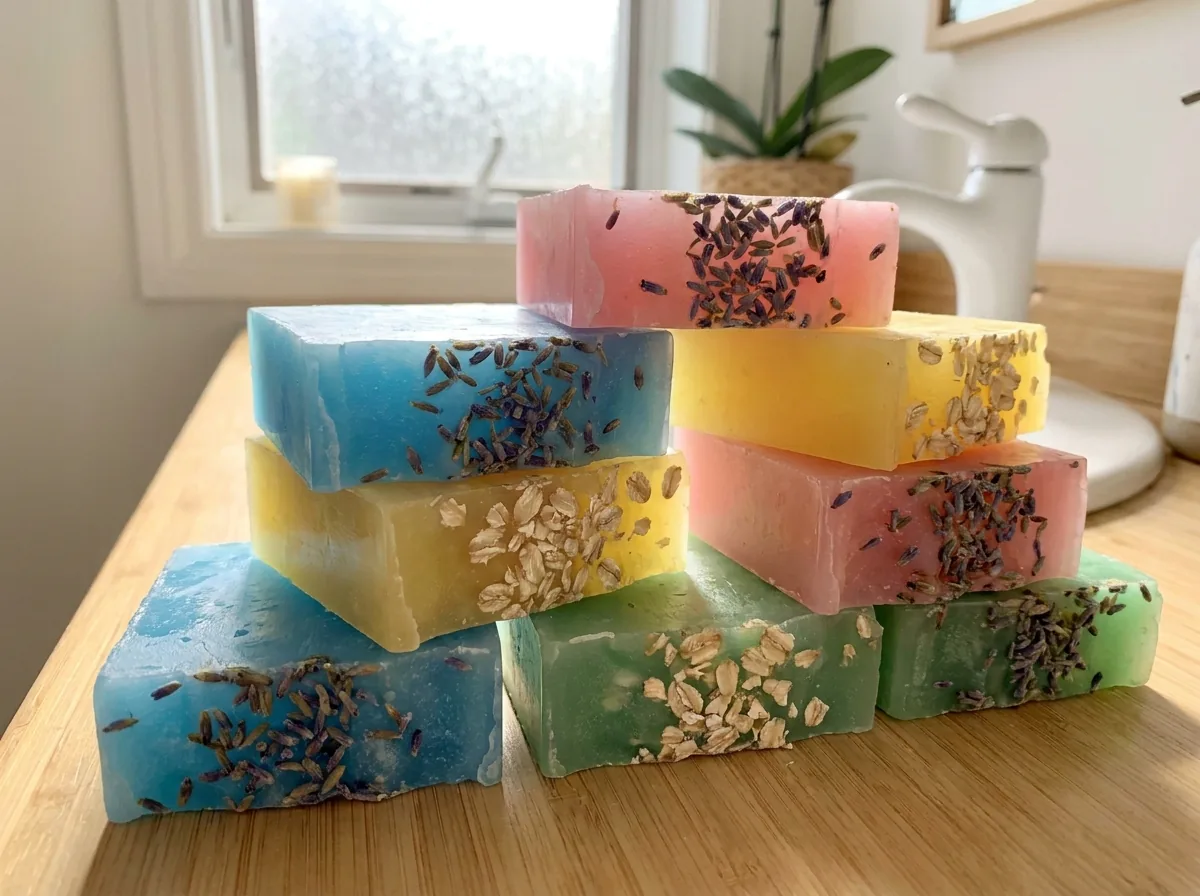
Ingredients
- 400 g Melt-and-pour soap base (clear glycerine or goat's milk)Buy it ready-made in blocks; cut into 2 cm cubes so it melts evenly
- 1 tbsp (about 2 g) Dried lavender budsCrush a little; whole buds tend to brown and float
- 1 tbsp (about 6 g) Rolled oats, ground fineFor gentle texture only
- 1 tsp (about 7 g) HoneyOptional; stir in well so it does not sink
- 1 tsp (about 3 g) Cosmetic clayOptional; mix with a teaspoon of the melted base first to avoid lumps
- A few drops or a pinch Skin-safe soap colourantOptional; add a little at a time
- Up to 8 drops (about 0.4 g, roughly 0.1% of the batch) Lavender essential oilOptional; leave out for a fragrance-free bar
- A few sprays Rubbing alcohol in a spray bottleTo pop surface bubbles
Equipment
- Heatproof jug (microwave-safe) or a bowl over a pan of simmering water
- Silicone soap mould or a small lined loaf tin
- Silicone spatula or spoon
- Sharp knife and chopping board
- Oven gloves
- Kitchen scales
Method
Understand what you are buying
Ordinary soap is made by combining fats or oils with an alkali such as lye. Melt-and-pour base has already been through that reaction, so there is no lye for you to handle. It is still soap, and it still needs to be handled with care.1
Prepare the mould and base
Set the mould on a tray so you can carry it once full. Weigh 400 g of base and cut it into small, even cubes.
Melt gently in short bursts
Put the cubes in the jug. Microwave in 30-second bursts, stirring between each, until only a few small lumps remain, then stir until they melt. Or melt in a bowl over simmering (not boiling) water. Do not let the base boil or scorch.
Let it cool slightly
Take the jug off the heat and let it cool for a minute or two while you stir. Cooling briefly helps the botanicals stay suspended rather than sinking, and makes it less likely to splash.
Stir in the additives
Add the ground oats, crushed lavender and any honey, clay or colour, stirring after each. If you are using essential oil, add it last, and keep to the low amount in the list.4,5
Pour into the mould
Pour slowly into the cavities. Carry the tray with oven gloves if the jug is hot. Scatter a few extra lavender buds on top if you like.
Spritz away bubbles
Mist the surface lightly with rubbing alcohol straight after pouring. The bubbles usually vanish within seconds.
Set, unmould and store
Leave the soap to harden at room temperature for about an hour, longer for large bars. Pop the bars out, and wrap them in cling film if you want to keep them for a while, because glycerine soap draws moisture from the air.
Safety
- Melted base is a hot liquid. If you scald yourself, hold the burn under cool running water for 20 minutes3
- Patch-test a finished bar before using it: wash a small patch of inner forearm with it and wait 24 hours
- Essential oils can cause allergic contact dermatitis, and lavender is one of the oils most often reported. Use little or none4,5
- If you label or sell it as moisturising or antibacterial, it stops being plain soap in law and becomes a cosmetic or drug1,2
- Keep the mould and any melted base away from children and pets while it is hot
Variations
Leave out the essential oil. It is the ingredient most likely to cause a skin reaction, and the lavender buds still give a little scent.
Use a goat's milk base, skip the lavender, and stir in the teaspoon of honey. Colour will vary from cream to pale tan.
Pour half the batch, wait until the surface has a skin, spritz it with alcohol, then pour the second layer so the two stick together.
Does it actually work?
It cleans like any soap, because the cleaning is done by the soap base. That is the only benefit you can count on. Oats, honey and clay are in the bar for texture and look, and we found no good evidence that they do anything extra to skin in a product you rinse off within seconds. Colloidal oatmeal has some evidence as a leave-on skin protectant, and honey has limited evidence in burns dressings, but neither has been shown to work in a soap bar. Our ingredient entries for oatmeal and honey give the detail. Essential oils add scent, not a proven skin benefit.1
Questions people ask
Can you really make soap without lye?
Not from scratch. Ordinary soap is made by combining fats or oils with an alkali such as lye. Melt-and-pour base has already been through that step at the factory, so you can shape it without handling lye yourself.
How hot should I melt the soap base?
Melt it just until it turns liquid, in 30-second bursts with stirring in between. It does not need to boil, and overheating can scorch it and make it hard to work with. Packaging from the maker of your base will give an exact range.
Are essential oils safe in homemade soap?
Some essential oils are known skin sensitisers, and lavender and tea tree are among those most often linked to allergic contact dermatitis. Use a very small amount, or leave them out.
Can I add fresh herbs, fruit or flowers?
It is better not to. Fresh plant material holds water, and it can go mouldy or brown in a bar. Stick to dried botanicals and use them sparingly.
Can I sell my melt-and-pour soap?
Rules depend on where you live and on what you claim. In the US, a bar that makes moisturising, fragrance or deodorising claims counts as a cosmetic, and one that claims to treat or prevent disease counts as a drug. Check the local rules before you sell.
Sources
- Regulator Frequently Asked Questions on Soap. US Food and Drug Administration.
- Regulator Is It a Cosmetic, a Drug, or Both? (Or Is It Soap?). US Food and Drug Administration.
- Public health Burns and scalds: Treatment. NHS.
- Clinical study Barbaud A, et al. Allergic contact dermatitis from essential oil in consumer products: Mode of uses and value of patch tests with an essential oil series. Contact Dermatitis. 2023.
- Review Karlberg AT, et al. Activation of non-sensitizing or low-sensitizing fragrance substances into potent sensitizers - prehaptens and prohaptens. Contact Dermatitis. 2013.
Educational only. Patch-test anything new on your skin, and stop if it irritates.