
How to tell if an essential oil or carrier oil is pure
Short answer
You cannot tell from the label or at home. ‘Pure’ and ‘therapeutic grade’ have no regulatory definition behind them[1], and laboratory studies find essential oils diluted with vegetable oil, cut with cheaper oils or added to with synthetic compounds[3]. The best evidence you can get is a batch-specific analysis from an independent laboratory, read with its limits in mind[5][6], from a seller who names the plant, the extraction method and the country.
What ‘pure’ and ‘therapeutic grade’ mean
FDA says there is no regulatory definition for ‘essential oils’, although people commonly use the term for certain oils extracted from plants[1]. We read FDA’s fragrance and aromatherapy pages and neither defines ‘pure’ or ‘therapeutic grade’[1][2]. In practice those are words a company chooses to print, not a standard it has been held to.
FDA decides how to regulate an aromatherapy product by its intended use. If it is intended to treat or prevent disease, or to affect the body’s structure or function, it is a drug, and claims such as easing pain or helping you sleep are drug claims[2]. FDA also says that coming from a plant does not make something safe[2]. ‘Pure’ is a statement about purity, not safety, so a pure oil can still irritate or be toxic.
How essential oils are adulterated
A 2021 peer-reviewed study from the University of Turin describes the common adulterations as adding cheaper essential oils or synthetic materials, and diluting the oil with vegetable oils. The authors tested commercial lavender, bergamot and tea tree oils adulterated with synthetic components, with essential oils of different origin and lower value, and with heavy vegetable oils[3].
Dilution is the awkward one. It changes neither which compounds are present nor their percentages, so the usual percentage profile stops being diagnostic and an absolute quantitative analysis, with a reference profile to compare against, is needed[3].
A 2026 study of four commercial lavender oils from the Egyptian market used GC-MS to find substantial differences in quality. Some samples had unusually high levels of fatty acid esters not characteristic of lavender and synthetic glycols, which the authors took to suggest dilution with carrier oils or formulation additives[4]. That is four samples from one market, so it shows that variation exists, not how common it is. See our lavender and tea tree oil entries for what those oils are used for.
Adding synthetic linalool to a linalool-rich oil such as lavender is a known case. Tisserand Institute notes that dihydrolinalool, a marker of synthetic linalool addition, is one of the compounds GC-MS can reveal that should not be in a given oil[5].
GC-MS reports, and what to look for
GC-MS (gas chromatography with mass spectrometry) separates an oil into its volatile compounds, identifies them and gives the proportions. Tisserand Institute calls it the core of any valuable quality control procedure, but says it does not tell us everything[5]. On a report, look for:
- A batch-specific report from a third-party laboratory, which the Tisserand Institute lists as a green flag. No analysis available even on request is a red flag[6]. Check that the batch number on the report matches your bottle.
- The expected main compounds for that species. For lavender the Egyptian study treated linalool and linalyl acetate as the principal quality markers[4]. GC-MS can confirm a stated botanical source, for example telling lavender from lavandin, and a chemotype[5].
- Compounds that should not be there, such as fatty acid esters or glycols, or markers of synthetic additions[4][5].
What a GC-MS report cannot show:
- Dilution with a vegetable oil, if it only lists percentages of the volatile compounds[3]. GC-MS also does not see non-volatile molecules[5].
- Whether a compound is natural or synthetic. Tisserand Institute says standard GC-MS cannot tell, and that chiral GC, carbon-14 testing or isotope ratios are needed for some cases. Even those may miss some additions[5].
- Pesticides and heavy metals. Standard GC-MS for composition is not sensitive enough for pesticides, and heavy metals need different techniques[5].
- Exact percentages. Percentages come from internal normalisation, described as a practical, commonly accepted approximation, and results are hard to compare between laboratories[5].
Latin name, country and batch
The Tisserand Institute’s checklist for judging a supplier is a useful filter, even though it is an educational body’s guidance, not a regulation[6]:
- Botanical (Latin) name. Different species give different oils, even within one genus. A missing or wrong name is a red flag[6].
- Extraction method and product type. For example, expressed lime oil is phototoxic while distilled lime is not, and an oleoresin is not an essential oil[6].
- Country of origin, noted or disclosed on request[6].
- Batch-specific analysis, as above[6].
- A plausible price. Yields differ by plant, so prices should differ between oils, and a price far below the going rate is a red flag[6].
Home tests and their limits
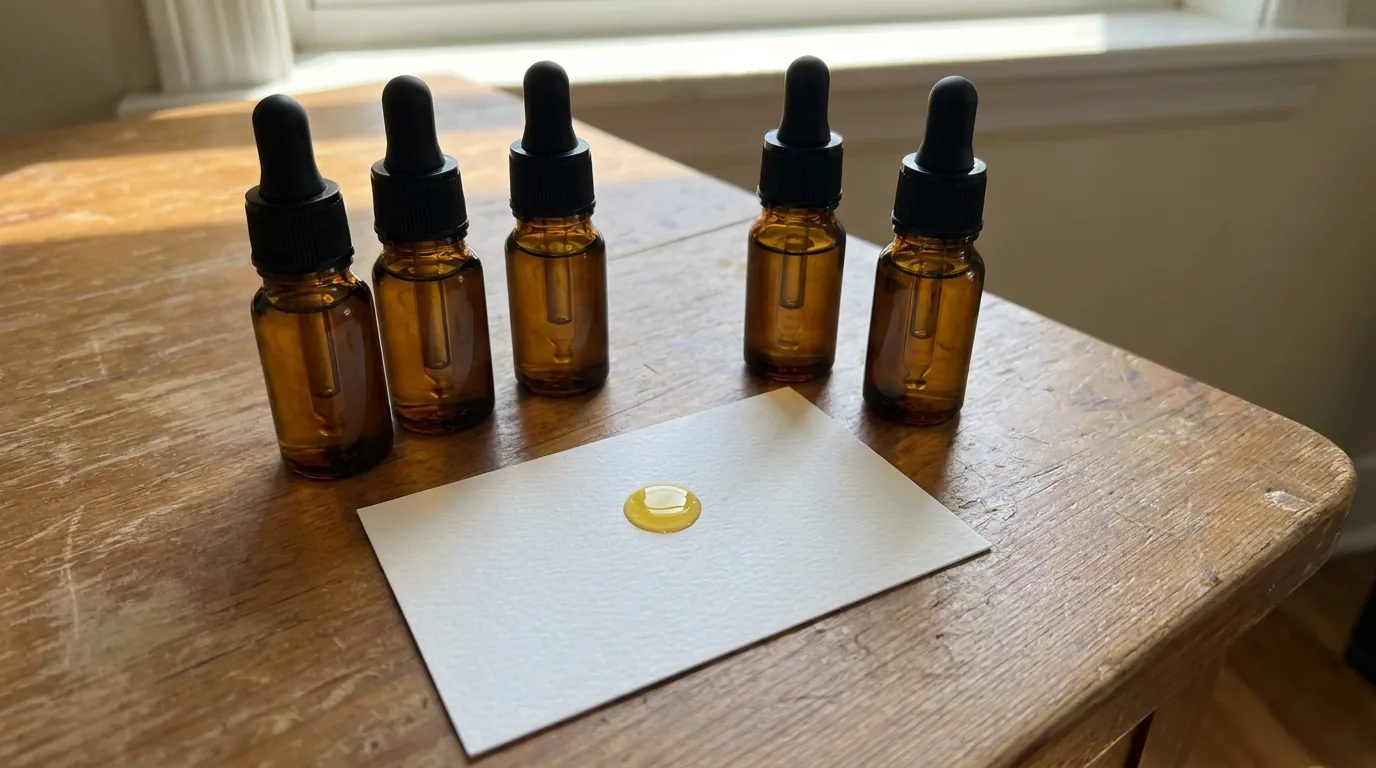
Two tests circulate widely. In the paper test you put a drop on plain paper and see whether it leaves a greasy mark after it dries. In the freezer test you see whether the oil goes cloudy or solid when chilled. We found no authoritative source that has validated either, so what follows is our reasoning from the laboratory evidence above, not a tested result.
- The paper test could at best hint at a fatty carrier oil, because essential oils are made of volatile molecules[5] and a fatty oil is not. It cannot detect cheaper essential oils or synthetic additions[3]. Some pure oils also leave a coloured mark, and a small amount of carrier oil might not show.
- The freezer test depends on what an oil is made of, which differs between species, chemotypes and batches, and across real commercial lavender oils[4]. An oil that stays liquid or turns cloudy tells you little about whether it was adulterated.
- Smell helps only when you know the oil well. Tisserand Institute does point out that an oil’s odour remains a fair starting point[5], but it cannot reveal synthetic linalool or a cheaper oil.
Passing a home test proves nothing about purity. Failing one, for instance a clearly greasy ring, is a fair reason to ask the seller questions.
Carrier oils: cold-pressed, refined and rancidity
Cold pressing is a mechanical extraction that uses no heat or solvents. A 2026 systematic review found cold-pressed oils keep significantly higher levels of polyunsaturated fatty acids, antioxidants and vitamins than refined oils[7]. Refined oils are processed more, which is why they are less likely to carry those compounds, though the review does not compare their shelf life directly.
The catch is rancidity. The same review says oils rich in mono- and polyunsaturated fatty acids are particularly susceptible to oxidation, and that quality and shelf life depend on raw material, harvest, moisture, pre-processing, extraction and storage conditions[7]. In one laboratory study of four cold-pressed grape seed oils, the most stable reached an oxidative stability index of 40 hours under accelerated conditions[8], which shows stability is measurable and varies, but not how long an oil keeps on your shelf. So ‘cold-pressed’ does not mean fresh or stable. Look for a pressing or best-before date, buy sizes you will use up, and store oils closed, cool and away from light. If an oil smells different from when you opened it, replace it.
A carrier oil is also not automatically what the label says. We have not found a study we can cite on carrier oil adulteration for this page, so the practical check is the same as for essential oils: a named species, the extraction method and a seller who can show batch information. For how other labels work, see How to read a supplement label and Standardised extracts, explained.
Questions people ask
Does ‘100% pure’ on the label mean anything?
Not by itself. FDA says there is no regulatory definition for “essential oils”, and neither of its pages we read defines “pure” or “therapeutic grade”, so they work as marketing words. What you can check is the botanical name, the extraction method, the country of origin and whether there is a batch-specific analysis.
Is a GC-MS report proof that an oil is pure?
No. It is the best single check, but it has limits. A report of percentages can miss an oil that has been diluted with a vegetable oil, and standard GC-MS cannot tell a natural compound from a synthetic copy of it. It is also only as good as its link to your batch.
Can I test an essential oil at home?
Not reliably. The home tests can at most hint at a fatty carrier oil. They cannot detect cheaper essential oils or synthetic additions, which are the adulterations the laboratory literature describes.
Sources (8)
- Regulator/health agency FDA. Fragrances in Cosmetics (section: “Essential Oils” and “Aromatherapy”).
- Regulator/health agency FDA. Aromatherapy (content current as of 8 September 2023).
- Laboratory study Capetti F, Marengo A, Cagliero C, et al. Adulteration of Essential Oils: A Multitask Issue for Quality Control. Three Case Studies: Lavandula angustifolia Mill., Citrus limon (L.) Osbeck and Melaleuca alternifolia (Maiden & Betche) Cheel. Molecules. 2021.
- Laboratory study Abouelela MB, El-Taher EM, Shawky EM, Baky MH. Uncovering adulteration and quality variations in commercial lavender essential oils from the Egyptian market using GC-MS and chemometrics. Sci Rep. 2026.
- Educational organisation St-Gelais A. The Highs and Lows of GC-MS in Essential Oil Analysis. Tisserand Institute.
- Educational organisation Tisserand H. Eight green and red flags when looking for your ideal essential oil supplier. Tisserand Institute.
- Systematic review Dash B, Sarangi A, Nayak A, et al. Cold pressed oils: a systematic review on physicochemical properties, nutritional composition and pharmacological activities. Front Nutr. 2026.
- Laboratory study Lutterodt H, Slavin M, Whent M, Turner E, Yu LL. Fatty acid composition, oxidative stability, antioxidant and antiproliferative properties of selected cold-pressed grape seed oils and flours. Food Chem. 2011.
Reviewed by Healthy and Herbal editors · 1 October 2026 · Next review April 2027
Reader notes
Experiences and questions from readers, read by an editor before they appear. They are personal accounts, not evidence, and are not medical advice.