
Moringa
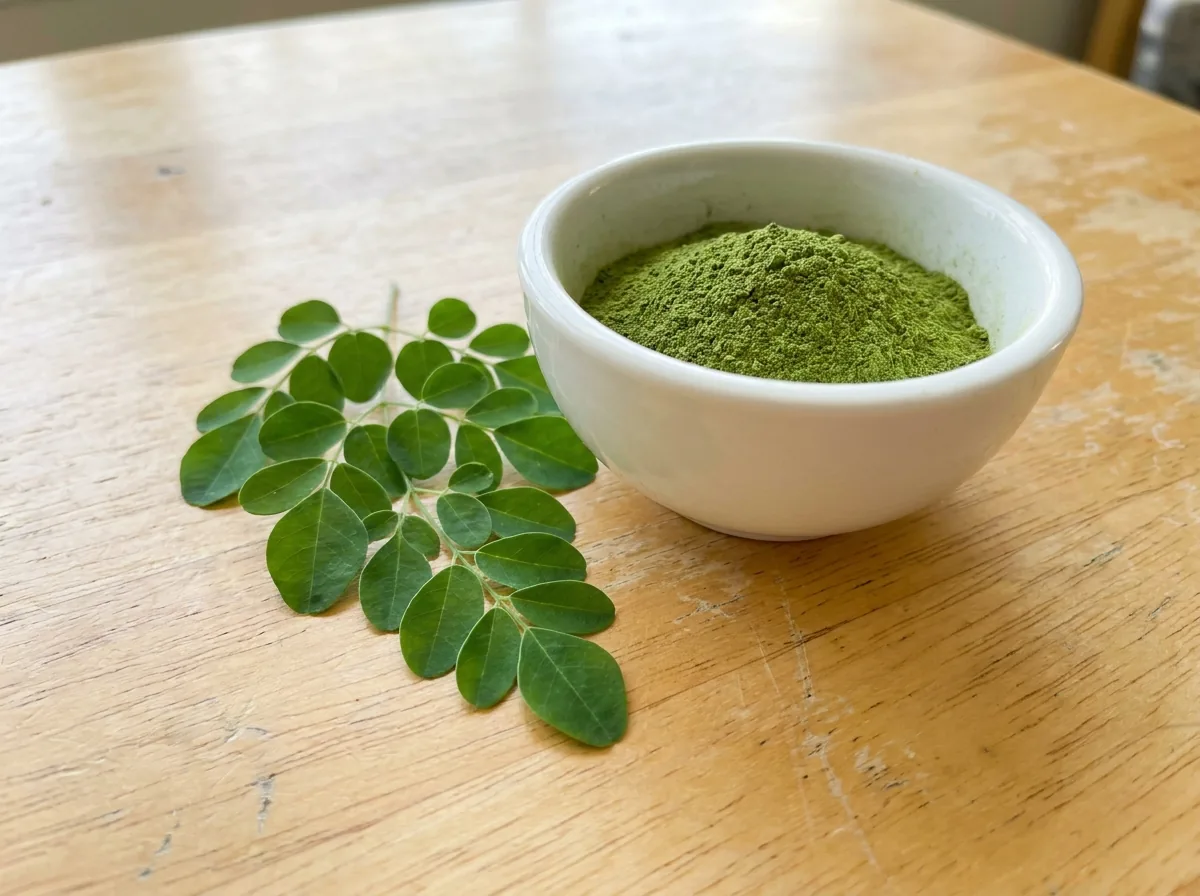
Moringa leaf powder had few reported side effects in trials lasting up to six months, but the evidence that it does anything medical is limited: small trials suggest more breast milk after birth and a slight fall in blood sugar in prediabetes, while pooled trials found no clear effect on glucose, cholesterol or blood pressure. Use only the leaf: the root and bark contain toxic alkaloids, and moringa is best avoided in pregnancy.
The famous nutrient claims hold, roughly, for 100 g of fresh leaves, not for a spoonful of dried powder.
At a glance
Last reviewed 10 October 2026What it's used for
Evidence is rated per use. The same ingredient can be strong for one thing and traditional for another.
| Use | Evidence | What the research shows |
|---|---|---|
| Breast milk supplyCompare remedies for women’s health → | Limited | A 2026 systematic review of herbal galactagogues for mothers of preterm babies found one moringa trial (68 mothers in the Philippines): 250 mg leaf capsules twice daily gave about 66 mL more milk than placebo on day 2 and about 200 mL more on day 3; the reviewers rated the evidence low certainty. In a small Kenyan pilot, mothers eating about 12 to 15 g of leaf powder a day in porridge expressed 947 mL a day at 3 months against 618 mL in controls, but each group came from a different hospital, so the place may explain the gap.3,4 |
| Blood sugar in prediabetesCompare remedies for blood sugar → | Limited | In a 12-week placebo-controlled trial of 73 adults with prediabetes, 2.4 g of leaf powder a day lowered HbA1c from 5.88% to 5.79% (placebo rose from 5.83% to 5.87%) and fasting glucose by about 3 mg/dL; it did not make more people return to normal glucose. A 2025 meta-analysis of 9 randomised trials found no clear effect on fasting glucose (7 trials) or HbA1c (3 trials) and rated the evidence very low certainty.2,1 |
| Blood pressure | Limited | The 2025 meta-analysis found no clear effect on systolic pressure and a small fall in diastolic pressure that disappeared when some studies were left out, all at very low certainty. A 2025 review found only four human studies, none in people with high blood pressure, and judged the evidence insufficient to recommend moringa for it.1,5 |
| Cholesterol and triglycerides | Limited | Pooling 5 randomised trials, the 2025 meta-analysis found no significant change in total, LDL or HDL cholesterol or triglycerides, with results that varied widely between trials and very low certainty. The 12-week prediabetes trial also saw no lipid change against placebo.1,2 |
| Anaemia (low iron) | Limited | In the Kenyan breastfeeding pilot, 3 months of leaf powder did not change the mothers' haemoglobin or ferritin compared with controls (12.8 vs 12.7 g/dL), although their babies' haemoglobin was slightly higher (11.3 vs 10.7 g/dL). Retail leaf powders tested in Thailand held about 4 to 10 mg of iron per 100 g, so a 2.4 g daily dose supplies roughly 0.1 to 0.25 mg.4,9 |
How much
Ranges below are what studies used and what supplements commonly contain. They are not a recommendation for you. Start at the low end.
How people take it
Safety
Who should avoid
- Pregnancy — no safety data; animal studies report anti-fertility effects
- Root or bark products — toxic alkaloids such as spirochin, mainly in root and bark
- Children — trials studied adults; no supplement dose established for children
- Diabetes or blood pressure medicine — ask first, effects may add up
Known interactions
Questions people ask
Does moringa really have more vitamin C than oranges and more calcium than milk?
Not in the form most people buy. Fresh raw leaves have about 52 mg of vitamin C per 100 g, roughly the same as an orange, but one analysis of dried powder found under 4 mg per 100 g, so a 2.4 g daily dose gives about 0.1 mg. Dried powder is rich in calcium by weight (about 830 mg per 100 g), yet a typical 2 to 3 g serving supplies only about 20 mg.
Does moringa increase breast milk?
Possibly, but the evidence is thin. One small trial in mothers of preterm babies found more milk on days 2 and 3 with 250 mg capsules twice a day, and a Kenyan pilot found more expressed milk after 3 months, but the reviewers rated it low certainty and the pilot's groups came from different hospitals.
If milk supply is a worry, a midwife or lactation consultant is the first step.
Can moringa lower blood sugar?
Only slightly, if at all. One 12-week trial in prediabetes found HbA1c about 0.1 percentage points lower than placebo, while a meta-analysis of 9 trials found no clear effect on fasting glucose or HbA1c. It is not a replacement for diabetes treatment, and if you take diabetes medicine, ask your prescriber before adding it.
Is moringa safe?
The leaf had few reported side effects in trials of up to six months, but the root and bark contain toxic alkaloids and should not be used. Powders can carry heavy metals: a Thai survey of 35 products found one capsule product with 24 mg of lead per kg, so pick brands that publish contaminant tests.
Sources (10)
- Systematic review and meta-analysis Crișan D, Gavrilaș L, Păltinean R, Frumuzachi O, Mocan A, Crișan G. Effects of Moringa oleifera Lam. Supplementation on Cardiometabolic Outcomes: A Meta-Analysis of Randomized Controlled Trials with GRADE Assessment. Nutrients. 2025.
- Randomised controlled trial Gómez-Martínez S, Díaz-Prieto LE, Vicente Castro I, et al. Moringa oleifera Leaf Supplementation as a Glycemic Control Strategy in Subjects with Prediabetes. Nutrients. 2021.
- Systematic review Cragg A, Levene I, Darabi S, Willcox M. Herbal galactagogues to improve breastmilk production and lactation in mothers of preterm babies: a systematic review of clinical trials. Eur J Clin Nutr. 2026.
- Cluster randomised pilot trial Attia SL, Owuor PM, Odhiambo SA, et al. Effect of Maternal Moringa oleifera Leaf Supplementation on Maternal and Infant Nutritional Status and Human Milk Output: A Pilot Single-Blinded Cluster-Randomized Trial. Curr Dev Nutr. 2025.
- Review Menichetti F, Berteotti C, Schirinzi V, Poli C, Arrighi R, Leone A. Moringa oleifera and Blood Pressure: Evidence and Potential Mechanisms. Nutrients. 2025.
- Interaction review Nyirenda KK, Mponda J, Chikowe I, et al. An exploratory evaluation of the interaction risk between herbal products and pharmaceutical medicines used concurrently for disease management in Blantyre, Malawi. Pharm Biol. 2025.
- Nutrient database US Department of Agriculture, FoodData Central. Drumstick leaves, raw (FDC ID 168416, SR Legacy). 2019.
- Composition analysis Kim YJ, Kim HS. Screening Moringa species focused on development of locally available sustainable nutritional supplements. Nutr Res Pract. 2019.
- Contamination analysis Limmatvapirat C, Limmatvapirat S, Charoenteeraboon J, et al. Comparison of Eleven Heavy Metals in Moringa Oleifera Lam. Products. Indian J Pharm Sci. 2015.
- Review Canett-Romero R, Arvayo-Mata KL, Ruvalcaba-Garfias NV. Aspectos tóxicos más relevantes de Moringa oleifera y sus posibles daños [Most relevant toxic aspects of Moringa oleifera and its possible harms]. Biotecnia. 2014.
Last reviewed 10 October 2026 · Next review April 2027 · How we rate evidence
Reader notes
Experiences and questions from readers, read by an editor before they appear. They are personal accounts, not evidence, and are not medical advice.