
How to Make a Sourdough Starter from Scratch
A sourdough starter is just flour and water left to ferment, fed by weight so the wild yeasts and lactic acid bacteria in flour take over. University of Illinois Extension's method starts with 50 g of whole rye flour and 55 g of water, kept at 21–28°C (70–82°F), then each feed keeps 50 g of starter and adds 50 g of flour and 50–55 g of water: once a day at first, twice a day from day 4.
It can raise bread from about day 7 and is fully reliable when it doubles within 4–6 hours of a feed, usually by day 14; throw it away if mould appears.
Ingredients
- 50 g (½ cup) on day 1, then 25 g (¼ cup) per feed Whole rye flourWholemeal wheat flour also works. Illinois Extension recommends whole grain flour to start because wild yeasts thrive on it
- 25 g (¼ cup) per feed, from day 2 Unbleached strong white bread flour or plain flourHalf rye or wholemeal and half white gives the culture more readily available food
- 55 g (about ¼ cup) on day 1, then 50–55 g per feed Water, unchlorinatedFiltered or bottled spring water, or tap water left to stand overnight. Standing doesn't remove chloramine, so use filtered water if your supply uses it
Equipment
- Wide-mouth glass jar of about 500 ml–1 litre (a large mason jar), or food-grade plastic. Not copper, iron or galvanised metal
- Digital kitchen scale (recommended)
- Spatula or spoon for stirring
- Rubber band to mark the level
- Loose lid, cloth or paper towel to cover
- Room thermometer (optional)
Method
Get the jar and water ready
Wash your hands and wash the jar and spatula in hot soapy water. If you'll reuse the same jar, weigh it empty and write the weight down so you can weigh the starter in it later. Use filtered or spring water, or tap water that has stood overnight, because chlorine can hold the culture back.1,2
Day 1: mix flour and water
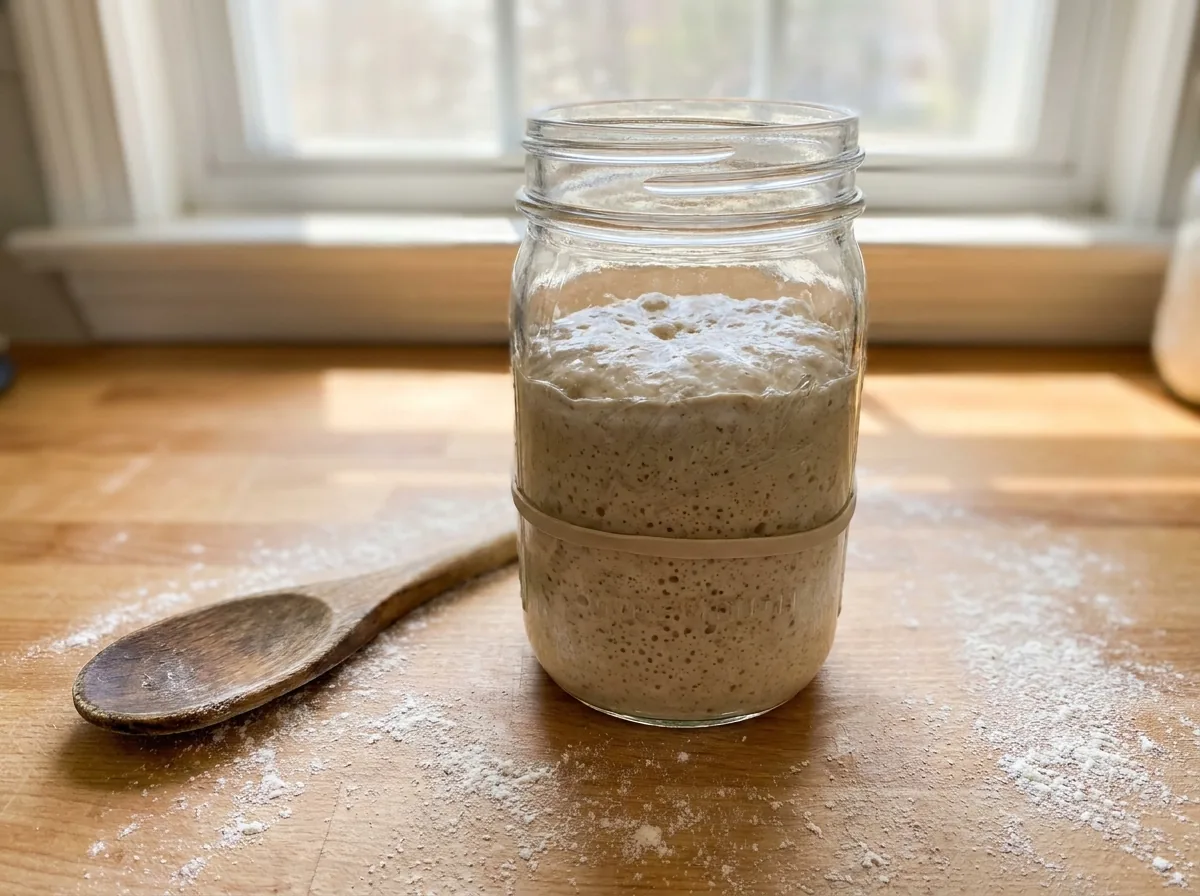
Stir 50 g (½ cup) of whole rye flour and 55 g (about ¼ cup) of water together in the jar until there's no dry flour. Put a rubber band round the jar at the level of the starter, cover it loosely and leave it somewhere warm, ideally 21–28°C (70–82°F), for 24 hours.2
Days 2 and 3: discard and feed once a day
Stir the starter, then discard all but 50 g. Add 25 g of white flour, 25 g of whole rye flour and 50–55 g of water, stir until smooth, move the rubber band to the new level, cover loosely and leave it in the warm for 24 hours. Discarding keeps the jar manageable and gives the microbes plenty of fresh food.1,2
Don't be fooled by an early burst
Many starters bubble up dramatically on day 2 or 3, then go quiet for a few days. That first activity comes from microbes that arrive on the flour; NC State researchers who followed 40 starters found the mix shifting from flour bacteria to lactic acid bacteria such as Weissella and Leuconostoc over these days, with acidity rising by day 3. It's normal: keep feeding.3
Day 4 onwards: feed twice a day
Feed every 12 hours using the same method: keep 50 g, add 25 g white flour, 25 g rye or wholemeal flour and 50–55 g water. Keep going for at least a week, and up to two.1,2
If it's sluggish, make it warmer
Starters need warmth and patience; establishing one can take 14 days to a month. If it isn't rising, move it somewhere warmer within 21–28°C (70–82°F) or use more rye flour. Keep feeding regularly rather than starting again.1
Check it is ready
It's ready when it reliably rises and falls, at least doubling within 4–6 hours of a feed, smells yeasty and pleasant, has bubbles on top and large ones down the sides, and is stretchy and mousse-like. It can raise bread from about day 7, but Illinois Extension advises waiting until at least day 14 for a stronger, more dependable starter.1
Bake with it at its peak
Use the starter once it has at least doubled, usually 4–6 hours after a feed and before it falls back. To have it peak in the morning, feed a bigger ratio the night before, such as 10 g starter, 100 g flour and 100 g water; more food slows it down.1
Keep it going
If you bake every day or several times a week, keep it on the counter and feed it daily. If you bake weekly, keep it in the fridge and take it out to feed the day before you bake; it doesn't need to warm up first. If you bake monthly, it may need a couple of feeds 12 hours apart to get going again.1
Dry some as a backup
For a long break, feed it, let it double, spread it very thinly on baking paper and leave it at room temperature until brittle. Break it up and keep it in a labelled airtight container away from heat and sun. Freezing works too, but can damage the cells so it performs poorly after thawing.1
Safety
- If you see mould, throw the whole starter away rather than scraping it off. Treat fuzzy patches and pink or orange streaks the same way1
- Use glass, food-grade plastic or a crock. Illinois Extension advises against copper, iron or galvanised metal containers1
- Wash your hands and equipment before handling the starter, and keep it loosely covered to limit what falls in from the air1
- Wheat, rye and barley sourdough still contains gluten and isn't safe with coeliac disease. Only bread labelled gluten-free is1,8
Variations
Feed with 50 g wholemeal wheat flour instead of the rye and white mix. Whole grain flours tend to ferment faster and give a stronger flavour; feed more often if it peaks and collapses quickly.
Use less water, for example 50 g starter, 50 g flour and 30 g water, for a dough-like starter that rises more slowly and is easier to time. Judge readiness by the same doubling test.
Use gluten-free flours such as teff, millet, sorghum or buckwheat, fed the same way. In the NC State study, starters made from teff, millet, sorghum, buckwheat and amaranth all rose.
Does it actually work?
Sourdough's health claims are smaller than its reputation. A 2024 meta-analysis of 18 trials found blood sugar was about 0.29 mmol/L lower an hour after sourdough than after ordinary bread or glucose, but rated the evidence low to very low certainty; a 2026 systematic review of 27 studies in healthy adults concluded the evidence for a glucose or insulin benefit over yeast bread is neither sufficient nor convincing.
Long fermentation does cut fructans, a FODMAP that can trigger IBS symptoms: in one small trial, the sourdough bread had about a quarter of the fructans of yeast bread, yet 26 people with IBS and wheat sensitivity reported no difference in gut symptoms. And sourdough made from wheat, rye or barley is not gluten-free, so it isn't safe with coeliac disease. Bake it because it tastes good and keeps well, not as a treatment.5,6,7,8
Questions people ask
What is the dark liquid on top of my starter?
It's called hooch: alcohol made by the yeasts, which collects on top when the starter hasn't been fed for a while. Pour it off or stir it back in, as you like, and feed the starter. It's a sign of hunger, not spoilage, unlike mould.
Does the float test show my starter is ready?
Dropping a spoonful in water and seeing it float only shows it is full of gas at that moment; a stiff or wholemeal starter can be active and still sink. We found no study testing it. The more reliable sign is the one Illinois Extension uses: it at least doubles within 4–6 hours of a feed, time after time.
Why is my starter not rising?
Usually it's too cool or too young. Keep it at 21–28°C (70–82°F), feed it regularly and give it time, as establishing a starter can take 14 days to a month. Switching some of the flour to rye can also help, and very hard or heavily chlorinated water can slow it down.
Does where you live change your sourdough starter?
Much less than people think. A study of 500 home starters from four continents found location did not predict which microbes a starter contained within the US; each held a median of three bacterial species and one yeast, usually baker's yeast, Saccharomyces cerevisiae.
Starters with more acetic acid bacteria rose more slowly and smelled more of vinegar.
Can I freeze sourdough starter?
You can, but freezing can damage the cells, so it may be slow when thawed. Illinois Extension recommends drying a thin layer of freshly fed starter instead, then storing the brittle flakes airtight.
Sources (8)
- University extension University of Illinois Extension. Sourdough Bread: 101.
- University extension University of Illinois Extension. Sourdough Bread: 101 – Sourdough Starter Recipe. Modified December 2025.
- Research study McKenney EA, Nichols LM, Alvarado S, et al. Sourdough starters exhibit similar succession patterns but develop flour-specific climax communities. PeerJ. 2023.
- Research study Landis EA, Oliverio AM, McKenney EA, et al. The diversity and function of sourdough starter microbiomes. eLife. 2021.
- Systematic review Rolim ME, Fortes MI, Von Frankenberg A, Duarte CK. Consumption of sourdough bread and changes in the glycemic control and satiety: A systematic review. Crit Rev Food Sci Nutr. 2024.
- Systematic review Starowicz M, Domínguez-Soberanes J, Garcia-Gutierrez E, et al. Effects of sourdough and yeast fermented breads consumption on glycaemia in healthy populations: a systematic review. Front Nutr. 2026.
- Randomised controlled trial Laatikainen R, Koskenpato J, Hongisto SM, et al. Pilot Study: Comparison of Sourdough Wheat Bread and Yeast-Fermented Wheat Bread in Individuals with Wheat Sensitivity and Irritable Bowel Syndrome. Nutrients. 2017.
- Health service NHS. Coeliac disease – Treatment.
Educational only. Patch-test anything new on your skin, and stop if it irritates.
Reader notes
Experiences and questions from readers, read by an editor before they appear. They are personal accounts, not evidence, and are not medical advice.