
How to Make Fire Cider at Home
Fire cider is a traditional infused vinegar: grated horseradish and ginger, garlic, onion, chilli and citrus steeped in apple cider vinegar for 3 to 4 weeks, strained, then sweetened with honey. Use a shop-bought vinegar of at least 5% acidity, keep every piece under the vinegar, and store the strained cider in the fridge, where extension guidance gives flavoured vinegars 6 to 8 months.
No trial has tested fire cider itself, and it is acidic, so take it diluted.
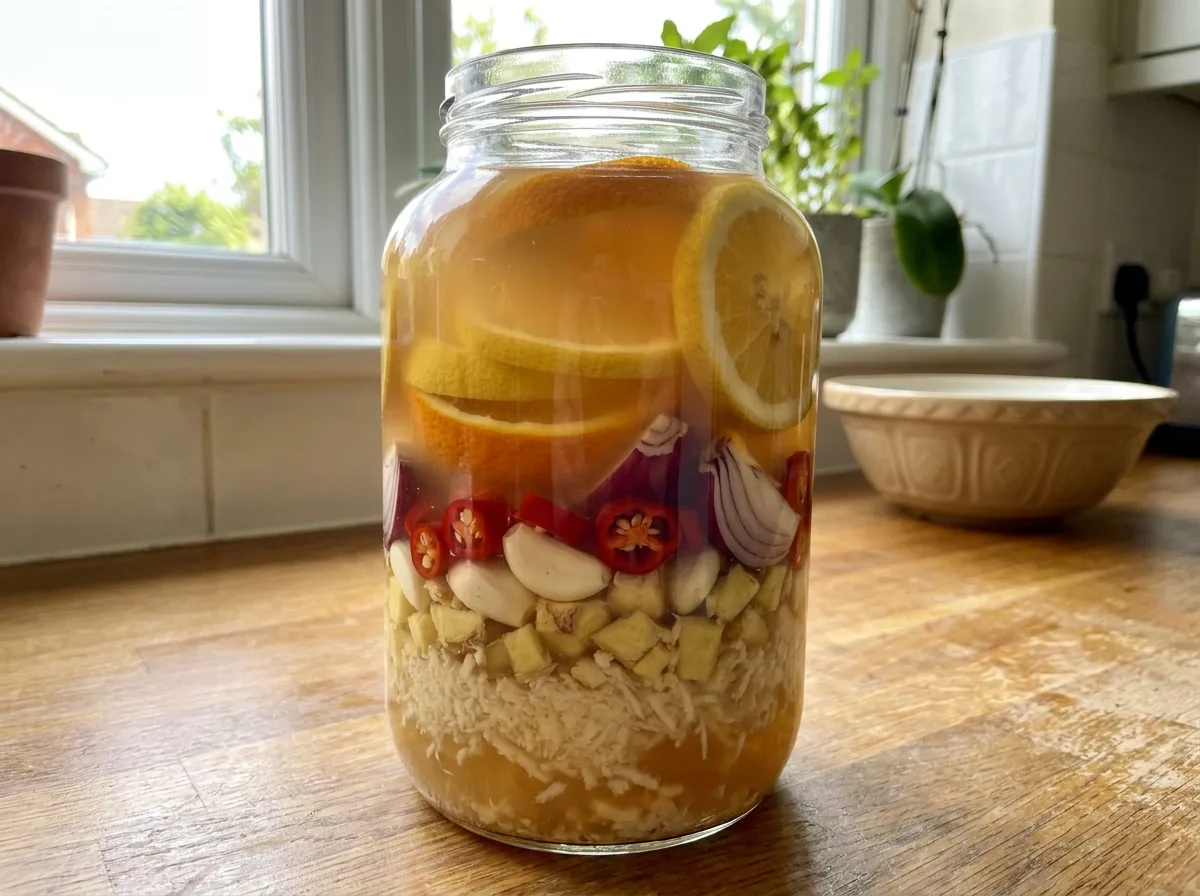
Ingredients
- About 750 ml (3 cups), enough to cover Apple cider vinegar, at least 5% acidityUse a commercially made vinegar with the acidity on the label, not homemade vinegar
- ½ cup (about 60 g) Fresh horseradish root, peeled and grated
- ½ cup (about 60 g) Fresh ginger, grated
- 1 medium (about 150 g) Onion, chopped
- 1 bulb (about 10 cloves, 50 g) Garlic cloves, crushed or chopped
- 1–2, to taste Fresh chillies, halvedOr ¼ tsp dried chilli flakes
- 1 of each Lemon and orange, scrubbed and slicedZest and slices both go in
- 2 tbsp fresh (about 15 g), or 1 tsp ground Fresh turmeric, grated (or ground turmeric)Optional
- ½ tsp Black peppercornsOptional
- ¼ cup (about 85 g), or to taste HoneyAdded after straining
Equipment
- Clean 1 litre (1 quart) wide-mouthed glass jar
- Plastic lid, or a sheet of baking parchment under a metal lid
- Grater, chopping board and knife
- Saucepan (stainless steel or enamel)
- Fine sieve or muslin, and a funnel
- Clean glass bottles for storing
Method
Sterilise the jar
Wash the jar with hot soapy water, rinse it, then simmer it fully submerged for 10 minutes. Lift it out with tongs and stand it upside down on a clean rack.1
Prepare the roots and vegetables
Rinse everything well. Peel and grate the horseradish and ginger, chop the onion and garlic, and halve the chillies. Grate horseradish near an open window: its fumes sting the eyes and nose.1
Pack the jar loosely
Put everything except the honey in the warm jar without packing it tight. This recipe uses about 2½ cups of solids to 3 cups of vinegar, in line with extension guidance of 1 to 2 cups of vegetables per pint of vinegar.1
Heat the vinegar and pour it over
Heat the vinegar until steaming, just below boiling, and pour it over the ingredients until they are covered, leaving about 5 mm (¼ in) of space at the top. Traditional recipes use cold vinegar; heating follows extension advice for flavoured vinegars.1
Seal and steep for 3 to 4 weeks
Cover with a plastic lid, or put parchment under a metal lid, because vinegar corrodes metal. Keep the jar somewhere cool and dark, below 18°C (65°F), or in the fridge if your kitchen is warm. Shake it every few days and push any floating pieces back under.1,2
Strain
After 3 to 4 weeks, strain through a sieve lined with muslin, pressing the solids to get the liquid out. Discard the solids.1
Sweeten, bottle and refrigerate
Stir in the honey to taste, then pour into clean bottles, label with the date and keep in the fridge. Use within 6 to 8 months.1
Use it diluted
Most people take about 1 tbsp (15 ml) stirred into a glass of water or warm water, or use it in salad dressings and marinades. Taking it with food and rinsing your mouth with water afterwards is kinder to your teeth.
Safety
- It is acidic. Daily apple cider vinegar has caused tooth enamel erosion, so dilute it, take it with food and rinse your mouth with water after4
- Don't swallow it neat or in tablet form: an apple cider vinegar tablet caused injury to the oesophagus (gullet) in a reported case5
- No honey, or fire cider sweetened with it, for babies under 12 months: it can cause infant botulism3
- Vinegar's acid stops botulism bacteria, but garlic in oil does not; never swap the vinegar for oil or store garlic in oil at room temperature2
- Throw it away without tasting if you see mould, bubbling, cloudiness or sliminess1
Variations
Halve the horseradish and chilli, and leave out the onion. The result is closer to a ginger and citrus vinegar.
Add a sprig of rosemary or thyme with the vegetables. Rinse and dry it first.
Leave it unsweetened, or stir in a little sugar or maple syrup instead. Make this version if a baby under 12 months could be given it.
Does it actually work?
No trial has tested fire cider. Of its ingredients, honey has the best evidence: it probably eases cold-related cough in children over 12 months (moderate evidence, mostly from one-night trials). A Cochrane review found only one trial of garlic for colds and judged the evidence insufficient. Ginger's evidence is for nausea and period pain, not colds, and we found no trials of horseradish, onion, chilli or vinegar for colds.
It is a sharp, warming vinegar to use in food or a hot drink; any effect on colds is unproven.7,6
Evidence ratings for what goes in: Ginger, Turmeric, Black pepper (piperine), Honey.
Questions people ask
How long does fire cider last?
Once strained, extension guidance gives flavoured vinegars up to 6 to 8 months in the fridge, or up to 3 months somewhere cool and dark below 18°C (65°F). Keep the bottle tightly sealed and throw it away if you see mould, bubbling or cloudiness.
Does fire cider need to be refrigerated?
We recommend it. Colorado State University Extension advises keeping homemade flavoured vinegars in the fridge for the best safety and flavour, and Oregon State University Extension says garlic in vinegar should not be kept at room temperature because it quickly grows mould.
Is fire cider safe to drink every day?
There is no tested daily amount. It is acidic, and a daily glass of apple cider vinegar has worn away tooth enamel, so if you take it regularly, dilute it well, have it with food and rinse your mouth afterwards.
Does fire cider help with colds?
No trial has tested it. Honey probably helps a child's cough, but the evidence for garlic is thin, and we found none for horseradish, onion, chilli or vinegar.
Sources (7)
- University extension Grubb D, Shackelton E, Bunning M. Making Flavored Vinegar. Fact Sheet 9.340. Colorado State University Extension. 2021.
- University extension Oregon State University Extension Service. Preserving garlic.
- Health agency NHS. Foods to avoid giving babies and young children.
- Case report Gambon DL, Brand HS, Veerman EC. Unhealthy weight loss. Erosion by apple cider vinegar. Ned Tijdschr Tandheelkd. 2012.
- Case report and product analysis Hill LL, Woodruff LH, Foote JC, Barreto-Alcoba M. Esophageal injury by apple cider vinegar tablets and subsequent evaluation of products. J Am Diet Assoc. 2005.
- Cochrane review Lissiman E, Bhasale AL, Cohen M. Garlic for the common cold. Cochrane Database Syst Rev. 2014.
- Cochrane review Oduwole O, Udoh EE, Oyo-Ita A, Meremikwu MM. Honey for acute cough in children. Cochrane Database Syst Rev. 2018.
Educational only. Patch-test anything new on your skin, and stop if it irritates.
Reader notes
Experiences and questions from readers, read by an editor before they appear. They are personal accounts, not evidence, and are not medical advice.