
How to Make Bone Broth: Hob, Slow Cooker or Pressure Cooker
Roast about 2 kg of beef or chicken bones, cover them with about 4 litres of cold water and 2 tablespoons of vinegar, and simmer gently for 6–12 hours on the hob, 12–24 hours in a slow cooker or 2–3 hours in a pressure cooker, then strain, chill and lift off the fat. The safety point is cooling: get it from hot to fridge-cold quickly in shallow containers, keep it no more than 1–2 days in the fridge and freeze the rest.
It is a tasty stock with some protein and gelatin; claims that it heals the gut, joints or skin are untested.
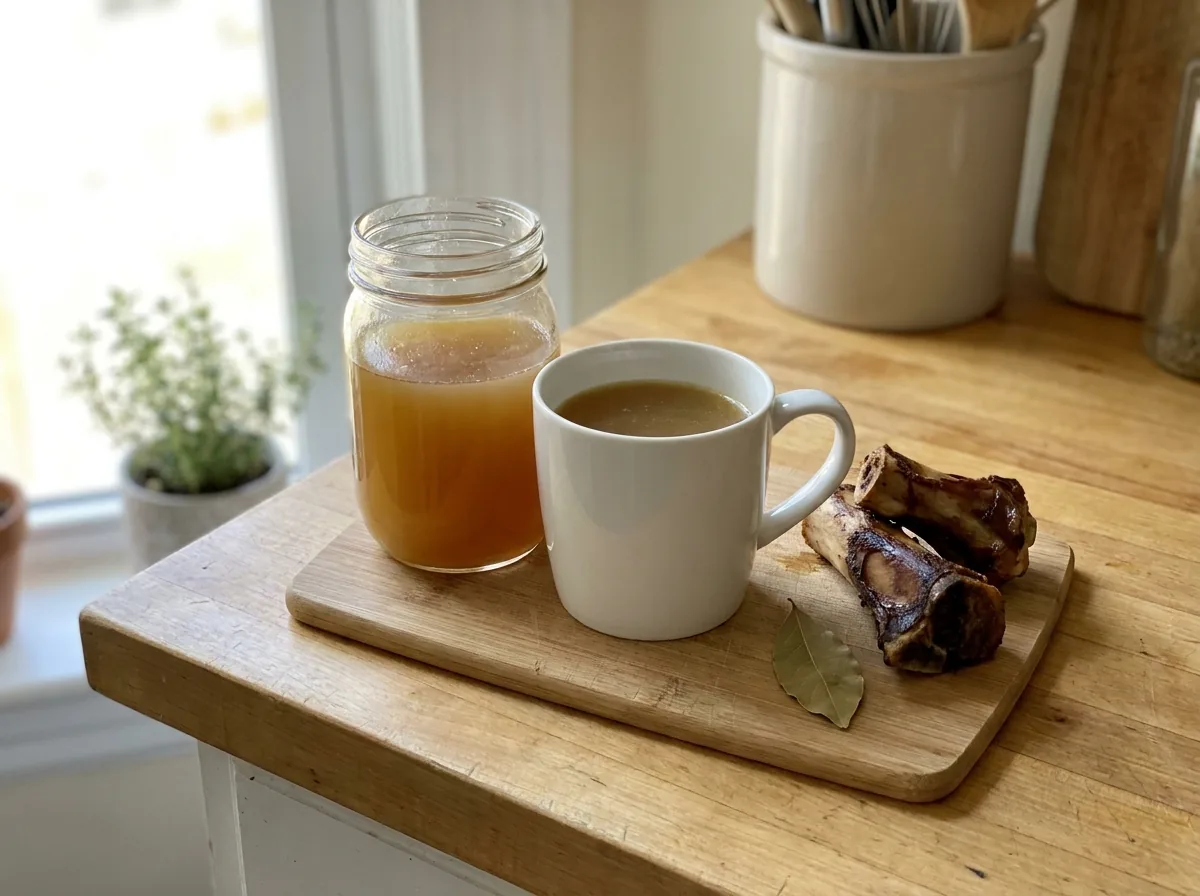
Ingredients
- About 2 kg Beef bones, or chicken carcasses and wingsMix meaty bones with joints, knuckles, oxtail or chicken feet and wings; the joints give the gelatin that makes broth set
- About 4 litres (to cover the bones by 5 cm) Cold waterLess water gives a richer broth that sets more firmly
- 2 tbsp (30 ml) Cider or white wine vinegarTraditional; see the FAQ for what it does and doesn't do
- 1 large, halved (skin on for colour) Onion
- 2, roughly chopped Carrots
- 2 sticks, roughly chopped Celery
- 2 bay leaves, 1 tsp peppercorns Bay leaves and black peppercorns
- To taste, at the end SaltSeason when you use the broth; it concentrates if you reduce it
Equipment
- Large roasting tin
- Stockpot of at least 6 litres, a slow cooker, or a pressure cooker
- Ladle, large sieve and a fine sieve or muslin
- Large bowl, and a sink or bigger bowl for an ice-water bath
- Shallow lidded containers or freezer bags
- Food thermometer (useful for checking cooling)
Method
Roast the bones
Heat the oven to 220°C (200°C fan, 425°F). Spread the bones in a roasting tin in one layer and roast for 30–45 minutes, turning once, until well browned. Roasting is for flavour and colour; chicken carcasses can go in raw for a paler broth.
Fill the pot
Put the bones in the pot, add a splash of water to the tin and scrape up the browned bits into the pot too. Add the vegetables, bay and peppercorns, then the vinegar, and pour in cold water to cover the bones by about 5 cm.
Bring to a simmer and skim
Bring it slowly up to a bare simmer, with just a few bubbles breaking the surface. For the first 30 minutes, skim off the grey foam with a ladle. A hard boil makes a cloudier, greasier broth.
Simmer on the hob: 6–12 hours
Partly cover and keep it at a gentle simmer, chicken for about 6–8 hours and beef for 8–12. Top up with hot water if the bones poke out. In a lab study, cooking for more than 8 hours drew more calcium and magnesium from the bones than shorter times. Don't leave a gas hob on overnight; use a slow cooker instead.4
Or use a slow cooker: 12–24 hours
Put everything in the slow cooker, filling it no more than about two-thirds full, and cook on low for 12–24 hours. Skim the foam once it has been simmering for an hour or so.
Or use a pressure cooker: 2–3 hours
Fill it no higher than the maximum line on your cooker, usually two-thirds, and cook at high pressure for about 2 hours for chicken or 3 for beef. Let the pressure release naturally rather than venting it, so hot broth doesn't spit out of the valve.
Strain
Lift out the big bones with tongs, then pour the broth through a large sieve into a bowl, and again through a fine sieve or muslin for a clear broth. Throw away the bones and vegetables.
Cool it fast
The US Food Code requires cooked food to cool from 57°C (135°F) to 21°C (70°F) within 2 hours, and to 5°C (41°F) or below within 6 hours in total. A big pot won't do that on its own: divide the broth into shallow containers, or stand the bowl in a sink of iced water and stir. Put the containers in the fridge loosely covered until cold.1
Skim off the fat
Once it is cold, the fat sets in a firm layer on top. Lift it off with a spoon and throw it away, or keep it in the fridge for roasting. Underneath, a good broth will have set to a wobbly jelly; it melts back to liquid when heated.
Store and reheat
Keep the broth in the fridge for no more than 1–2 days, the FDA's chart time for meat broth, and freeze the rest in portions; freezer bags laid flat or ice-cube trays work well. Reheat to at least 74°C (165°F), simplest done by bringing it to the boil.1,2
Safety
- Cool it fast: from 57°C (135°F) to 21°C (70°F) within 2 hours, and to 5°C (41°F) within 6. Split it into shallow tubs or stir it in an ice bath1
- Keep meat broth in the fridge for only 1–2 days. Freeze the rest: frozen at -18°C (0°F) it stays safe, and it is best used within 2–3 months2
- Reheat until steaming all the way through, at least 74°C (165°F). Bringing it to the boil is the simple check1
- Bones store lead. One small study found chicken-bone broth had several times the lead of the water used; another found low levels per serving3,4
- Treat raw bones as raw meat: keep them away from ready-to-eat food, and wash your hands, boards and sink after handling them
Variations
Use the carcasses of 2–3 roast chickens, plus wings or feet for body, with about 3 litres of water. It needs no further roasting; simmer for 4–6 hours on the hob.
Add a thumb of sliced fresh ginger and a bunch of spring onions to chicken broth for the last hour. Good as a base for noodle soups.
After straining and skimming, simmer the broth uncovered until it has reduced by half. It sets firmly and takes up less freezer space; dilute it with water to use.
Does it actually work?
Bone broth is a savoury stock with some protein and gelatin, and its contents vary widely.
A 2019 analysis of home-made, café and commercial bone broths found that broth made to a standard recipe contained much less glycine, proline and hydroxyproline (the building blocks of collagen) than a 20 g dose of the collagen supplements used in research, and that broths made to other recipes varied a lot; the authors concluded broth is unlikely to be a reliable source.
A lab study found calcium and magnesium per serving under 5% of daily needs, even with vinegar and long cooking. We found no trials testing bone broth itself for gut healing, joints or skin.
The collagen trials tested hydrolysed collagen supplements: our collagen entry rates knee osteoarthritis pain 3 (Moderate) and skin 2 (Limited), because the skin benefit disappeared in trials not funded by supplement companies. A bowl of broth is not a measured dose of any of that; see /ingredients/hydrolyzed-collagen/ for the full ratings.5,4,7,6
Evidence ratings for what goes in: Black pepper (piperine).
Questions people ask
How long should I simmer bone broth?
On the hob, about 6–8 hours for chicken and 8–12 for beef; in a slow cooker, 12–24 hours on low; in a pressure cooker, about 2–3 hours. These are common kitchen times rather than tested figures. One lab study found more than 8 hours drew more calcium and magnesium from the bones, though the amounts were still small.
Why add vinegar to bone broth?
Vinegar makes the water a little acidic. In a lab study, 20 ml of vinegar per litre lowered the broth's pH from about 8.4 to 5.3 and drew far more calcium and magnesium out of the bones, but a serving still held under 5% of daily needs. It won't make the broth noticeably more nutritious, and 2 tablespoons won't make it taste sour.
Why didn't my bone broth turn to jelly?
It usually means too much water for the bones, or not enough joints, knuckles, feet or wings, which supply the collagen that becomes gelatin. Reduce the strained broth by simmering it uncovered, and use more of those bones next time. Broth that doesn't set is still fine to use.
How long does homemade bone broth last?
The FDA's storage chart gives 1–2 days in the fridge for meat broth, so freeze anything you won't use by then. Frozen at -18°C (0°F) it stays safe indefinitely, and the chart suggests using it within 2–3 months for best quality.
Is bone broth good for your gut and joints?
Nobody has shown that it is. We found no trials of bone broth for gut, joint or skin problems, and an analysis of broths found their collagen building blocks were lower and far less consistent than the supplements used in collagen trials. Enjoy it as a warming food and a good stock.
Sources (7)
- Regulator US Food and Drug Administration. Food Code 2022: Recommendations of the United States Public Health Service, Food and Drug Administration (sections 3-501.14 Cooling, 3-501.15 Cooling Methods, 3-403.11 Reheating).
- Regulator US Food and Drug Administration. Refrigerator & Freezer Storage Chart. 2018.
- Laboratory study Monro JA, Leon R, Puri BK. The risk of lead contamination in bone broth diets. Med Hypotheses. 2013.
- Laboratory study Hsu DJ, Lee CW, Tsai WC, Chien YC. Essential and toxic metals in animal bone broths. Food Nutr Res. 2017.
- Laboratory study Alcock RD, Shaw GC, Burke LM. Bone Broth Unlikely to Provide Reliable Concentrations of Collagen Precursors Compared With Supplemental Sources of Collagen Used in Collagen Research. Int J Sport Nutr Exerc Metab. 2019.
- Systematic review Myung SK, Park Y. Effects of Collagen Supplements on Skin Aging: A Systematic Review and Meta-Analysis of Randomized Controlled Trials. Am J Med. 2025.
- Systematic review Simental-Mendía M, Ortega-Mata D, Acosta-Olivo CA, et al. Effect of collagen supplementation on knee osteoarthritis: an updated systematic review and meta-analysis of randomised controlled trials. Clin Exp Rheumatol. 2025.
Educational only. Patch-test anything new on your skin, and stop if it irritates.
Reader notes
Experiences and questions from readers, read by an editor before they appear. They are personal accounts, not evidence, and are not medical advice.