
How to Make Turmeric Tea at Home
Stir ¼–½ teaspoon of ground turmeric (about 0.75–1.5 g) into 250 ml of just-boiled water and leave it for 5–10 minutes, or simmer 2 cm of grated fresh root for 10 minutes; the EU herbal regulator's traditional tea is 0.5–1 g of root in 150 ml of boiling water. A pinch of black pepper is fine for flavour, but the absorption research used a concentrated piperine extract, not a pinch.
A cup holds a few tens of milligrams of curcumin, far below the doses in trials, and the rare liver injuries linked to turmeric have mostly involved supplements.
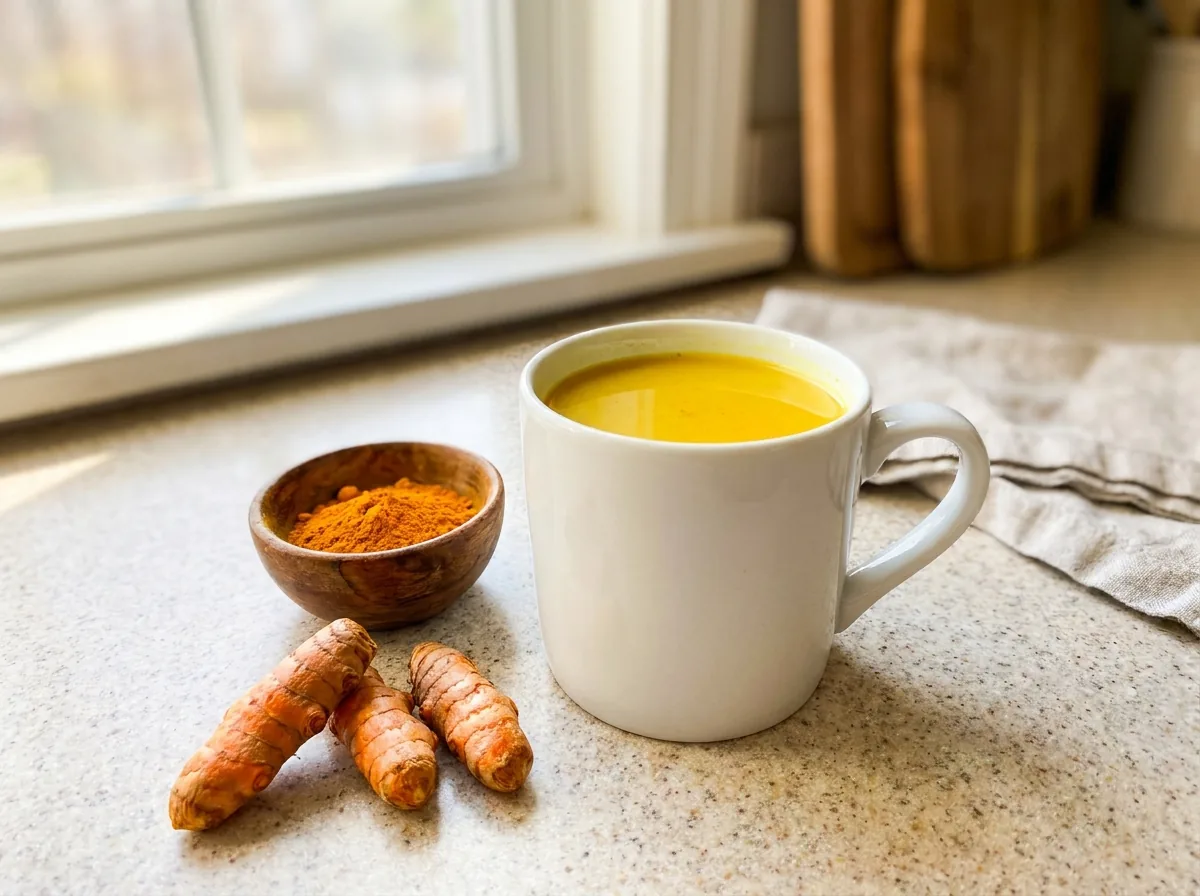
Ingredients
- ¼–½ tsp (about 0.75–1.5 g) per mug Ground turmericStart with ¼ tsp; it gets earthy and bitter quickly
- 2 cm piece (about 5–10 g) per mug Fresh turmeric root (instead of ground)Wear gloves when grating; it stains skin, nails and boards
- 250 ml (1 cup) per mug WaterFreshly boiled
- A pinch Black pepper (optional)For flavour; see 'Does it work?' below on absorption
- 1 cm piece, sliced Fresh ginger (optional)Adds warmth and rounds out the taste
- 1 tsp honey, a squeeze of lemon Honey and lemon (optional)Add once the tea has cooled a little
Equipment
- Mug and a teaspoon
- Small saucepan (for fresh root or golden milk)
- Fine sieve or tea strainer
- Disposable gloves (for fresh root)
Method
Measure the turmeric
Put ¼ to ½ teaspoon of ground turmeric (about 0.75–1.5 g) in a mug. The EU herbal regulator's traditional-use tea is 0.5–1 g of root in 150 ml of boiling water, two or three times a day, so this is in the same range.1
Make a paste
Add a tablespoon of hot water and stir to a smooth paste. Turmeric powder clumps if you pour the full mug of water straight on.
Pour and steep
Top up with 250 ml of just-boiled water, stir, add the pepper and ginger if using, and leave for 5–10 minutes. The powder doesn't dissolve and will settle, so stir before each sip or strain it through a fine sieve.
With fresh root: grate and simmer
Wearing gloves, scrub and grate a 2 cm piece of fresh turmeric. Simmer it in a small pan with 300 ml of water for 10 minutes, then strain into a mug. Rinse the grater and board straight away to limit staining.
Flavour and drink
Let it cool a little, then stir in honey and a squeeze of lemon to taste. Taste before adding more turmeric; too much tastes bitter and medicinal rather than stronger.
Clean up before it stains
Turmeric's yellow colour clings to plastic, wooden boards, grout and fabric. Wipe spills at once, and use glass, steel or ceramic where you can. Mugs that stain usually come clean with a soak and a scrub with bicarbonate of soda.
Safety
- Rare, serious liver injury is linked to turmeric, mostly supplements. Stop and get advice if you have dark urine, yellow skin or eyes, or unusual tiredness2,5
- The EU regulator does not recommend medicinal turmeric if you have liver disease, gallstones, a blocked bile duct or other bile problems1
- Pregnancy and breastfeeding: the EU regulator does not recommend medicinal use, and NCCIH says turmeric supplements in pregnancy may be unsafe. Ask first1,2
- Turmeric can cause nausea, acid reflux, stomach upset and diarrhoea. If a cup upsets your stomach, make it weaker or stop2
- Don't treat a cup of tea as a substitute for turmeric or curcumin supplements, or the other way round: their doses are not comparable3,6
Variations
Warm 250 ml of milk or a plant milk in a pan with ½ tsp ground turmeric, a pinch of cinnamon, a slice of ginger and a pinch of black pepper. Whisk, bring just to a simmer, then strain and sweeten with honey.
Add a 1–2 cm piece of sliced fresh ginger with the turmeric and steep for the full 10 minutes. See our ginger tea guide for ginger's own cautions.
Make a double-strength mug, let it cool, strain it well and pour over ice with lemon. Drink it the same day.
Does it actually work?
Our turmeric entry rates its best use, knee osteoarthritis pain, 2 (Limited), and that evidence comes almost entirely from concentrated curcumin extracts, not the spice; the EU regulator accepts turmeric tea only for mild indigestion, on traditional use (our rating 1).
The amounts are very different. Ground turmeric averaged about 3% curcumin by weight in one analysis of 28 spice products, so ½ teaspoon (about 1.5 g) holds roughly 45–50 mg of curcumin, while curcumin trials compared doses above and below 1,000 mg a day.
Black pepper's reputation comes from one small study where 20 mg of isolated piperine raised blood curcumin about 20-fold after a 2 g dose; nobody has tested a pinch of pepper in tea. A cup of turmeric tea is a pleasant drink, not a dose. See /ingredients/turmeric/ and /ingredients/curcumin/ for the ratings.7,1,3,6,4
Evidence ratings for what goes in: Turmeric, Black pepper (piperine), Ginger, Honey.
Questions people ask
How much turmeric do I put in a cup of tea?
About ¼ to ½ teaspoon of ground turmeric (0.75–1.5 g) per 250 ml mug, or a 2 cm piece of fresh root. The EU herbal regulator's traditional tea uses 0.5–1 g of root in 150 ml of boiling water.
Do I need black pepper in turmeric tea?
Only if you like the taste. The study behind the pepper advice used 20 mg of isolated piperine with 2 g of curcumin, which is a supplement, not a seasoning, and no study we found tested pepper in food or tea.
Is it safe to drink turmeric tea every day?
Turmeric in food amounts is widely eaten, and the serious liver injury reports mostly involve supplements. Still, the EU regulator advises against medicinal turmeric if you have liver or gallbladder disease, or are pregnant or breastfeeding, so ask your doctor or pharmacist first in those cases.
Does turmeric tea reduce inflammation?
It hasn't been shown to. The joint-pain trials used concentrated curcumin extracts at many times the amount in a cup, and even those results are rated low certainty. A cup of tea holds a few tens of milligrams of curcumin.
How do I get turmeric stains out?
Act quickly: wipe worktops straight away, and scrub stained mugs or boards with a paste of bicarbonate of soda and water. Pale stains on plastic often fade in sunlight. Fabric stains are hard to shift, so wear an apron.
Sources (7)
- Regulator monograph European Medicines Agency HMPC. European Union herbal monograph on Curcuma longa L., rhizoma (EMA/HMPC/329755/2017). 2018.
- Regulator/health agency NCCIH. Turmeric: Usefulness and Safety. National Center for Complementary and Integrative Health.
- Laboratory analysis Tayyem RF, Heath DD, Al-Delaimy WK, Rock CL. Curcumin content of turmeric and curry powders. Nutr Cancer. 2006.
- Human pharmacokinetic study Shoba G, Joy D, Joseph T, Majeed M, Rajendran R, Srinivas PS. Influence of piperine on the pharmacokinetics of curcumin in animals and human volunteers. Planta Med. 1998.
- Case series Halegoua-DeMarzio D, Navarro V, Ahmad J, et al. Liver Injury Associated with Turmeric-A Growing Problem: Ten Cases from the Drug-Induced Liver Injury Network [DILIN]. Am J Med. 2023.
- Meta-analysis Hsiao AF, Lien YC, Tzeng IS, Liu CT, Chou SH, Horng YS. The efficacy of high- and low-dose curcumin in knee osteoarthritis: A systematic review and meta-analysis. Complement Ther Med. 2021.
- Systematic review Wang Z, Singh A, Jones G, et al. Efficacy and Safety of Turmeric Extracts for the Treatment of Knee Osteoarthritis: a Systematic Review and Meta-analysis of Randomised Controlled Trials. Curr Rheumatol Rep. 2021.
Educational only. Patch-test anything new on your skin, and stop if it irritates.
Reader notes
Experiences and questions from readers, read by an editor before they appear. They are personal accounts, not evidence, and are not medical advice.