Awaiting clinical review. This entry is sourced but has not yet been signed off by a pharmacist or clinician.
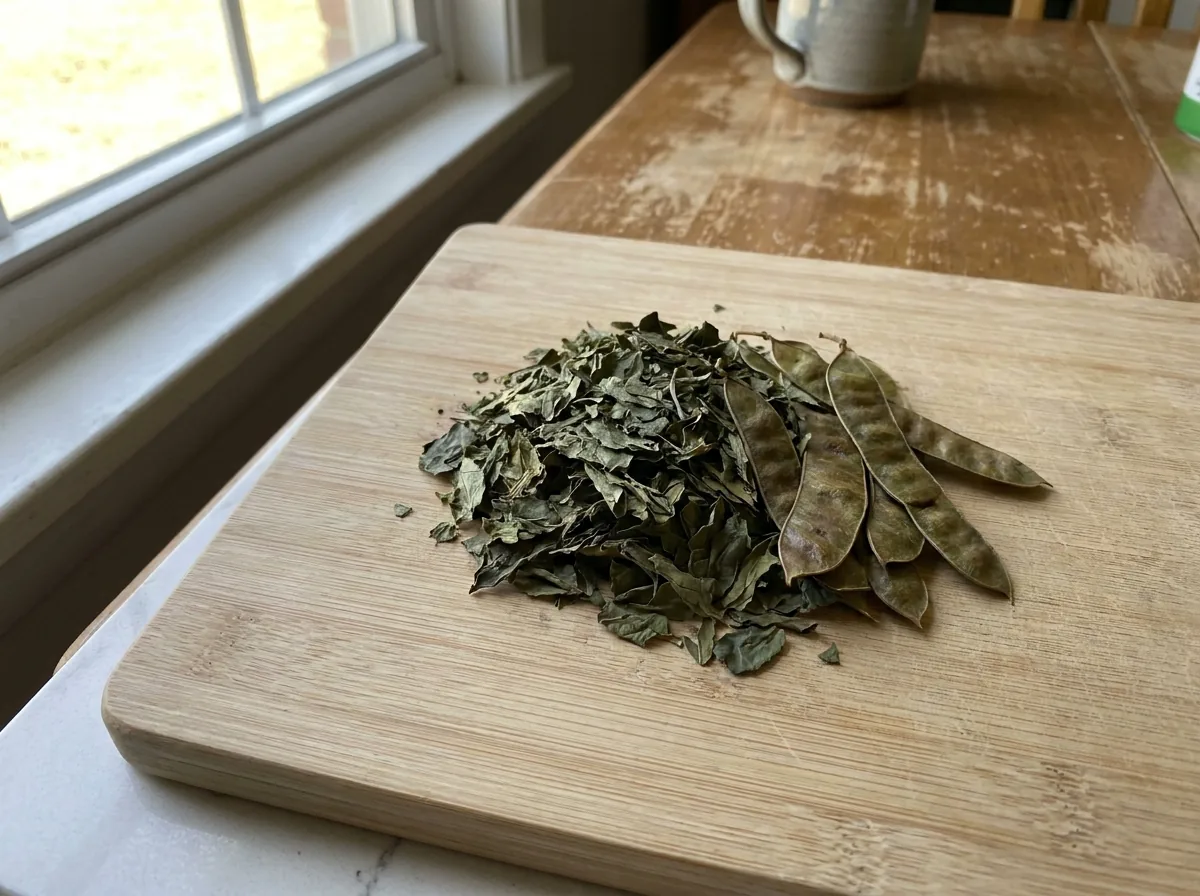
Senna
Senna works for constipation: a 2021 systematic review graded it good evidence, and it is one of only two over-the-counter laxatives to get the top recommendation. It is meant for short-term use only, because using it for more than a brief period can impair bowel function and cause dependence, and the EU regulator sets a limit of 1 week. It should not be used in pregnancy, while breastfeeding, or by children under 12.
At a glance
Last reviewed 29 September 2026What it's used for
Evidence is rated per use. The same ingredient can be strong for one thing and traditional for another.
| Use | Evidence | What the research shows |
|---|---|---|
| Constipation | Moderate | A 2021 systematic review of over-the-counter laxatives found two placebo-controlled trials of senna lasting 4 weeks or more, both favouring senna on symptoms and stool frequency, and graded it good evidence (grade A). Limits: only two senna trials, sponsor funding from Bayer, and in the newer trial (starting dose 1 g a day, higher than typical US practice) 83.3% of people needed a dose reduction for abdominal pain or diarrhoea. The trials were in chronic constipation over weeks, whereas the EU licence covers occasional constipation for up to 1 week.1,4 |
| Bowel preparation before colonoscopy | Limited | A 2022 meta-analysis of 11 trials (3,343 patients) found senna-based regimens cleaned the bowel no better and no worse than other regimens (odds ratio 1.02, 95% CI 0.63 to 1.67). People on senna regimens tolerated them better (odds ratio 1.66) and were more likely to complete them (odds ratio 3.05). The comparison regimens varied, so this does not show how senna performs alone; it is used under medical direction.2 |
| Constipation after childbirth | Limited | A Cochrane review found one trial (471 women) in which senna increased the number having a first bowel movement within 24 hours (risk ratio 2.90) and also increased abdominal cramps (risk ratio 4.23). Certainty was low or very low, and the review concluded there was too little evidence to draw general conclusions. The EU regulator contraindicates senna during breastfeeding, so this is a question for a midwife or doctor.3,4 |
How much
Ranges below are what studies used and what supplements commonly contain. They are not a recommendation for you. Start at the low end.
How people take it
Safety
Who should avoid
- Pregnancy and breastfeeding — EU monograph contraindicates it
- Children under 12 — contraindicated by the EU regulator
- Bowel obstruction, Crohn's disease, ulcerative colitis or appendicitis
- Abdominal pain, nausea or vomiting of unknown cause — see a doctor first
- Severe dehydration or electrolyte loss
- Kidney disease — risk of electrolyte imbalance
- Use every day or beyond 1 week — the cause should be investigated
Known interactions
Compare with
Head-to-head pages for the pairs people search most.
Questions people ask
How long can I take senna?
The EU regulator says not more than 1 week, and usually two to three doses in that week is enough. Longer use may impair bowel function and cause dependence, and if you need a laxative every day the cause of the constipation should be investigated.
How long does senna take to work?
Usually 8 to 12 hours, because bacteria in the large intestine have to convert it to its active form. That is why the EU monograph advises taking it once at night.
Is senna safe in pregnancy or for children?
No. The EU monograph contraindicates it in pregnancy, while breastfeeding, and for children under 12, citing genotoxicity concerns for related compounds in laboratory studies and small amounts of an active metabolite in breast milk. The Cochrane review of childhood constipation found almost no useful data on senna.
What side effects does senna cause?
Abdominal pain, cramps and loose stools are the main ones, especially at higher doses, and reducing the dose usually helps. Urine may turn yellow or red-brown, which is not clinically significant, and long-term use can cause water and electrolyte imbalance and harmless dark bowel lining that usually clears once it is stopped.
Sources
- Systematic review Rao SSC, Brenner DM. Efficacy and Safety of Over-the-Counter Therapies for Chronic Constipation: An Updated Systematic Review. Am J Gastroenterol. 2021.
- Meta-analysis Tian H, Fan Y, Yang L, et al. The Efficacy of Senna Bowel Preparation for Colonoscopy: A Systematic Review and Meta-analysis. Gastroenterol Nurs. 2022.
- Cochrane review Turawa EB, Musekiwa A, Rohwer AC. Interventions for preventing postpartum constipation. Cochrane Database Syst Rev. 2020.
- Regulator monograph European Medicines Agency HMPC. European Union herbal monograph on Senna alexandrina Mill. (Cassia senna L.; Cassia angustifolia Vahl), folium (EMA/HMPC/625849/2015). 2018.
- Cochrane review Gordon M, MacDonald JK, Parker CE, Akobeng AK, Thomas AG. Osmotic and stimulant laxatives for the management of childhood constipation. Cochrane Database Syst Rev. 2016.
Last reviewed 29 September 2026 · Next review March 2027 · How we rate evidence