
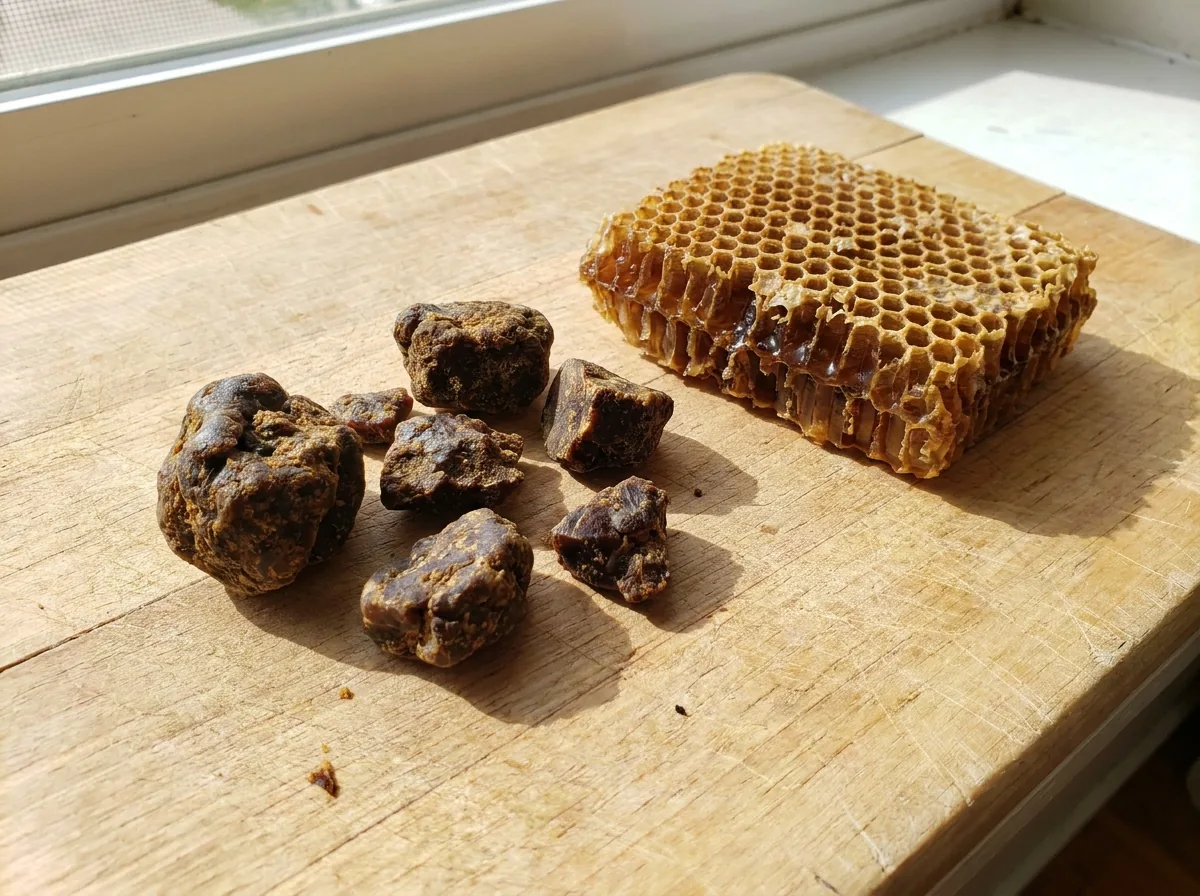
Propolis
Propolis applied to cold sores healed them about a day faster than 5% aciclovir cream in two large trials of one standardised 0.5% extract, but no trial compared it with a dummy cream, so the size of the benefit is uncertain. It is well tolerated in those trials, but propolis is a recognised contact allergen and can cause a skin or lip rash, so stop if the area gets redder or itchier.
Evidence for mouth ulcers and gum health is weaker, and for wound healing and immunity we found no reliable support.
At a glance
Last reviewed 10 October 2026What it's used for
Evidence is rated per use. The same ingredient can be strong for one thing and traditional for another.
| Use | Evidence | What the research shows |
|---|---|---|
| Cold sores (herpes labialis)Compare remedies for skin → | Limited | In a double-blind trial of 397 people, a 0.5% propolis lip cream reached crusting or healing in a median of 3 days versus 4 days for 5% aciclovir cream (p < 0.0001); a single-blind trial of 379 people found 4 versus 5 days. A 2026 meta-analysis of seven studies (propolis and/or honey versus aciclovir) found lesions resolved 1.87 days sooner. Rated 2, not 3: the comparator was aciclovir cream, which itself has only modest benefit, there was no placebo arm, both trials used one manufacturer's extract, and the meta-analysis pooled honey with propolis.1,2,3 |
| Recurrent mouth ulcers (aphthous) | Limited | A 2024 systematic review of 10 randomised trials (825 people) found propolis, applied topically or taken as tablets, may shorten healing time and reduce pain and redness compared with placebo. The review rated the certainty of the evidence as very low because of bias risk, inconsistency and small trials, and cautioned that results should be interpreted with care.4 |
| Dental plaque and gum inflammation | Limited | A 2025 meta-analysis of seven trials of alcohol-free propolis mouthwash found lower plaque and gingival index scores, but the comparison was against baseline, not against a control, which overstates any effect. It does not show that propolis beats ordinary brushing or a standard mouthwash.5 |
| Wound healing | Traditional | The one recent randomised trial we read, 72 women using a propolis ointment on episiotomy wounds for 10 days, found no difference from placebo in healing or pain. We did not review the laboratory and animal work often cited for wound healing, so this use is rated on the absence of supporting human evidence.6 |
How much
Ranges below are what studies used and what supplements commonly contain. They are not a recommendation for you. Start at the low end.
How people take it
Safety
Who should avoid
- Known propolis allergy — a rash is a reason to stop
- Fragrance allergy — cross-reactions with propolis are reported
- Broken or weeping skin or inflamed gums — allergy risk is unclear here
- Pregnancy and breastfeeding — no safety data we can point to; ask a clinician
- Children — cold sore trials were in adults
Known interactions
Questions people ask
Does propolis work for cold sores?
In two large trials, a 0.5% propolis lip cream healed cold sores about a day faster than 5% aciclovir cream (median 3 versus 4 days in one, 4 versus 5 days in the other). Neither trial used a placebo and both tested the same extract, so treat it as promising, not proven.
Can you be allergic to propolis?
Yes. Propolis is a recognised contact allergen in dermatology.
In North American patch-test clinics, 2.2% to 3.7% of tested patients reacted to Chinese propolis and 14.7% to Brazilian propolis, though these are people already referred for suspected allergy and the Brazilian result may include false positives. The cold sore trials reported no allergic reactions.
Does propolis boost immunity?
We did not find a systematic review showing that it does. A 2026 narrative review found only limited clinical data, mostly for COVID-19, and called for large placebo-controlled trials. Laboratory findings on immune cells do not show that taking propolis prevents colds.
Is propolis good for mouth ulcers?
It may shorten healing and reduce pain, according to a 2024 systematic review of 10 trials, but the certainty of that evidence was rated very low. It is a reasonable thing to ask a pharmacist about, not a proven treatment.
Sources (8)
- Meta-analysis Niode NJ, Christopher PM, Tallei TE. Superiority of propolis and honey over topical acyclovir for herpes simplex: A meta-analysis. Int J STD AIDS. 2026.
- Randomised controlled trial Jautová J, Zelenková H, Drotarová K, et al. Lip creams with propolis special extract GH 2002 0.5% versus aciclovir 5.0% for herpes labialis (vesicular stage): randomized, controlled double-blind study. Wien Med Wochenschr. 2019.
- Randomised controlled trial Arenberger P, Arenbergerova M, Hladíková M, Holcova S, Ottillinger B. Comparative study with a lip balm containing 0.5% propolis special extract GH 2002 versus 5% aciclovir cream in patients with herpes labialis in the papular/erythematous stage: a single-blind, randomized, two-arm study. Curr Ther Res Clin Exp. 2018.
- Systematic review Roberts T, Kallon II, Schoonees A. Efficacy and safety of propolis for treating recurrent aphthous stomatitis (RAS): a systematic review and meta-analysis. Dent J (Basel). 2024.
- Meta-analysis Propolis as a natural remedy in reducing dental plaque and gingival inflammation: a systematic review and meta-analysis. J Funct Biomater. 2025.
- Randomised controlled trial Rafatnia M, Ghanbari-Homaie S, Mirghafourvand M, Ebrahimi F, Kamalifard M. The effect of topical propolis ointment on severity of episiotomy pain and wound healing: a triple-blinded randomized controlled clinical trial. J Caring Sci. 2025.
- Review de Groot A, Rustemeyer T. Contact allergy to propolis: update 2013-2025. Dermatitis. 2026.
- Cohort study DeKoven JG, DeKoven SJ, Warshaw EM, et al. Comparison between Brazilian propolis and Chinese propolis: results from the North American Contact Dermatitis Group 2019-2022. Dermatitis. 2026.
Last reviewed 10 October 2026 · Next review April 2027 · How we rate evidence
Reader notes
Experiences and questions from readers, read by an editor before they appear. They are personal accounts, not evidence, and are not medical advice.