
How to Make Chia Pudding: Ratio, Soak Time and Safety
Chia pudding is chia seeds soaked in milk until they swell into a thick, spoonable gel. Stir 30 g (about 3 tbsp) of chia seeds into 240 ml (1 cup) of milk or a plant drink, stir again after 5 minutes, and chill for at least 2 hours or overnight. Always eat chia soaked: a man who swallowed a spoonful of dry chia followed by water needed an emergency endoscopy to clear his oesophagus.
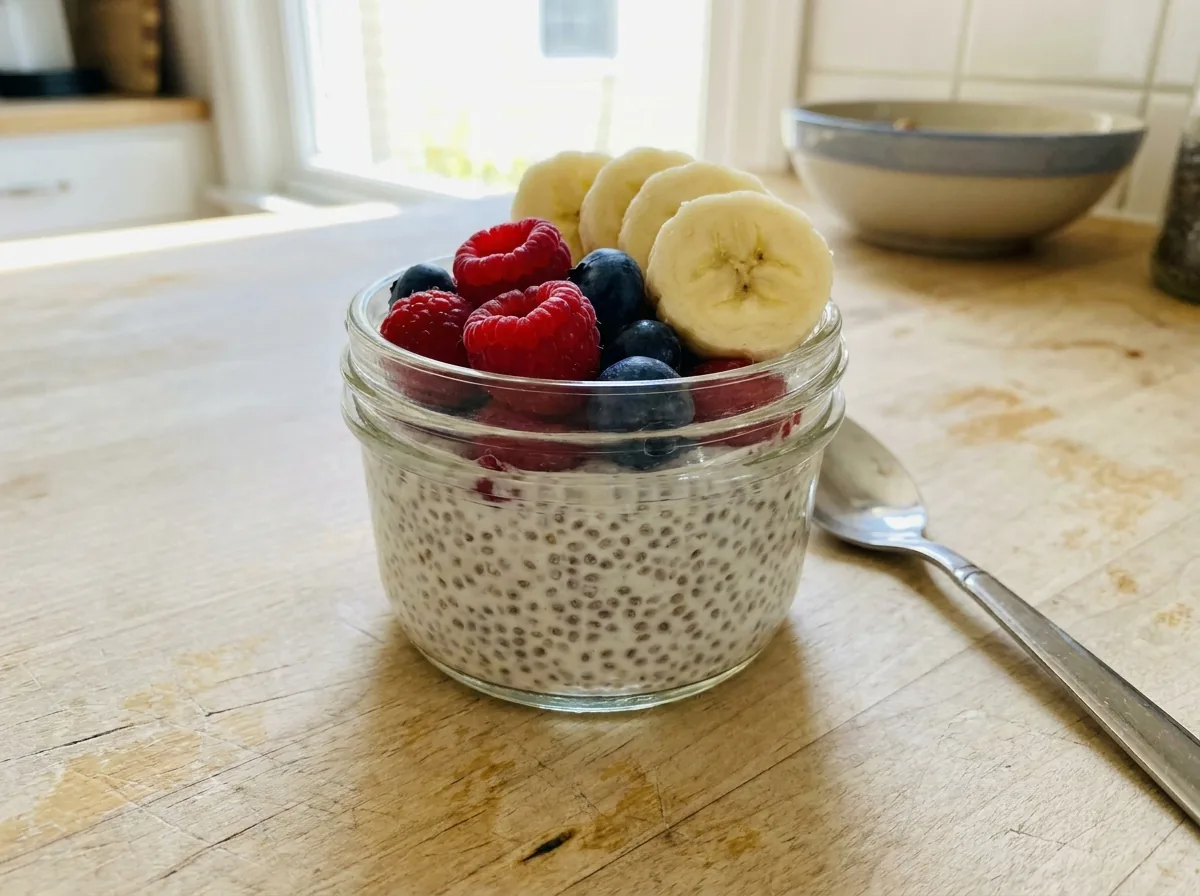
Ingredients
- 30 g (about 3 tbsp) Chia seedsBlack or white seeds work the same. Their omega-3 is ALA, not the EPA and DHA in fish oil (see Does it work)
- 240 ml (1 US cup) Milk or unsweetened plant drinkDairy, soya, oat or almond. Thinner drinks give a slightly looser set
- 1–2 tsp, optional Honey or maple syrupLeave it out if your milk is sweetened. Never give honey to a baby under 12 months
- ¼ tsp, optional Vanilla extract
- A handful, optional Fruit, nuts or yoghurt to topBerries, sliced banana, mango or a spoonful of yoghurt
Equipment
- A jar or bowl with a lid (at least 350 ml)
- Measuring spoons or kitchen scales
- A fork or small whisk
Method
Measure the chia and milk
Weigh 30 g of chia seeds, or use about 3 level tablespoons, and measure 240 ml of milk. That is roughly 1 part chia to 8 parts milk by weight, a common home ratio that sets thick but still spoonable. Use a little more chia for a firmer pudding, a little less for a looser one.
Whisk everything together
Put the chia in the jar, pour in the milk, and add the sweetener and vanilla if using. Whisk or stir well with a fork so every seed is wet.
Stir again after 5 minutes
Leave it for about 5 minutes, then stir again. As the seeds start to swell they stick together and sink, and this second stir breaks up clumps so the pudding sets evenly.
Chill for at least 2 hours, ideally overnight
Cover and put it in the fridge, which should run at 0–5°C (32–41°F). Chia seeds can absorb up to 27 times their weight in water, so give them time: after 2 hours it is thick, and overnight it is fully set.2,3,8
Check the texture
Stir and look before you eat it. It should be thick and creamy with soft, swollen seeds and no crunchy dry ones. If it is runny, stir in another teaspoon of chia and leave it for 15 minutes more; if it is too stiff, loosen it with a splash of milk.
Top and serve
Spoon it into a bowl or eat it from the jar, topped with fruit, nuts or yoghurt. Keep any you don't eat in the fridge and finish it within 2 days, the limit UK food safety guidance gives for leftovers.8
Safety
- Never eat chia seeds dry and wash them down with water: they swelled into a gel that fully blocked a man's oesophagus and needed emergency endoscopy2,3
- If you have trouble swallowing, a narrowed oesophagus or eosinophilic oesophagitis, eat chia only fully soaked, and ask your doctor first2,3
- If you can't swallow your own saliva after eating, the oesophagus may be completely blocked. Get emergency help2
- One pudding has about 10 g of fibre, a third of the UK's 30 g daily target. If you eat little fibre, start with a smaller portion1,7
- Keep it in the fridge at 0–5°C (32–41°F) and eat it within 2 days8
Variations
Whisk 1 tbsp (about 5 g) of unsweetened cocoa powder into the milk before adding the chia, and sweeten a little more to taste. Top with sliced banana.
Use coconut drink or half tinned coconut milk and half water, then layer the set pudding with chopped mango or mango purée.
Mash a handful of raspberries or blueberries with a fork, spoon them into the bottom of the jar, and pour the chia mixture on top before chilling.
If you dislike the seedy texture, blend the set pudding until smooth. Blend only after soaking, never before, so the seeds are already fully swollen.
Does it actually work?
Chia pudding is a filling, high-fibre breakfast, and the seeds are genuinely nutritious. According to USDA data, 30 g of dried chia seeds provides about 146 kcal, 10 g of fibre (a third of the UK's 30 g daily target), 5 g of protein, 189 mg of calcium and 5.3 g of alpha-linolenic acid (ALA), a plant omega-3, before you add the milk.
ALA is not the same as the EPA and DHA in oily fish and fish oil: the body converts a limited amount of ALA to EPA and very little to DHA, so chia is not a swap for oily fish. Our omega-3 entry rates fish and algal oils, which lower triglycerides but showed little or no effect on heart attacks and strokes in pooled trials.
The trials of chia itself are small. A 2024 meta-analysis of 8 trials (362 people) found no significant effect on fasting blood sugar, HbA1c or insulin. Another 2024 meta-analysis of 10 trial reports found lower blood pressure (systolic about 8 mmHg) but also slightly lower HDL ('good') cholesterol, no effect on other risk factors, and mostly low-quality studies.
Diets high in fibre are linked with lower risk of heart disease and type 2 diabetes, so chia pudding is a sensible way to add fibre, but it is not a treatment for blood pressure or diabetes.1,4,5,6,7
Questions people ask
What is the ratio of chia seeds to milk for chia pudding?
About 30 g (3 tbsp) of chia to 240 ml (1 cup) of milk, roughly 1 to 8 by weight, gives a thick, spoonable pudding. Add a teaspoon more chia for a firmer set or a splash more milk for a looser one.
How long does chia pudding need to soak?
At least 2 hours in the fridge, and overnight is best. The seeds can absorb many times their weight in liquid, so give them time to swell fully; stirring after the first 5 minutes stops them clumping.
Can you eat chia seeds without soaking them?
Sprinkling a few on wet food is common, but don't eat a spoonful of dry seeds and then drink water. That is how a 39-year-old man ended up with his oesophagus blocked by a chia gel that took emergency endoscopy to clear. Soaking first, as in chia pudding, avoids it.
Is chia pudding a good source of omega-3?
It is rich in ALA, about 5 g per 30 g of seeds, but ALA is a plant omega-3 that the body converts to EPA only in limited amounts and to DHA very little. If you want EPA and DHA, oily fish is the direct source.
How long does chia pudding last in the fridge?
We suggest up to 2 days, covered, at 0–5°C, in line with UK guidance for leftovers. That is cautious, but the milk is the perishable part, so never keep it past the milk's use-by date.
Sources (8)
- Government database U.S. Department of Agriculture, Agricultural Research Service. FoodData Central (SR Legacy): Seeds, chia seeds, dried (FDC ID 170554).
- Conference abstract Rawl R. Watch It Grow: Esophageal Impaction With Chia Seeds (P643). American College of Gastroenterology Annual Scientific Meeting. 2014.
- Case report Simmelink A, Rawl RE, Browne L, Scobey M. Watch it grow: Esophageal impaction with chia seeds. Case Reports in Internal Medicine. 2017.
- Review Burdge GC, Calder PC. Conversion of alpha-linolenic acid to longer-chain polyunsaturated fatty acids in human adults. Reprod Nutr Dev. 2005.
- Meta-analysis Pam P, El Sayed I, Asemani S, Jamilian P, Zarezadeh M, Ghoreishy Z. The effectiveness of chia seed in improving glycemic status: A systematic review and meta-analysis. Diabetes Metab Syndr. 2024.
- Meta-analysis Kiani S, Naghshi S, Saghafi-Asl M. Effects of chia (Salvia hispanica. L) on anthropometric measures and other cardiometabolic risk factors: A systematic review and dose-response meta-analysis. Complement Ther Med. 2024.
- Public health guidance NHS. How to get more fibre into your diet.
- Food safety guidance Food Standards Agency. How to chill, freeze and defrost food safely. GOV.UK.
Educational only. Patch-test anything new on your skin, and stop if it irritates.
Reader notes
Experiences and questions from readers, read by an editor before they appear. They are personal accounts, not evidence, and are not medical advice.