
How to Make Ghee from Butter at Home
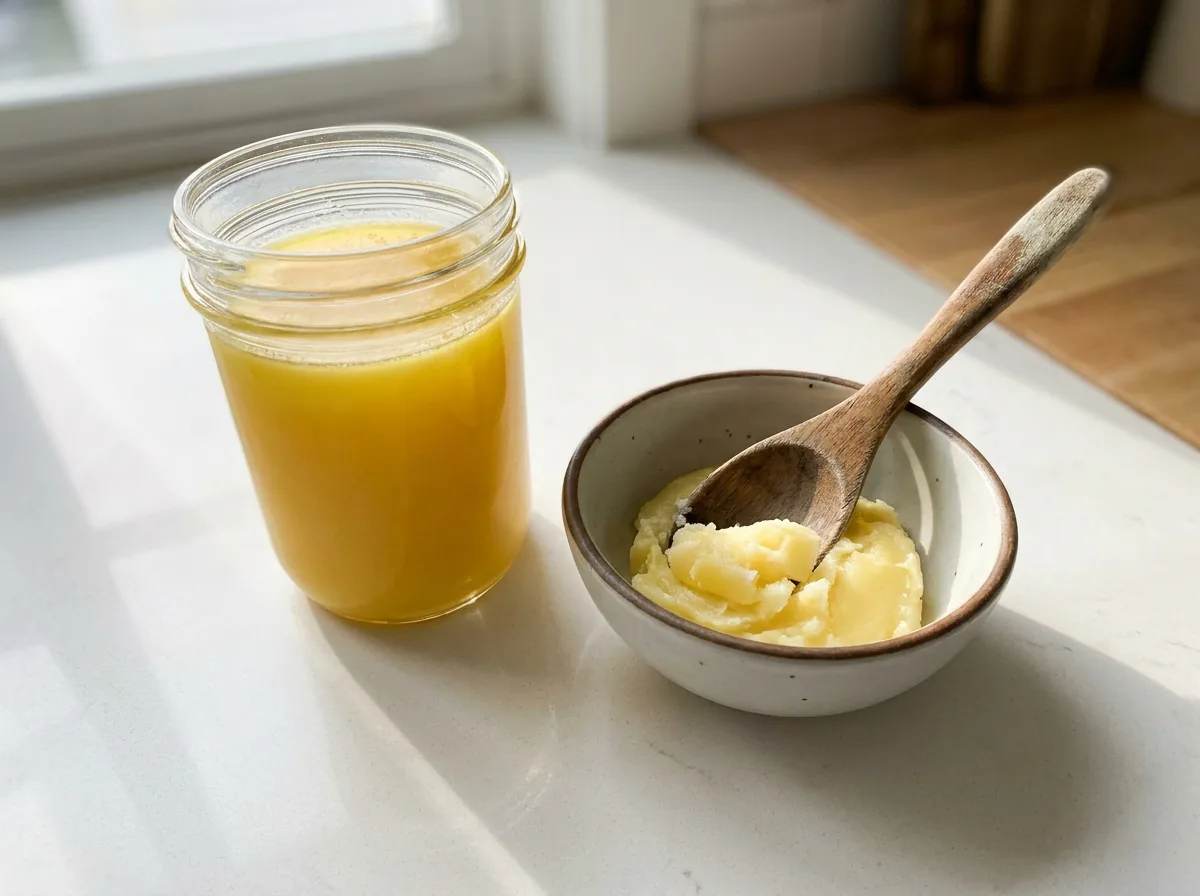
Melt 500 g of unsalted butter in a heavy pan and simmer it gently for 15–25 minutes, until the foam dies down, the milk solids on the bottom turn golden brown and the fat is clear, then strain it through muslin into a clean, dry jar. You get about 400 g of nutty, golden ghee that keeps well because almost all the water is gone.
Hot fat burns badly, so stay with the pan; and ghee is nearly pure butterfat, about two-thirds saturated, so use it like butter, not as a health food.
Ingredients
- 500 g (two 250 g blocks; about 2¼ US cups) Unsalted butterUnsalted, so the salt doesn't concentrate. Any good butter works; cultured butter gives a tangier ghee
Equipment
- Heavy-based saucepan, light-coloured inside if possible so you can see the solids brown
- Spoon for skimming
- Fine sieve lined with muslin, cheesecloth or a paper coffee filter
- Clean, completely dry glass jar with a lid (about 500 ml)
- Oven glove
Method
Melt the butter
Cut the butter into chunks and melt it in the pan over a low-to-medium heat. Use a pan with room to spare, as it foams up.
Simmer while the water boils off
Let it bubble gently. Butter is a little over 80% fat; most of the rest is water, which boils off as foam and crackling. Commercial ghee is heated to 110–120°C (230–248°F) for 10–20 minutes; at home you judge it by sight and smell instead.1,2
Skim the foam
Skim off the white foam from the surface with a spoon as it builds up, or leave it to subside; either way the fat underneath gradually turns clear and golden.
Watch the milk solids brown
After 15–25 minutes the bubbling quietens, the fat is clear and the milk solids that have sunk to the bottom turn from pale to golden brown, with a nutty, toffee-like smell. Take the pan off the heat straight away: black solids mean burnt, bitter ghee.
Cool for a few minutes
Let it stand for 3–5 minutes so the remaining solids settle. The fat is still well above boiling point, so don't touch it or let it splash.
Strain into a dry jar
Pour the ghee slowly through the lined sieve into the clean, dry jar, holding back the browned solids at the bottom of the pan. The solids are what holds most of the milk protein and sugar.1
Cool, cover and store
Leave it uncovered until cool, so condensation doesn't drip back in, then put the lid on. It sets to a soft, grainy, pale-yellow solid at cool room temperature and turns liquid when warm.
Use a clean, dry spoon
Ghee keeps because it has almost no water (under 0.5%) and no milk solids for bacteria to grow on; its main enemy is oxidation, which turns it rancid faster in the warm. Keep it sealed, away from heat and light, and never put a wet spoon in the jar. If you use it slowly or your kitchen is warm, keep it in the fridge.1,2
Safety
- Hot fat causes deep burns. Stay with the pan, keep children and pets away, and never let water drip in: it makes hot fat spit
- For a burn, hold it under cool running water for 20 minutes. Don't put creams, oils or butter (or ghee) on it5
- Not safe for a milk allergy: traces of milk protein can remain. Children's Hospital of Philadelphia lists ghee as an ingredient to avoid4
- Ghee is high in saturated fat. The NHS advises no more than 30 g of saturated fat a day for men and 20 g for women3
- Throw it out if it smells sour, soapy or like old paint, or if you see mould: that means it has gone rancid or water got in
Variations
Cook it a minute or two longer, until the solids are a deeper hazelnut brown, for a stronger, nuttier flavour. Watch closely, as it goes from brown to burnt quickly.
Stop as soon as the water has boiled off and the solids have separated but before they colour, then strain. You get a cleaner, milder butterfat for frying and sauces.
Warm a spoonful of ghee with whole dried spices such as cumin seeds, cardamom or a bay leaf, then strain. Use dried spices only for a jar you plan to keep.
Halve everything: 250 g of butter makes about 200 g of ghee and is ready a little sooner. A smaller pan makes the solids easier to see.
Does it actually work?
Ghee is a lovely cooking fat, but it is not a health food. It is almost pure butterfat: one analysis of ghee samples found 64 g of saturated fat in every 100 g of fat, so a tablespoon (about 13 g) carries roughly 8 g, around 40% of the NHS daily maximum for a woman.
The NHS names ghee alongside butter and lard as foods high in saturated fat, and says too much raises LDL cholesterol and the risk of heart disease and stroke, while swapping some saturated fat for unsaturated oils such as olive or rapeseed helps lower it.
Making ghee removes most of the milk solids, so some people who are sensitive to lactose find it easier than butter, but it is not guaranteed milk-free and isn't suitable for a milk allergy. Claims that ghee aids digestion, heals the gut or helps joints come from tradition and animal studies, not trials in people. Use it in small amounts, like butter.2,3,1,4
Questions people ask
What is the difference between ghee and clarified butter?
Both are butter with the water and milk solids removed. Clarified butter is strained as soon as the solids separate; ghee is cooked longer, at higher heat, until the solids brown, which gives it a nutty flavour and even less moisture.
Does ghee need to be refrigerated?
Not necessarily. With under 0.5% water and no milk solids, ghee doesn't support bacteria the way butter can; it spoils mainly by going rancid, faster when warm. A sealed jar in a cool, dark cupboard is fine for regular use; the fridge keeps it fresh for longer.
Is ghee healthier than butter?
Not really. Weight for weight it is more concentrated fat than butter, because the water is gone, and it is about two-thirds saturated. The NHS lists ghee with butter and lard as high in saturated fat and advises keeping those down.
Is ghee dairy-free or lactose-free?
It is made from milk, so it isn't dairy-free. Most lactose and protein are strained out with the solids, but traces can remain, so people with a milk allergy should avoid it and those with lactose intolerance should try a little first.
Does ghee have a higher smoke point than butter?
It is often said to, because the milk solids that scorch first in butter have been removed, and ghee does fry hotter without burning. We haven't found a measured figure from a source we trust, so we don't quote one.
Sources (5)
- Review Kumbhare S, Prasad W, Khamrui K, Wani AD, Sahu J. Recent innovations in functionality and shelf life enhancement of ghee, clarified butter fat. J Food Sci Technol. 2023.
- Analytical study Mohammadi-Nasrabadi F, Rashidimehr A, Khoshtinat K, et al. A Comparative Analysis of Butter, Ghee, and Margarine and Its Implications for Healthier Fat and Oil Group Choices: SWOT Analysis. Food Sci Nutr. 2024.
- Public health body NHS. Fat: the facts.
- Hospital patient guidance Children's Hospital of Philadelphia. Milk Allergy Diet.
- Public health body NHS. Burns and scalds.
Educational only. Patch-test anything new on your skin, and stop if it irritates.
Reader notes
Experiences and questions from readers, read by an editor before they appear. They are personal accounts, not evidence, and are not medical advice.