
How to Make Sea Moss Gel at Home
Sea moss gel is dried sea moss (Irish moss, Chondrus crispus) soaked overnight, rinsed, then blended with fresh water and chilled until it sets: roughly 30 g of dried moss to 250–500 ml (1–2 cups) of water. It sets because the seaweed contains carrageenan, the same gelling agent used in food.
No human trials support the popular health claims, and seaweed can carry variable iodine and heavy metals, so treat it as an occasional food, not a daily supplement.
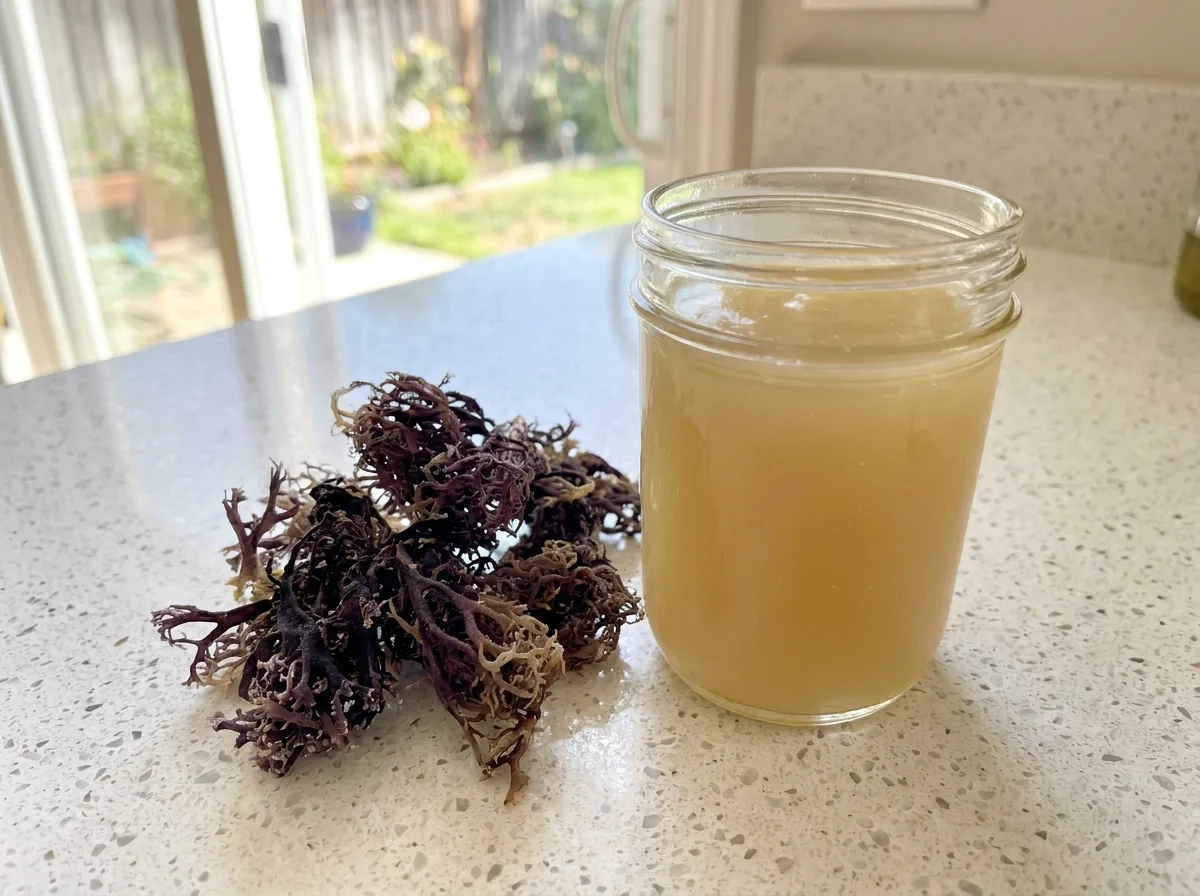
Ingredients
- About 30 g (a large loose handful) Dried sea moss (Irish moss, Chondrus crispus)Buy from a seller who states the species and where it was harvested, and ideally gives heavy-metal test results
- About 1 litre (4 cups), changed once or twice Cold water, for soaking and rinsing
- 250–500 ml (1–2 cups) Fresh drinking water, for blendingLess water gives a thicker gel
Equipment
- Large bowl
- Colander or sieve
- Blender
- Clean glass jar with a lid, about 500 ml
- Ice-cube tray (optional, for freezing)
Method
Rinse off sand and grit
Put the dried sea moss in a bowl of cold water and swish it around, rubbing it with your fingers to loosen sand, salt and bits of shell. Drain and repeat until the water stays clear.
Soak it in the fridge
Cover the moss with fresh cold water and leave it to soak for 12 to 24 hours, in the fridge rather than on the counter. It swells to two or three times its size and turns soft and pale. Soaking in the fridge is our advice: the moss is a raw food, and commercial sea moss has been found to carry bacteria.2
Rinse again and drain
Lift the soaked moss out, discard the soaking water and rinse it once more under the cold tap. Throwing the soaking water away also removes some of the iodine and arsenic that leach out of seaweed into water, though how much varies by species.6
Blend with fresh water
Put the moss in the blender with 250 ml (1 cup) of fresh water and blend for 1 to 2 minutes until completely smooth. Add more water, up to 500 ml in total, if you want a looser gel.
Jar and chill
Pour into a clean jar, close it and refrigerate. It thickens to a soft jelly within a few hours as it cools. The set comes from carrageenan, a natural gelling carbohydrate in the seaweed.1
Use within a week, or freeze
Label it with the date and use it within about a week. For longer, freeze spoonfuls in an ice-cube tray and thaw them one at a time in the fridge. Throw it away if it smells sour or fishy, looks slimy or grows mould.
Safety
- Seaweed iodine varies a lot between products and batches. If you have a thyroid condition or take thyroid medication, ask your doctor first4,5
- Sea moss can contain arsenic, lead, cadmium and mercury from the water it grew in. Eat it occasionally, not as a daily supplement1,2
- LactMed advises avoiding sea moss while breastfeeding unless its iodine and heavy metals are shown to be low; in pregnancy, ask your midwife1
- Treat the gel as a perishable food: keep it in the fridge in a clean jar. Shop-bought gels have tested positive for bacteria such as Salmonella2
Variations
Use 250 ml (1 cup) of blending water or less. The firmer gel can thicken soups, stews and puddings, much as carrageenan does in shop-bought foods.
Some cooks simmer the soaked moss in fresh water for 5 to 10 minutes, discard that water, then blend. Boiling leaches some iodine and arsenic out of seaweed, though in one study Irish moss lost less than kelp did.
Blend in a little lime juice or fruit for flavour. Add fruit only to the portion you will use within a day or two, as it shortens the keeping time.
Does it actually work?
No human trials support the popular claims for sea moss, whether for thyroid health, immunity, skin or energy, and LactMed notes that no medicinal value has been proven. It is a seaweed and a source of carrageenan, which is why it gels.
Its iodine content is unpredictable: measurements of dried Irish moss range from about 3.9 to 186 mg per kg, and dried sea moss sold online has tested positive for arsenic and mercury. See our kelp entry for the thyroid risks of too much seaweed iodine.1,2,3,4,7
Evidence ratings for what goes in: Sea moss.
Questions people ask
What is sea moss gel good for?
As a food, it thickens smoothies, soups and puddings. No human trials support the health claims made for it, such as thyroid or immune support, and LactMed says no medicinal value has been proven.
How long does homemade sea moss gel last?
We suggest about a week in the fridge, or several months frozen in small portions. That is our cautious advice, not a tested figure: the gel is mostly water, and a study of shop-bought gels found bacteria, yeasts and moulds in them.
Is sea moss high in iodine?
It can be, and you can't tell from the label. One study measured about 3.9 mg of iodine per kg of dried Irish moss, but EFSA's figures for dried carrageen moss averaged about 186 mg per kg.
At those levels 4 g of dried moss would hold roughly 15 µg or 740 µg of iodine, the second above the EU's 600 µg daily upper limit for adults (our calculation). Anyone with a thyroid condition, or who is pregnant or breastfeeding, should ask a doctor first.
Does sea moss contain heavy metals?
It can. LactMed notes arsenic, lead, cadmium and mercury from the water it grew in, and a 2026 study of 53 dried sea moss products sold online detected arsenic, cobalt and mercury. Choose a seller who publishes test results and don't eat it every day.
Sources (7)
- Regulator/health agency Drugs and Lactation Database (LactMed). Sea Moss. National Institute of Child Health and Human Development. 2026.
- Product analysis Rejuso A, Çobo M, Curran JE, et al. Microbial and Heavy Metal Analyses of Commercially Available Sea Moss and Sea Moss Products. J Food Prot. 2026.
- Product analysis Darias-Rosales J, Rubio C, Gutiérrez ÁJ, Paz S, Hardisson A. Risk assessment of iodine intake from the consumption of red seaweeds (Palmaria palmata and Chondrus crispus). Environ Sci Pollut Res Int. 2020.
- Product analysis Aakre I, Solli DD, Markhus MW, et al. Commercially available kelp and seaweed products - valuable iodine source or risk of excess intake? Food Nutr Res. 2021.
- Professional body British Dietetic Association. Iodine: Food Fact Sheet.
- Laboratory study Correia H, Soares C, Morais S, et al. Seaweeds rehydration and boiling: impact on iodine, sodium, potassium, selenium, and total arsenic contents and health benefits for consumption. Food Chem Toxicol. 2021.
- Regulator report European Food Safety Authority (EFSA), Dujardin B, Ferreira de Sousa R, Gómez Ruiz JÁ. Dietary exposure to heavy metals and iodine intake via consumption of seaweeds and halophytes in the European population. EFSA Journal. 2023.
Educational only. Patch-test anything new on your skin, and stop if it irritates.
Reader notes
Experiences and questions from readers, read by an editor before they appear. They are personal accounts, not evidence, and are not medical advice.