
Homemade Electrolyte Drink: WHO-Based Recipe and Safety
A homemade electrolyte drink is a rehydration solution of clean water, salt and sugar. Alberta Health Services' WHO-based recipe is 1 litre plus 60 ml (4¼ cups) of water, ½ level teaspoon (3 g) of salt and 2 level tablespoons (30 g) of sugar, stirred until dissolved; measure exactly, because too much salt is dangerous, especially for children.
Pharmacy oral rehydration sachets are the better choice whenever you can get them, and for babies and young children ask a pharmacist or NHS 111.
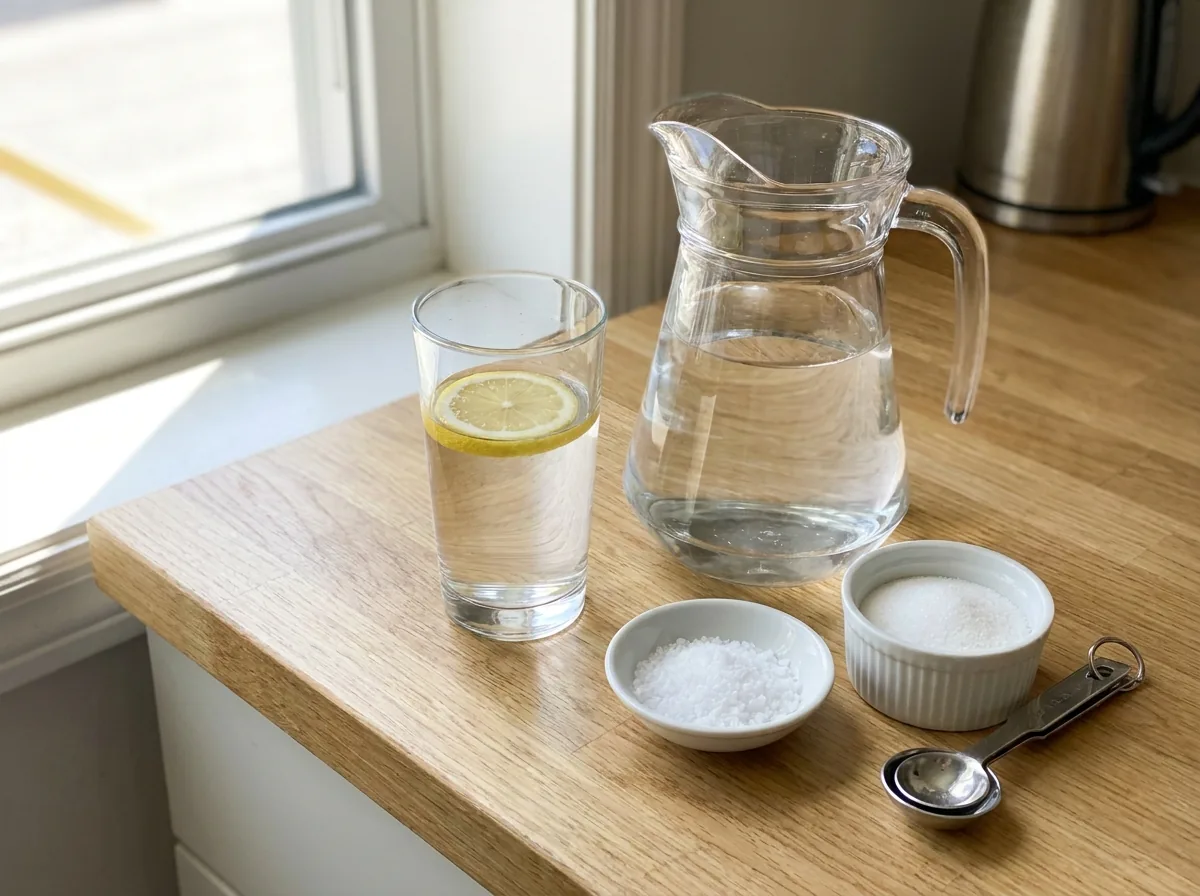
Ingredients
- 1 litre plus 60 ml (4¼ US cups) Clean drinking waterTap water where it is safe to drink; otherwise boiled and cooled
- ½ level tsp (3 g) Fine saltTable salt or fine sea salt. Weigh it if you can: coarse or flaky salt packs differently on a spoon
- 2 level tbsp (30 g) White sugarDon't add extra: sugary drinks can make diarrhoea worse
Equipment
- Measuring jug
- Level measuring spoons (not cutlery) or digital kitchen scales
- A clean jug or bottle with a lid
- A spoon for stirring
Method
Use a pharmacy sachet if you can
Oral rehydration sachets from a pharmacy are made to a precise formula and are the first choice, especially for babies, children and older people. WHO says a home-made salt and sugar solution is effective but not generally recommended, because the recipe is often forgotten or wrongly made.1,3
Measure the water exactly
Measure 1 litre plus 60 ml (4¼ US cups) of clean drinking water in a measuring jug and pour it into a clean jug or bottle. Too little water makes the drink too salty.2
Measure the salt and sugar level
Add ½ teaspoon (3 g) of salt and 2 tablespoons (30 g) of sugar, using proper measuring spoons levelled off with a knife, or weigh them. In a Brazilian study, nearly half of home-made salt-sugar drinks had dangerously high sodium, and those made with ordinary spoons were least accurate.2,4
Stir until dissolved
Stir or shake until you can't see any grains of salt or sugar. It should taste slightly salty and slightly sweet; if it tastes very salty, throw it away and start again.2
Sip it slowly
Take small sips often rather than gulping. If you are sick, wait 5–10 minutes and then carry on more slowly; WHO notes most of the fluid is still absorbed. Keep drinking water too.1
Store it and throw out leftovers
Keep it covered in the fridge and use it within 24 hours, or within 12 hours if it stays at room temperature. Make a fresh batch rather than keeping it longer.2
Watch for signs that need help
Rehydration drinks don't treat the cause. Get an urgent GP appointment or call NHS 111 for unusual tiredness, dizziness on standing that doesn't pass, dark pee or peeing much less, or a fast heartbeat or breathing. In children, also look for few or no tears, drowsiness or, in a baby, fewer wet nappies or a sunken soft spot.3
Safety
- For babies and young children, use pharmacy oral rehydration solution and ask a pharmacist or NHS 111. Don't rely on a home mix1,3
- Too much salt is dangerous. Salt poisoning is rare but can kill, especially in children, so measure exactly and never add extra salt4,5
- Don't use extra sugar, fizzy drinks or fruit juice for diarrhoea in children: sugary drinks can worsen diarrhoea and push sodium up1,3
- Call 999 or go to A&E for dehydration with blue, grey or pale skin or lips, cold skin, difficulty breathing, confusion or unusual sleepiness3
- If you have heart or kidney disease, or have been told to limit salt or fluids, ask your doctor before using rehydration drinks2,7
- For exercise under an hour, water is enough. In long events, drinking far more than you sweat can dangerously dilute blood sodium6
Variations
Alberta Health Services gives a version made with 175 ml (¾ cup) of 100% apple or grape juice, 810 ml (3¼ cups) of water and ½ teaspoon (3 g) of salt. It tastes more like a sports drink. Don't use it for a young child with diarrhoea: the NHS advises against fruit juice then.
WHO's diarrhoea manual describes a home solution of 3 g of table salt and 18 g of sugar per litre of water. It is a little less sweet; weigh both on digital scales.
A squeeze of lemon or a little sugar-free squash can make it easier to drink. Keep additions small and never add more salt or sugar.
Does it actually work?
Oral rehydration genuinely works. WHO says dehydration from acute diarrhoea, unless severe, can be treated safely and effectively in over 90% of cases with oral rehydration solution, which is absorbed even during heavy diarrhoea.
WHO's standard formula has, per litre, 2.6 g of sodium chloride, 13.5 g of glucose, 1.5 g of potassium chloride and 2.9 g of trisodium citrate, giving 75 mmol of sodium. A home salt-and-sugar drink is a simpler version without the potassium or citrate: by our arithmetic, the 3 g of salt in this recipe gives about 48 mmol of sodium per litre, inside the 30–100 mmol range a Brazilian study treated as safe and effective.
WHO calls such home solutions effective but not generally recommended, mainly because people mix them wrongly, which is why pharmacy sachets come first.
For sport, a review of hydration and performance found water is the best choice for activity lasting under an hour, and that popular sports drinks don't contain enough sodium to replace heavy sweat losses anyway. Most people exercising for under an hour need only water.1,4,6
Evidence ratings for what goes in: Sea salt.
Questions people ask
How do you make a homemade electrolyte drink?
Stir ½ level teaspoon (3 g) of salt and 2 level tablespoons (30 g) of sugar into 1 litre plus 60 ml (4¼ cups) of clean water until dissolved. Measure with proper measuring spoons or scales, keep it in the fridge and use it within 24 hours.
Is a homemade electrolyte drink as good as pharmacy rehydration sachets?
Not quite. Pharmacy oral rehydration salts contain potassium and citrate as well as salt and glucose, in exact amounts. A home mix of salt and sugar can work, but WHO doesn't generally recommend it because it is easy to get wrong, so use sachets when you can.
Can I give a homemade electrolyte drink to my baby or child?
Use a pharmacy rehydration solution instead and ask a pharmacist or call NHS 111, especially for a child under 5. Mistakes in the salt are most dangerous for children, and babies should keep breastfeeding or having their usual formula.
Do I need an electrolyte drink after exercise?
Usually not. For activity lasting under an hour, water is the best choice. Longer, sweaty sessions in the heat are where added salt and sugar may help, and even then the goal is to replace what you lose, not to drink as much as possible.
Sources (7)
- WHO guideline World Health Organization. The treatment of diarrhoea: a manual for physicians and other senior health workers. 4th revision. 2005.
- Public health guidance Alberta Health Services, Nutrition Services. Oral Rehydration Solution Recipes. 404316-NFS. 2024.
- Public health guidance NHS. Dehydration.
- Cross-sectional study Sena LV, Maranhão HS, Moraes MB. Evaluation of mothers' knowledge about oral rehydration therapy and sodium concentration in homemade sugar salt solutions. J Pediatr (Rio J). 2001.
- Systematic review Metheny NA, Krieger MM. Salt Toxicity: A Systematic Review and Case Reports. J Emerg Nurs. 2020.
- Review Rothenberg JA, Panagos A. Musculoskeletal performance and hydration status. Curr Rev Musculoskelet Med. 2008.
- WHO fact sheet World Health Organization. Sodium reduction. Fact sheet.
Educational only. Patch-test anything new on your skin, and stop if it irritates.
Reader notes
Experiences and questions from readers, read by an editor before they appear. They are personal accounts, not evidence, and are not medical advice.