
How to Make Almond Milk at Home (Soak, Blend, Strain)
Almond milk is almonds blended with water and strained. Soak 140 g (1 cup) of almonds in the fridge for 8–12 hours, drain, blend with 950 ml (4 cups) of fresh water and squeeze through a nut-milk bag. It is unfortified, so it is much lower in calcium than cow's milk or fortified shop almond drinks, and it is not a drink for babies or a main milk for young children.
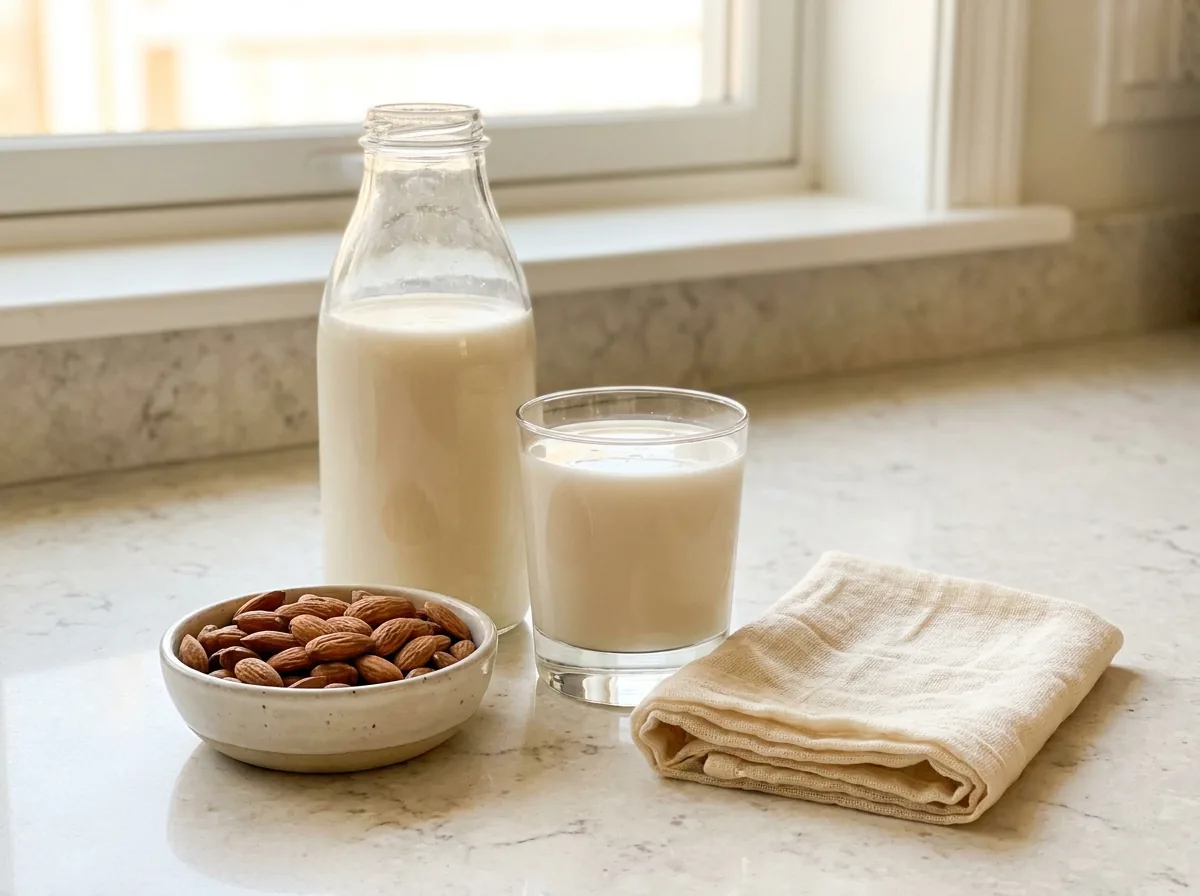
Ingredients
- 140 g (1 US cup) Whole almondsPlain, unsalted. Skin-on almonds work; blanched ones give a whiter milk
- Enough to cover by about 5 cm Cold water, for soakingThrown away after soaking
- 950 ml (4 US cups) Fresh cold water, for blendingUse 700 ml (3 cups) for a creamier milk
- A small pinch, optional Pinch of saltRounds out the flavour
- 1–2 dates or 1–2 tsp, optional Pitted dates or maple syrupLeave out for an unsweetened milk to use in cooking
- ¼ tsp, optional Vanilla extract
Equipment
- Bowl or jar for soaking, with a lid
- Sieve or colander
- Blender
- Nut-milk bag, or a fine sieve lined with clean muslin or cheesecloth
- Large jug or bowl
- Clean glass bottle or jar with a lid
Method
Soak the almonds in the fridge
Rinse the almonds, put them in a bowl, cover with cold water by about 5 cm and put them in the fridge for 8–12 hours. Soak in the fridge rather than on the counter: in lab tests, Salmonella, E. coli and Listeria multiplied on almonds soaked for 24 hours at 23°C (73°F) but not at 15°C (59°F).3,8
Drain and rinse
Tip the almonds into a sieve, throw away the soaking water and rinse them under cold running water. The almonds will have plumped up and softened.
Blend with fresh water
Put the almonds in the blender with 950 ml of fresh cold water and blend on high for 1–2 minutes, until the almonds are finely ground and the liquid is white and frothy.
Strain through a nut-milk bag
Set the nut-milk bag (or lined sieve) over a jug and pour the mixture in. Twist the top closed and squeeze firmly with clean hands until the pulp left inside is fairly dry.
Flavour it, if you like
Rinse the blender, pour the milk back in with the salt, dates or maple syrup, and vanilla, and blend for 30 seconds. Strain again if you used dates.
Bottle and chill
Pour into a clean bottle, seal and refrigerate straight away at 0–5°C (32–41°F). We suggest using it within 2 days, the limit UK food safety guidance gives for leftovers. It separates as it stands, so shake before pouring.4
Use or freeze the pulp
The leftover almond pulp can go into porridge, baking or granola. Keep it covered in the fridge and use it within 2 days, or freeze it as soon as possible, as the same guidance advises for homemade foods.4
Safety
- Soak almonds in the fridge, not at room temperature. Raw almonds have caused Salmonella outbreaks, and bacteria grew on almonds soaked at 23°C3,8
- Never give almond milk to a baby instead of breast milk or formula. Babies fed plant drinks this way developed severe malnutrition and rickets5,6
- From age 1 the NHS suggests unsweetened, calcium-fortified plant drinks. Homemade almond milk isn't fortified, so it is not a main milk for young children1,5
- Almonds are a tree nut, one of the most common food allergens. Don't make or serve this for anyone with a tree-nut allergy7
- Keep it at 0–5°C (32–41°F), use within 2 days, and throw it out if it smells sour or tastes off4
Variations
Blend with 700 ml (3 cups) of water instead of 950 ml for a richer milk that works better in coffee and sauces. You will get about 650 ml.
Blend the strained milk with 1 tbsp of unsweetened cocoa powder and 2 dates or 2 tsp of maple syrup, then strain again.
Blend the strained milk with 2 pitted dates, ½ tsp of ground cinnamon and the pinch of salt. Shake well before serving, as the spice settles.
Cashews make a creamier milk that needs little or no straining; hazelnuts give a nutty flavour. The same allergy and fridge-soaking advice applies.
Does it actually work?
Homemade almond milk is a pleasant, mild drink, but it is not nutritionally the same as cow's milk. In USDA data, whole cow's milk has 3.15 g of protein and 113 mg of calcium per 100 g, and also supplies vitamin B12. Unsweetened shop almond milk has just 0.4 g of protein per 100 g; its 184 mg of calcium and its vitamin D are added by fortification. Plain almonds contain no vitamin B12 or vitamin D, and homemade milk has nothing added.
Even if every bit of calcium in the 140 g of almonds passed into the milk, it would come to about 40 mg per 100 ml, roughly a third of cow's milk; in practice some stays in the pulp. Nobody has measured how much protein homemade almond milk keeps.
Made with more almonds than shop drinks it is likely richer, but a Swiss analysis of 27 shop plant drinks found that apart from soya, most had 1% protein or less, with lower-quality protein and less calcium, iodine and vitamin B12 than milk. If you switch from cow's milk, get calcium, B12 and iodine elsewhere, or choose a fortified drink.1,2
Questions people ask
How long does homemade almond milk last?
We suggest up to 2 days in the fridge at 0–5°C. We found no tested guideline for homemade nut milk, so we use the UK limit for leftovers. It has no preservatives, so throw it out if it smells sour, tastes off or thickens.
Do you have to soak almonds to make almond milk?
Soaking softens them so they blend more smoothly. If you soak, do it in the fridge: in a lab study, harmful bacteria multiplied on almonds soaked for 24 hours at 23°C but not at 15°C, and the researchers advised soaking for under 8 hours or keeping it cool.
Is homemade almond milk as healthy as cow's milk?
Not for calcium, vitamin B12 or iodine. Unfortified homemade almond milk has far less calcium than cow's milk and no B12 at all, and shop plant drinks other than soya are usually low in protein. It is fine as a drink, but not a like-for-like swap.
Can I give homemade almond milk to my baby or toddler?
Not to a baby: under 12 months they need breast milk or formula. From age 1, the NHS suggests unsweetened, calcium-fortified plant drinks as part of a balanced diet, which homemade almond milk is not. Talk to your health visitor or GP if your child can't have cow's milk.
Sources (8)
- Government database U.S. Department of Agriculture, Agricultural Research Service. FoodData Central (SR Legacy): Nuts, almonds (FDC 170567); Milk, whole, 3.25% milkfat, with added vitamin D (FDC 171265); Beverages, almond milk, unsweetened, shelf stable (FDC 174832).
- Food composition study Walther B, Guggisberg D, Badertscher R, et al. Comparison of nutritional composition between plant-based drinks and cow's milk. Front Nutr. 2022.
- Food safety study Feng Y, Lieberman VM, Jung J, Harris LJ. Growth and Survival of Foodborne Pathogens during Soaking and Drying of Almond (Prunus dulcis) Kernels. J Food Prot. 2020.
- Food safety guidance Food Standards Agency. How to chill, freeze and defrost food safely. GOV.UK.
- Public health guidance NHS. Drinks and cups for babies and young children.
- Case series Le Louer B, Lemale J, Garcette K, et al. Severe nutritional deficiencies in young infants with inappropriate plant milk consumption. Arch Pediatr. 2014.
- Public health guidance NHS. Food allergy.
- Public health report Centers for Disease Control and Prevention. Outbreak of Salmonella serotype Enteritidis infections associated with raw almonds--United States and Canada, 2003-2004. MMWR Morb Mortal Wkly Rep. 2004.
Educational only. Patch-test anything new on your skin, and stop if it irritates.
Reader notes
Experiences and questions from readers, read by an editor before they appear. They are personal accounts, not evidence, and are not medical advice.