
How to Make Almond Extract at Home
Home almond extract is chopped, toasted sweet almonds steeped in 40% vodka for 4 to 6 weeks. It tastes milder than shop-bought extract, which gets its punch from bitter almond oil, because sweet almonds hold little of the amygdalin that makes bitter almonds taste strongly of almond. Do not swap in bitter almonds or apricot kernels: they release cyanide.
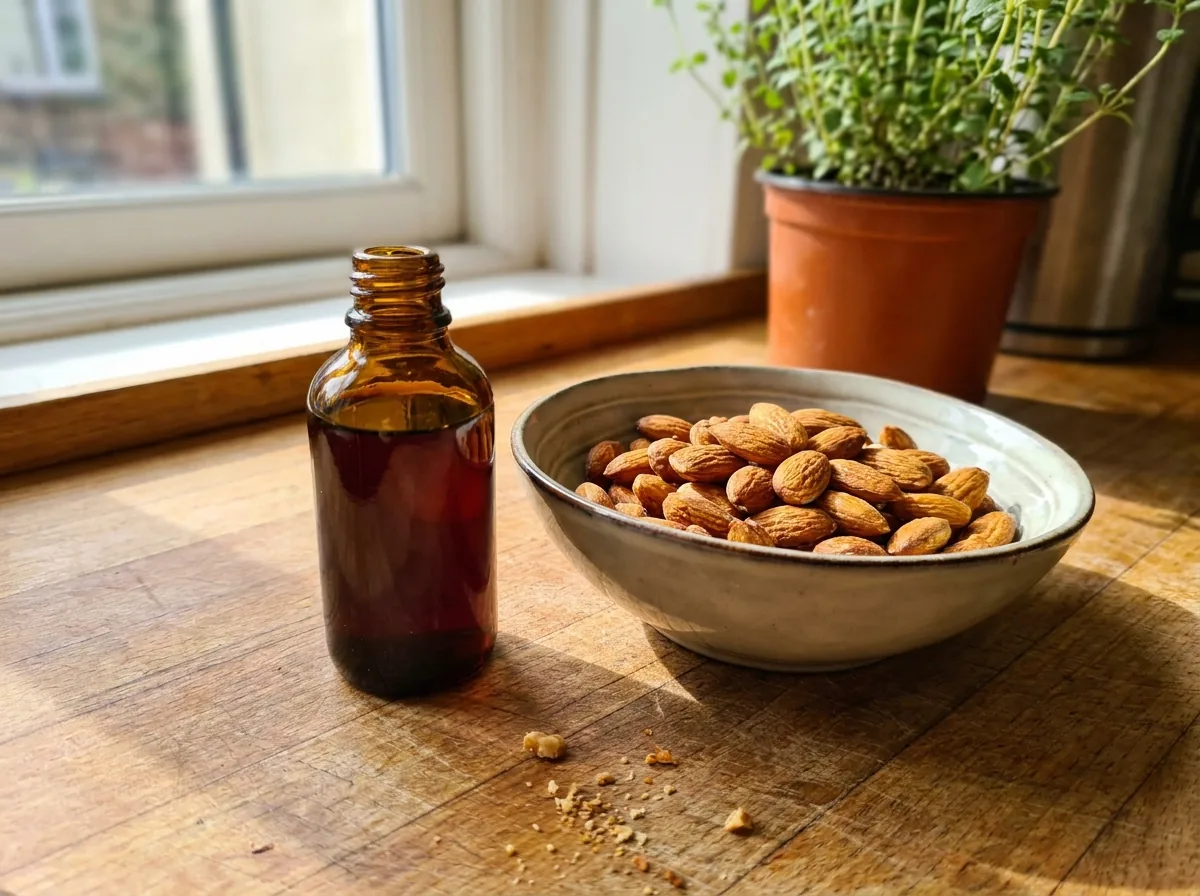
Ingredients
- 100 g (about ¾ cup) Raw sweet almonds (whole, unsalted)Eating almonds from any supermarket. Make sure the pack says sweet or simply almonds, not bitter almonds or apricot kernels
- 250 ml (1 cup) Vodka, 80 proof (40% alcohol by volume)Brandy or light rum at 40% also work and add their own flavour
Equipment
- Baking tray and oven
- Sharp knife and chopping board
- Clean 350–500 ml glass jar with a tight lid
- Kitchen scales
- Fine sieve or muslin (cheesecloth), and a funnel
- Small dark glass bottle for the finished extract
Method
Toast the almonds
Heat the oven to 160°C (325°F). Spread the almonds on a tray and toast for 8 to 10 minutes until lightly golden and fragrant. Let them cool completely. Toasting is ordinary kitchen practice and gives a rounder flavour; it is optional.
Chop them roughly
Chop the cooled almonds into small pieces, about the size of a lentil. More cut surface lets the alcohol draw out more flavour.
Fill the jar
Put the almonds in the clean jar and pour over 250 ml of 40% vodka so that every piece is covered. The standard for vanilla extract in the US sets a floor of 35% alcohol by volume; there is no such standard for almond extract, so we use the same strength as a sensible target.1,2
Seal, label and shake
Close the lid tightly, shake, and write the date on a strip of tape. Nothing needs heating.
Steep for 4 to 6 weeks
Keep the jar in a cupboard away from light and heat and shake it every few days. Taste a drop on a spoon after 4 weeks. The timing is common home practice, not a tested figure, and it will taste gentler than commercial extract however long you wait.
Strain and bottle
Pour the extract through a fine sieve lined with muslin into a clean dark bottle, pressing the almonds lightly. Discard the almonds, or dry them out and use them in baking.
Use it to taste
Because it is milder, use about two to three times the amount a recipe gives for shop-bought extract, and adjust to taste. Add it towards the end of cooking, as the alcohol and flavour cook off with heat.
Safety
- Never use bitter almonds or apricot kernels: amygdalin in them releases cyanide when chewed, ground or digested3,4,5
- EFSA found that 0.1–1.4 g of bitter almonds could reach the acute reference dose for cyanide, and the FSA says raw apricot kernels shouldn't be eaten4,6
- Shop-bought pure almond extract is made from bitter almond oil that has had the cyanide-forming compound removed. Don't try to copy that at home7
- This is 40% alcohol. Keep it out of children's reach and use it only for cooking and baking by the teaspoon
Variations
Use 200 g of almonds per 250 ml of vodka. It is stronger and more expensive, and still milder than commercial extract.
Replace the vodka with 40% brandy for a warmer, slightly fruity note that suits cakes and biscuits.
Steeping in vegetable glycerin gives a sweet, weaker almond flavouring. Keep it in the fridge and use within a few months; that timing is our advice, not tested.
Does it actually work?
Almond flavour comes mainly from benzaldehyde, which forms when the amygdalin in bitter almonds breaks down, along with hydrogen cyanide. Sweet almonds are sweet because they lack that bitter component, so a sweet-almond extract has a nutty, marzipan-light flavour rather than the sharp, cherry-like note of commercial extract. That is the trade for safety. There is no health claim here; it is a flavouring.3
Questions people ask
Why does homemade almond extract taste weaker than shop-bought?
Shop-bought pure almond extract is flavoured with bitter almond oil, which is rich in benzaldehyde. Sweet almonds contain much less of the amygdalin it comes from, so your extract tastes nutty and mild. Use more of it, or accept a gentler flavour.
Can I use apricot kernels to make almond extract?
We don't advise it. Raw apricot kernels contain amygdalin, which releases cyanide, and the FSA says they shouldn't be eaten raw. EFSA estimated that a fraction of one kernel could exceed the safe level for a toddler.
Is there a legal standard for almond extract?
Not in the US: the FDA's standards of identity for flavourings in 21 CFR Part 169 cover vanilla products only. Almond extract is governed by general food and labelling rules, so the 35% alcohol figure here is borrowed from the vanilla standard.
How long does homemade almond extract last?
Kept in a cool, dark cupboard in a sealed bottle, a high-alcohol extract lasts a year or more in practice. This is common experience rather than a tested figure.
Sources (7)
- Regulation 21 CFR Part 169 - Food dressings and flavorings. Code of Federal Regulations, Title 21.
- Regulation 21 CFR 169.175 - Vanilla extract. Code of Federal Regulations, Title 21.
- Plant biochemistry Sánchez-Pérez R, et al. Prunasin hydrolases during fruit development in sweet and bitter almonds. Plant Physiol. 2012.
- Regulator opinion EFSA CONTAM Panel. Evaluation of the health risks related to the presence of cyanogenic glycosides in foods other than raw apricot kernels. EFSA Journal. 2019.
- Regulator news EFSA. Apricot kernels pose risk of cyanide poisoning. 2016.
- Regulator guidance Food Standards Agency. Plant toxins.
- Regulation 21 CFR 182.20 - Essential oils, oleoresins (solvent-free), and natural extractives (including distillates). Code of Federal Regulations, Title 21.
Educational only. Patch-test anything new on your skin, and stop if it irritates.
Reader notes
Experiences and questions from readers, read by an editor before they appear. They are personal accounts, not evidence, and are not medical advice.